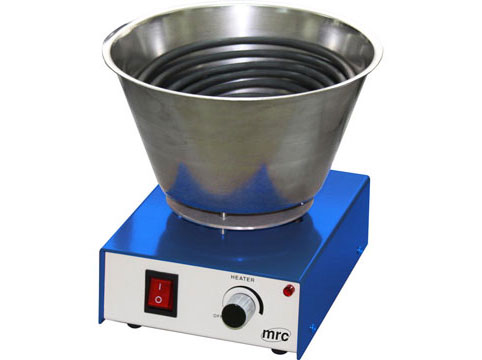
A heating mantle is a common laboratory equipment used to heat chemical substances. It consists of an outer casing, typically made of stainless steel or another durable material, that encloses a heating element. The heating element is usually wrapped around a central support rod, and the entire assembly is often enclosed in a glass or metal housing. The heating mantle is used in various settings, including academic and industrial research laboratories, pilot plants, and quality control testing facilities. It fits the boiling and distillation flask with a neck of uniform size.
You can heat organic liquids with a heating mantle by placing the flask containing the liquid onto the support rod in the center of the heating element. It prevents the heating element from directly contacting the liquid and helps distribute heat evenly around the flask. This heating mantle is often used for distillation, refluxing, and solvent extraction applications.
Different Types Of Mantles
Heating mantles come in two forms: fabric or rigid. The choice of fabric or rigid form is dependent on the application. The main difference between the two mantle types is that the rigs mailed are less expensive to construct but have a shorter useful life. On the other hand, fabric mantles are more expensive but have a longer useful life.
Metal-housed mantles are considered the most durable and have the longest useful life. They are, however, more expensive than cloth-housed mantles. They have temperature capabilities up to 450° C; they also fit small to large flasks.
What Is The Science Behind Mantles?
Laboratory Heating mantles generate electricity by converting AC voltage into heat. Substantial energy is consumed to produce a high level of required heat. The heating mantle must maintain a consistent temperature and support the weight of the container holding the substance being heated. The heat is then transferred from the element to the flask, raising the temperature of the substance inside. This heat can blow off the socket or melt the fuse, so it's important to get a mantle with a good heating system.
The mantle needs time to heat up before being used. The time it takes to heat up depends on the mantle's power rating. Once the substance has reached the desired temperature, the heating mantle can be turned off or left on at a lower setting to maintain that temperature.
How Heating Mantles Work
Heating mantles use electric resistance wires embedded within a fiberglass or fabric casing. When current flows through these wires, they heat up, and the surrounding insulation distributes the heat evenly to the glassware placed within the mantle.
Some models come with built-in temperature controls, while others require a separate controller for precise adjustments.
Applications of Heating Mantles
Heating mantles are used in a wide range of scientific and industrial processes, including:
-
Chemical synthesis
-
Solvent evaporation
-
Distillation
-
Crystallization
-
Sample digestion
They are commonly seen in academic labs, pharmaceutical R&D, food testing labs, and industrial quality control labs.
For laboratories looking for different models and capacities, explore our full range of heating mantles designed for precise and safe temperature control.