Applications and uses for all types of laboratory shakers
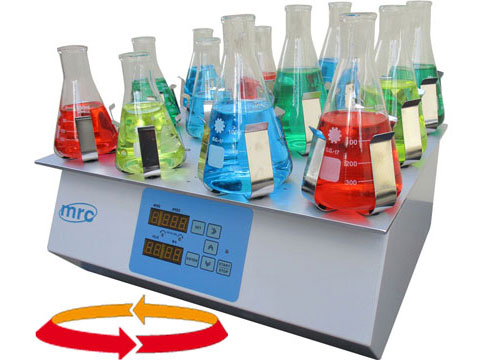
Uses of Orbital shakers
Orbital shakers are commonly used in various laboratory experiments that require consistent and uniform mixing of solutions in flasks. Here are some typical experiments and applications where orbital shakers are essential:
By providing a controlled and consistent shaking motion, orbital shakers help in achieving reproducible experimental conditions, which is crucial for scientific research and commercial applications.
These advantages make orbital shakers indispensable for culture growth in various fields, including microbiology, biotechnology, pharmaceutical development, and academic research.
Cell Culture:
Mammalian Cell Culture: Ensures even distribution of cells and nutrients.
Bacterial and Yeast Culture: Maintains aerobic conditions and homogeneous mixing for optimal growth.
Cell culture growth typically requires orbital shaking for several critical reasons:
Uniform Mixing:
Orbital shakers provide consistent and uniform mixing, ensuring that cells are evenly distributed throughout the culture medium. This uniformity is crucial for achieving reproducible and reliable experimental results.
Oxygenation:
Many cell cultures, including bacterial and yeast cultures, require oxygen for growth. Orbital shaking enhances the aeration of the culture medium by increasing the surface area exposed to air, facilitating better oxygen transfer to the cells.
Nutrient Distribution:
Shaking ensures that nutrients are evenly distributed throughout the culture medium, preventing nutrient gradients that could affect cell growth and metabolism. This helps in maintaining optimal growth conditions for the cells.
Preventing Sedimentation:
In static cultures, cells can settle at the bottom of the flask, leading to uneven growth and potential cell death due to lack of nutrients or oxygen. Orbital shaking keeps the cells suspended in the medium, promoting consistent growth.
Enhanced Cell-Cell Interaction:
For some types of cell cultures, such as mammalian cell cultures, cell-cell interactions are important for proper growth and function. Orbital shaking helps in maintaining these interactions by keeping cells in close proximity.
Temperature Uniformity:
In conjunction with incubators, orbital shakers help in maintaining a uniform temperature throughout the culture, which is essential for optimal cell growth and metabolic activity.
Scalability:
Orbital shakers are suitable for scaling up cultures from small to large volumes, making them versatile for various experimental needs, from small-scale laboratory research to large-scale industrial applications.
Consistency and Reproducibility:
Solubility Studies:
Dissolution Testing: Helps in dissolving substances uniformly for testing solubility.
Drug Development: Facilitates the dissolution of compounds to test their solubility in various solvents.
Protein Expression and Purification:
Recombinant Protein Production: Ensures even distribution of cells and nutrients in cultures.
Protein Extraction: Helps in lysing cells and extracting proteins uniformly.
Molecular Biology:
Hybridization Experiments: Ensures even mixing of nucleic acid probes in solutions.
Transformation and Transfection: Mixes solutions to facilitate the uptake of DNA by cells.
Chemical Reactions:
Synthesis Reactions: Ensures thorough mixing of reactants for consistent reaction conditions.
Enzyme Reactions: Provides a uniform environment for enzymatic activity.
Assay Preparation:
ELISA (Enzyme-Linked Immunosorbent Assay): Ensures even mixing of reagents and samples.
Colorimetric and Fluorometric Assays: Mixes solutions to ensure homogeneity for accurate readings.
Fermentation:
Small-Scale Fermentation: Maintains aerobic conditions and even mixing for microbial fermentation processes.
General Laboratory Mixing:
Sample Preparation: Homogenizes samples before analysis.
Solution Preparation: Ensures complete dissolution and uniformity of solutions.
Uses of Reciprocal shakers
Reciprocal shakers, which move back and forth in a linear motion, are used in several laboratory applications where this type of motion is particularly beneficial. Here are some key applications that require reciprocal shaking:
DNA, RNA, and Protein Extraction:
Cell Lysis: Efficiently disrupts cells to release their contents for nucleic acid or protein extraction.
Homogenization: Provides thorough mixing for extracting DNA, RNA, or proteins from various samples.
Hybridization Experiments:
Southern Blotting: Enhances the hybridization of DNA probes to target sequences.
Northern Blotting: Facilitates the hybridization of RNA probes to target sequences.
Western Blotting: Assists in the binding of antibodies to target proteins on membranes.
Gel Staining and Destaining:
Agarose and Polyacrylamide Gels: Ensures even distribution of staining and destaining solutions for visualizing DNA, RNA, or proteins.
Enzyme Reactions:
Enzymatic Digests: Provides thorough mixing for enzymatic reactions, such as restriction enzyme digests or protease treatments.
Enzyme Kinetics: Ensures uniform substrate distribution and mixing for kinetic studies.
Sample Preparation:
Suspension of Particulate Matter: Keeps particles in suspension, which is critical for certain analytical techniques.
Mixing Viscous Solutions: More effective at mixing viscous solutions than orbital shakers due to the back-and-forth motion.
Cell Culture:
Suspension Cells: Keeps suspension cell cultures uniformly mixed, similar to orbital shakers, but with a different motion.
Adherent Cell Detachment: Helps in the detachment of adherent cells from culture surfaces when used with detachment agents.
Chemical Reactions:
Synthesis Reactions: Facilitates thorough mixing of reactants in small-scale chemical synthesis.
Precipitation Reactions: Ensures uniform mixing to avoid localized supersaturation and uneven precipitation.
General Laboratory Mixing:
Mixing Samples in Tubes or Bottles: Useful for applications requiring thorough mixing of samples in various containers.
Buffer Preparation: Ensures complete dissolution of solutes in buffer solutions.
Diagnostic Assays:
ELISA (Enzyme-Linked Immunosorbent Assay): Provides consistent mixing of reagents and samples for more reliable assay results.
Agglutination Tests: Enhances the mixing of antibodies and antigens in agglutination tests.
These applications highlight the versatility and importance of reciprocal shakers in various laboratory settings, where their specific motion provides advantages over other types of shakers.

Uses of Rocking Shakers
Rocking shakers, which provide a gentle back-and-forth rocking motion, are used in various laboratory applications where this type of motion is particularly beneficial. Here are some key applications that require rocking shakers:
Western Blotting:
Antibody Incubation: Facilitates even distribution and binding of primary and secondary antibodies to target proteins on membranes.
Washing Steps: Ensures gentle washing of membranes to remove excess antibodies and reduce background noise.
Cell Culture:
Gentle Mixing: Ideal for maintaining cells in suspension without causing shear stress or damage, making it suitable for sensitive cell lines.
Adherent Cell Cultures: Helps in distributing nutrients and gases evenly across the culture surface without detaching adherent cells.
Staining and Destaining:
Gel Staining: Ensures even distribution of staining solutions for visualizing DNA, RNA, or proteins in agarose and polyacrylamide gels.
Gel Destaining: Provides gentle agitation for removing excess stain from gels.
Hybridization Experiments:
Nucleic Acid Hybridization: Enhances the hybridization of DNA or RNA probes to target sequences in Southern and Northern blotting.
Microarray Hybridization: Ensures uniform hybridization of probes to microarray slides.
Sample Preparation:
Mixing Blood Samples: Prevents clotting and ensures homogeneous mixing of blood samples in anticoagulant tubes.
Mixing Viscous Samples: Provides gentle mixing for viscous samples, such as tissue homogenates or cell lysates.
Diagnostic Assays:
ELISA (Enzyme-Linked Immunosorbent Assay): Provides consistent mixing of reagents and samples, improving the reliability and accuracy of assay results.
Immunoassays: Ensures gentle mixing of antibodies and antigens for optimal binding and reaction conditions.
Chemical Reactions:
Slow Reactions: Suitable for gentle mixing required in slow or sensitive chemical reactions, preventing over-agitation.
Solid-Phase Reactions: Helps in suspending solid-phase reactants uniformly in solution.
Protein and Nucleic Acid Extraction:
Cell Lysis: Facilitates gentle mixing during cell lysis and extraction processes, preserving the integrity of proteins and nucleic acids.
Resuspension of Pellets: Ensures gentle resuspension of pelleted cells or precipitated nucleic acids.
General Laboratory Use:
Buffer Preparation: Ensures thorough mixing of buffers and solutions without introducing air bubbles or causing foaming.
Sample Homogenization: Provides gentle homogenization of samples in tubes, flasks, or bags.
Rocking shakers are particularly advantageous for applications requiring gentle, low-shear mixing to maintain the integrity of delicate samples, prevent damage to cells or biomolecules, and ensure even distribution of reagents and samples.
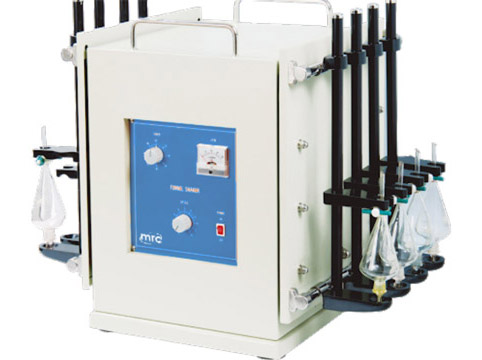
Uses of Funnel shakers
Funnel shakers, designed to provide vigorous shaking of large-volume containers like separatory funnels, are essential in several laboratory applications where thorough mixing, extraction, or phase separation is required. Here are some key applications that necessitate the use of funnel shakers:
Liquid-Liquid Extraction:
Solvent Extraction: Facilitates the mixing of aqueous and organic phases to extract compounds from mixtures. Common in environmental testing, pharmaceutical extraction, and chemical synthesis.
Sample Preparation: Prepares samples by extracting target analytes from complex matrices for subsequent analysis.
Chemical Synthesis:
Reaction Mixing: Ensures thorough mixing of reactants in separatory funnels during chemical reactions, leading to more complete reactions and higher yields.
Purification: Aids in the purification of reaction products by separating impurities through multiple extraction steps.
Environmental Testing:
Contaminant Analysis: Used to extract environmental contaminants such as pesticides, herbicides, and hydrocarbons from soil, water, and air samples for analysis.
Water Quality Testing: Extracts pollutants from water samples to assess water quality and compliance with environmental regulations.
Pharmaceutical and Biotechnology:
Drug Development: Used in the extraction of active pharmaceutical ingredients (APIs) from natural sources or reaction mixtures.
Biological Sample Preparation: Prepares biological samples by extracting biomolecules like lipids, proteins, and metabolites.
Food and Beverage Testing:
Nutrient and Contaminant Extraction: Extracts nutrients, additives, and contaminants from food and beverage samples for quality control and safety testing.
Flavor and Fragrance Extraction: Isolates flavor compounds and fragrances from natural sources or product mixtures.
Forensic Science:
Toxicology: Extracts drugs, toxins, and other substances from biological samples for forensic analysis.
Crime Scene Analysis: Prepares samples for analysis by extracting potential evidence from complex matrices.
Petrochemical Industry:
Oil and Gas Analysis: Extracts components from crude oil, refined products, and environmental samples for compositional analysis and quality control.
Catalyst Testing: Prepares samples by extracting products and intermediates from catalytic reactions.
Agricultural Testing:
Pesticide Residue Analysis: Extracts pesticide residues from soil, water, and crop samples to ensure compliance with safety standards.
Nutrient Analysis: Prepares samples by extracting nutrients and additives from agricultural products.
Cosmetic Industry:
Product Development: Extracts active ingredients and contaminants from cosmetic formulations during product development and testing.
Quality Control: Ensures the consistency and safety of cosmetic products by extracting and analyzing various components.