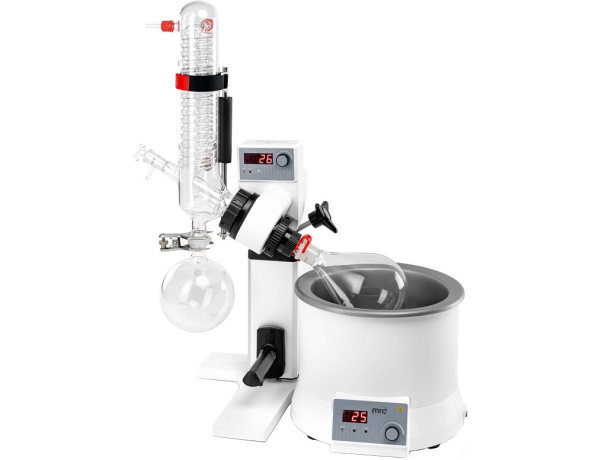
In every chemical and research lab, rotary evaporators are essential tools. In situations where effective solvent removal and distillation are necessary, they are particularly useful. The idea that materials with lower boiling points evaporate more quickly is the basis of these rotary evaporators. Solvents have a wide range of boiling points that drop when pressure is increased. Such evaporators are chosen over traditional distillation systems because of the efficiency of the distillation process. The most frequent uses of rotary evaporators are for the extraction of chemicals in labs. This instrument effectively evaporates away solvents from samples.
Working principle of a rotary evaporator, how are solvents evaporated?
The procedure carried out by rotary evaporators is particularly distinctive and effective. The sample is put in a flask with a round bottom. After that, the flask is turned into a warm water bath. The pressure is lowered with the help of a vacuum pump. The sample forms a thin layer inside the inner side of the flask and is pulled away from the solvent, leaving the chemical behind. Before being collected in the collecting bottle, the solvent is cooled.
The rotary evaporator's functions:
Rotary evaporators have many uses. These devices typically eliminate volatile solvents from a liquid combination by evaporating and condensing the solvents.
The biotechnology, chemical, and pharmaceutical sectors all employ these evaporation devices to distill volatile liquids, solvent recovery, separation, drying, crystallization, and concentration.
The below components make up the instrument:
- Tube for evaporation: The sample is rotated via the vacuum system in the evaporation tube, which also serves as a revolving support shaft for the sample.
- Receiving flask: Recycling the condensed sample is done in the receiving flask.
- Tube to condensate: For condensation of samples, acetone and dry ice is used in the condensate tube.
- Bath kettle: The sample is heated in the bath kettle.
- Vacuum apparatus: The rotary evaporator system's pressure is reduced by the vacuum system.
- Flask for evaporation: The process of evaporation is initiated when there is the rotation of the sample at a consistent speed and temperature.
Benefits of rotary evaporators:
A rotary evaporator's greater evaporation efficiency and improved precision are its main benefits. The solvent is removed using a vacuum system, which lowers the boiling point. As a result, distillation at high temperatures is no longer necessary.
The revolving evaporating flask increases the material's surface area while submerged in a heated water bath, hastening the distillation procedure. Forced convection ensures that the mixture is heated and mixed uniformly.
This saves a lot of time and lab productivity increases since solvent removal is effective and quick.