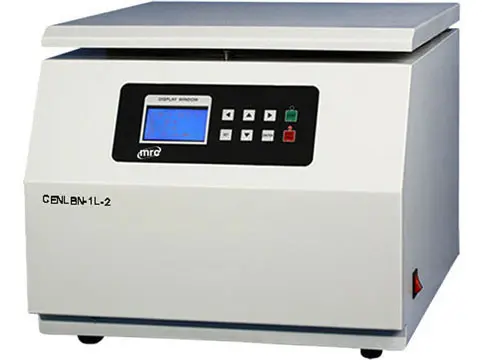
Blood contains red cells, white cells, platelets, and plasma—all with different weights. Spin them fast enough, and they sort themselves like layers in a smoothie left out too long.
Role of Centripetal Force
The centrifuge generates force by spinning samples at high speeds, forcing heavier elements (like red cells) to the bottom, and leaving lighter ones (like plasma) at the top.
Main Types of Blood Centrifuges
Fixed-Angle Centrifuge
Great for quick separations with minimal distortion, ideal for small volume samples.
Swing-Bucket Centrifuge
Perfect when you want horizontal sedimentation, especially useful in separating plasma or serum.
Continuous Flow Centrifuge
Used in large-scale operations like blood banks, where constant throughput is critical.
Key Components and Features
Rotor Design
The rotor’s shape determines how your sample behaves during the spin—some maximize speed, others focus on even separation.
Speed Control and RCF
You don’t just crank it up. RCF (Relative Centrifugal Force) must match your specific need, or you risk damaging blood cells.
Temperature Regulation
Heat buildup can destroy cells. Good centrifuges keep things cool.
Safety Mechanisms
Auto-lock lids, imbalance detection, and emergency shut-offs are non-negotiables in modern centrifuges.
Step-by-Step: How Blood is Separated
- Collect the sample using anticoagulant tubes.
- Load it evenly—balance is critical.
- Set the speed/time according to the protocol.
- Run the cycle.
- Interpret the layers: plasma, buffy coat (WBCs and platelets), and RBCs.
Applications of Blood Separating Centrifuges
- Diagnostics: CBCs, serology, and more.
- Blood Banks: Component extraction for transfusions.
- PRP Therapy: Aesthetic and orthopedic uses.
- Research: Isolating cells for study.
-
- Consistent and accurate results
- Reduced cross-contamination
- Increased lab efficiency