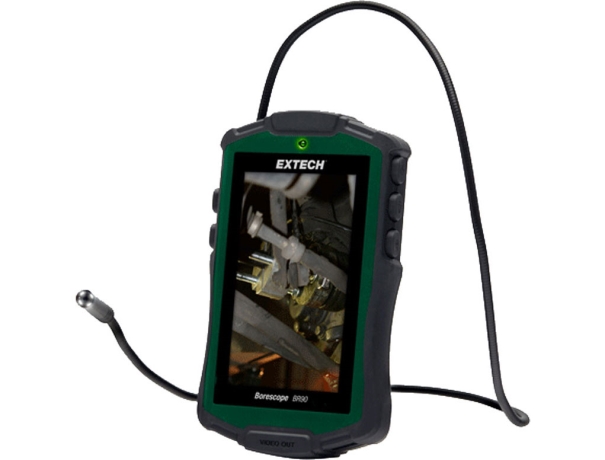
A borescope (also called a video borescope or inspection camera) is a precision optical instrument designed for internal visual inspection of inaccessible areas such as engines, turbines, pipes, welds, or machinery cavities. This Q&A guide explains the main technical aspects of borescopes, including optics, probes, lighting, and imaging performance.
1. What resolution options are available for borescope cameras (e.g., 720p, 1080p, 4K)?
Modern video borescopes offer various resolutions depending on model and application:
- 720p (1280×720): Standard for industrial field inspection.
- 1080p (1920×1080): High-definition imaging suitable for welds, corrosion, or precision components.
- 4K (3840×2160): Premium models for detailed analysis or documentation.
Higher resolution improves defect visibility but may require stronger lighting and higher data storage capacity.
2. What is the field of view (FOV) and depth of field (DOF)?
- Field of View (FOV): Typically ranges from 60° to 120°. Wide-angle lenses allow broader coverage but can distort edges.
- Depth of Field (DOF): Defines the sharp focus range, usually from 5 mm to 100 mm, depending on optical design. Long DOF is preferred for general inspection, while short DOF enhances close-up detail.
3. How does illumination work – LED, fiber optic, or laser-based lighting?
Borescopes use integrated LED arrays, fiber optic light guides, or laser illumination:
- LED: Compact, energy-efficient, standard in most portable units.
- Fiber optic: Delivers intense light from an external source for deep cavities or high-temperature environments.
- Laser: Used in high-precision borescopes for uniform and focused lighting.
4. Is the camera equipped with digital zoom or optical zoom?
- Digital zoom enlarges the image electronically, potentially reducing clarity.
- Optical zoom adjusts lens elements for true magnification without loss of resolution.
Premium systems combine both for maximum flexibility in confined spaces.
5. Can images and videos be captured and stored internally or on SD card?
Yes. Most professional borescopes include internal memory (8–32 GB) and support removable SD cards (up to 128 GB).
Captured data can be exported via USB, HDMI, or Wi-Fi for documentation and reporting.
6. What probe diameters are available (e.g., 2 mm, 4 mm, 6 mm)?
Common probe diameters include:
- 2 mm: Ideal for micro-mechanical inspection and fine tubing.
- 4 mm: Standard for automotive and small engine inspection.
- 6 mm: Offers better durability and lighting for industrial machinery and pipelines.
Custom diameters up to 12 mm are available for heavy-duty inspection.
7. What is the standard insertion tube length, and can it be extended?
Standard lengths range from 1 m to 10 m, depending on the application.
Many borescopes allow modular extensions using quick-connect couplings or reel systems for up to 30 m total reach.
8. What materials are used for the probe (stainless steel, tungsten braid, etc.)?
- Stainless steel: Rigid, corrosion-resistant.
- Tungsten braid: High flexibility and abrasion resistance.
- Polyurethane or nylon sheathing: Provides lightweight insulation for handheld use.
Material choice depends on chemical exposure, bending radius, and environmental stress.
9. What is the bending angle or articulation range (up/down/left/right)?
Articulation defines how far the camera tip can bend for directional viewing:
- 2-way articulation: Up and down (120°–180°).
- 4-way articulation: Up, down, left, and right for full control (up to 360° total).
Motorized or joystick-controlled articulation is common in advanced systems.
10. How durable is the probe against oil, water, and high temperature?
Industrial-grade probes feature IP67 or IP68 waterproof ratings and oil-resistant coatings.
High-temperature models can withstand up to 250°C with cooling sheaths or air purge systems for turbine and exhaust inspection.
11. How many LEDs are built into the camera head?
Typical camera heads include 4 to 8 ultra-bright LEDs, optimized for uniform illumination.
Micro borescopes may use 2–4 LEDs due to limited tip size, while large heads may integrate 12 or more.
12. Is LED brightness adjustable?
Yes. Most systems include variable intensity control through buttons or touch screens.
This prevents overexposure in reflective areas and ensures balanced lighting in dark environments.
13. Can external light sources or fiber optic bundles be attached?
Advanced borescopes allow connection to external cold-light sources via fiber optic cables for high-intensity applications.
This is particularly useful in long or narrow cavities where internal LEDs are insufficient.
14. How does glare reduction or reflection control work in metallic cavities?
Modern borescopes use polarized light filters, matte coatings, and software-based image enhancement to minimize glare.
Auto-exposure and HDR (High Dynamic Range) processing further balance brightness in shiny or reflective environments.