15684
  • LOGIN
    MUNRO- Laboratory Equipment UK
      • laboratory equipment
      • Laboratory Balances
      • Measuring Instruments
      • material testing
      1. home page
      2. BLOGS
      3. Comparing cup anemometers (Air speed )to Impeller anemometers

      Comparing cup anemometers (Air speed )to Impeller anemometers

      Omni-Directional Sensitivity:

      Cup Anemometer: Measures wind speed from any direction without needing to be oriented into the wind. This makes it ideal for fluctuating wind directions.

      Propeller/Impeller Anemometer: Requires orientation into the wind to measure accurately, which can necessitate additional mechanisms for alignment.


      Simple and Robust Design:

      Cup Anemometer: Generally has a simpler mechanical design with fewer moving parts, leading to higher durability and lower maintenance requirements.

      Propeller/Impeller Anemometer: Has more complex moving parts, which can be more susceptible to wear and tear and may require more frequent maintenance.


      Reliability in Varied Conditions:

      Cup Anemometer: Performs consistently in a wide range of environmental conditions, including turbulent and gusty winds.

      Propeller/Impeller Anemometer: Can struggle with fluctuating wind directions and may not be as reliable in highly variable wind conditions.
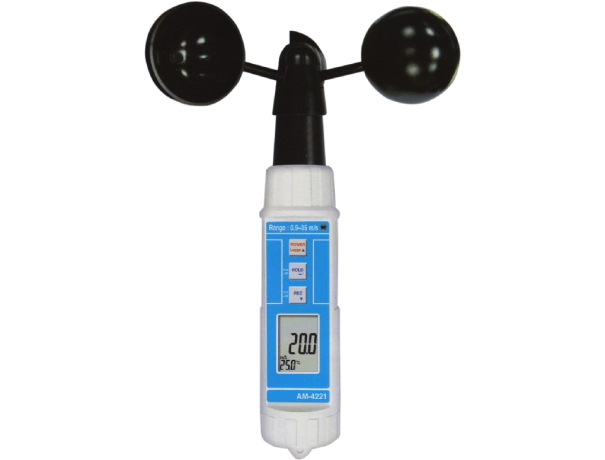
      COMPARING CUP ANEMOMETERS (AIR SPEED )TO IMPELLER ANEMOMETERS

      Calibration Stability:

      Cup Anemometer: Typically maintains calibration better over time due to its robust design and fewer moving parts.

      Propeller/Impeller Anemometer: May require more frequent recalibration due to the wear of its mechanical components.


      Ease of Use:

      Cup Anemometer: Easier to install and use since it does not require alignment with the wind direction.

      Propeller/Impeller Anemometer: Needs careful installation and alignment to ensure accurate measurements.

      These advantages make cup anemometers particularly well-suited for applications where wind direction changes frequently or where low maintenance is a priority. They are commonly used in meteorological stations and for various environmental monitoring purposes.


      In explosive environments, such as helipads on gas rigs, it is crucial to use non-electrical anemometers to ensure safety and prevent potential ignition sources.

      Electrical Anemometers: Can generate sparks due to electrical components and battery, which could ignite flammable gases or vapors present in the atmosphere.

      Non-Electrical portable mechanical anemometer Munro Instruments model IM159   is asfe for use in flamble atmosphere 

      MUNRO- Laboratory Equipment UK

      BLOGS

      ABOUT US

      ABOUT US

      CONTACT US

      CONTACT US

      SERVICE CENTER

      CENTRE

      • ABOUT
      • |
      • PRODUCTS
      • |
      • CATALOGUES
      • |
      • SUPPORT
      • |
      • CENTRE
      • |
      • CUSTOMERS
      • |
      • Privacy Policy
      • |
      • TERMS
      • |
      • FAQ
      • |
      • BLOGS

      [email protected]
      UK: Cavendish House, Parkway, Harlow Business Park, Harlow, Essex CM19 5QF UK

      • Bsmart בניית אתרים
      • SAP
      altImg

      • Fully Supported on Chromee*
      • Color Blind Adjusted
      • Heavy Vision Adjusted
      • Regular Display
      • Access Keys MenuAlt + 0
      • Stop Motion
      • Remove Underline Links
      • Press Keys For View Resize
      • Ctrl + Larger
      • Ctrl - Smaller
      • Ctrl 0 Reset Size
      • Enable Disable Keyboard Focusing
      • Reset All To Defualt

      Access Keys

      • Enable/Disable This MenuAlt + 0
      • Skip To Main MenuAlt + 1
      • Skip To Main ContentAlt + 2
      • דלג למפת אתר מונגשת Alt + Shift + 3
      • SearchAlt + 4
      • Contact PageAlt + 7
      • דלג למפת העמוד Alt+5
      • Skip To HomepageAlt + h
      • Skip To Accessibilty MenuAlt + m

      *Firefox users: Use Alt + Shiftnumber

      In order to move between elements, Press - Tabkey, To backtrack press, - Shift + Tab

    • Skip To Main Menu
    • Skip To Main Content
    • Skip To Accessbilty Menu
    • This website uses cookies for the purpose of ongoing and proper operation in accordance with the privacy policy