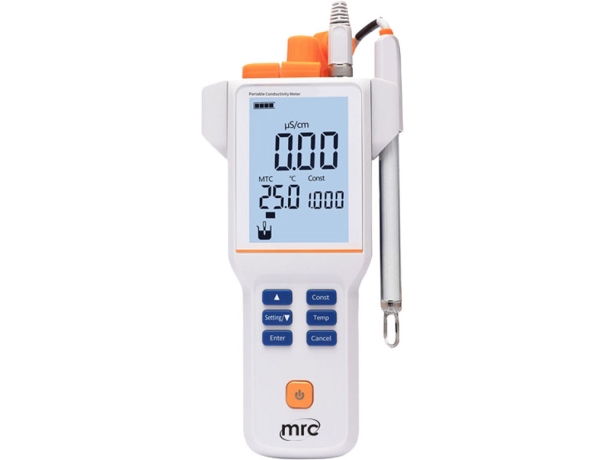
Water is a good conductor of electricity, and its conductivity is an important water quality parameter. It is typically measured in units of Siemens per meter (S/m) or microsiemens per centimeter (µS/cm). The conductivity of water is influenced by the presence of dissolved ions, as these ions can carry electric current.
The principle of conductivity measurement using a probe and electrode is based on the flow of electric current through a conductor. When an electric current is passed through a conductor, such as water, the ions in the water will move and carry the current. The conductivity of the water is directly proportional to the amount of ions present and the mobility of these ions.
To measure the conductivity of a water sample using a probe and electrode, a voltage is applied across the electrodes, and the resulting electric current is measured. The conductivity of the water is then calculated based on the measured electric current and the applied voltage.
Conductivity probes typically consist of two or more electrodes that are immersed in the water sample. The electrodes are typically made of a conductive material, such as platinum or gold, and are separated by an insulating material. The probe is connected to a conductivity meter, which applies the voltage and measures the electric current.
Types
There are several different types of conductivity probes available, including single-electrode probes, two-electrode probes, and four-electrode probes. Single-electrode probes are the simplest and least expensive type of conductivity probe, but they are less accurate than other types of probes. Two-electrode probes are more accurate than single-electrode probes, but they are still less accurate than four-electrode probes. Four-electrode probes are the most accurate type of conductivity probe, but they are also the most expensive.
In summary, the principle of conductivity measurement using a probe and electrode is based on the flow of electric current through a conductor. To measure the conductivity of a water sample, a voltage is applied across the electrodes, and the resulting electric current is measured. Conductivity probes consist of two or more electrodes that are immersed in the water sample, and they are connected to a conductivity meter, which applies the voltage and measures the electric current. There are several different types of conductivity probes available, including single-electrode probes, two-electrode probes, and four-electrode probes.
Theory
The theory behind the measurement of water conductivity is based on the fact that an electric current will flow through a solution if there is a difference in electric potential between two points. When an electric current is passed through a conductor, such as water, the ions in the water will move and carry the current. The conductivity of the water is directly proportional to the amount of ions present and the mobility of these ions.
TYPES OF CONDUCTIVITY METER
There are several different types of conductivity meters available for measuring the conductivity of water. These include handheld meters, benchtop meters, and online monitors. Handheld meters are portable and easy to use, making them well-suited for field testing. Benchtop meters are more accurate and precise, but they are not as portable. Online monitors are continuous monitoring systems that are installed in a pipe or flow stream and can measure conductivity in real-time.
Conductivity meters are used in a variety of applications, including water treatment, industrial process control, and environmental monitoring. In water treatment, conductivity measurements are used to control the addition of chemicals and to monitor the effectiveness of treatment processes. In industrial processes, conductivity measurements can be used to control and optimize processes, such as the production of ultrapure water. In environmental monitoring, conductivity measurements can be used to assess the quality of surface water and ground water.
In conclusion, the conductivity of water is an important water quality parameter that is influenced by the presence of dissolved ions. Conductivity meters are used to measure the conductivity of water in a variety of applications, including water treatment, industrial process control, and environmental monitoring.
TDS (Total Dissolved Solids ) AND CONDUCTIVITY
Total Dissolved Solids (TDS) is a measure of the total amount of dissolved solids in water, including minerals, salts, and other small organic and inorganic molecules. TDS is typically expressed in units of milligrams per liter (mg/L) or parts per million (ppm).
TDS is directly related to the conductivity of water. The higher the TDS, the higher the conductivity of the water. This is because the dissolved solids in water, such as minerals and salts, are ions that can carry electric current. Therefore, the greater the number of ions present, the higher the conductivity of the water.
TDS is an important water quality parameter because it can affect the taste and odor of the water and it can have an impact on the solubility of other substances in the water. TDS is commonly used as an indicator of water quality, as high TDS levels can indicate the presence of contaminants in the water.
Conductivity meters are often used to measure the TDS of water, as the conductivity of the water is directly related to the TDS. To determine the TDS of the water, the conductivity of the water is first measured, and then a conversion factor is used to convert the conductivity measurement to a TDS value. Conductivity meters are commonly used in a variety of applications, including water treatment, industrial process control, and environmental monitoring.
Distilled water and Pure water measurment
To measure the conductivity of distilled water and pure water, you would need a conductivity meter with a low range of measurement, as pure water has a very low conductivity. The specific range needed will depend on the expected conductivity of the water, but a range of 0 to 20 µS/cm or 0 to 50 µS/cm is typically sufficient for measuring the conductivity of pure water.
There are several different types of conductivity meters available that are suitable for measuring the conductivity of pure water. These include benchtop meters, handheld meters, and online monitors.
Benchtop meters are typically the most accurate and precise option for measuring the conductivity of pure water. They are designed for use in a laboratory or other controlled environment, and they typically have a low range of measurement and a high level of sensitivity. Benchtop meters may be a good choice for measuring the conductivity of pure water in a research or quality control setting.
Handheld meters are portable and easy to use, making them well-suited for field testing. They may not be as accurate as benchtop meters, but they can still provide reliable conductivity measurements for pure water.
Online monitors are continuous monitoring systems that are installed in a pipe or flow stream and can measure conductivity in real-time. They may not be as precise as benchtop meters, but they are well-suited for continuous monitoring of the conductivity of pure water in an industrial or process control setting.
To measure the conductivity of pure water, you will need a conductivity meter with a low range of measurement, such as 0 to 20 µS/cm or 0 to 50 µS/cm. There are several different types of conductivity meters available that are suitable for measuring the conductivity of pure water, including benchtop meters, handheld meters, and online monitors. The type of meter you choose will depend on your specific measurement needs and application.