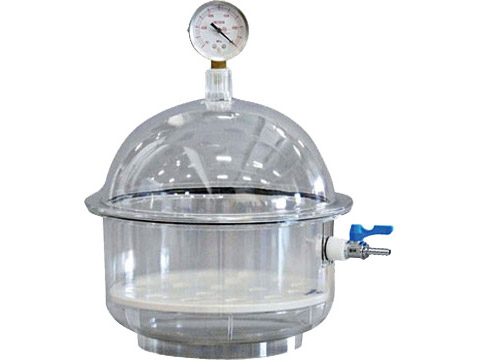
A laboratory desiccator is a sealed container used to store or dry out samples or substances that are sensitive to moisture. It typically consists of a transparent or translucent container, often made of plastic or glass, with a removable shelf or tray inside. The container has a valve or other mechanism for controlling the flow of air into and out of the container, and a desiccant, such as silica gel, is placed inside to absorb moisture. The desiccant helps to create a dry atmosphere within the container, which can be useful for preserving the integrity and shelf life of the materials being stored. Laboratory desiccators are commonly used in scientific and research labs, as well as in industrial and manufacturing settings.
Application of desiccator
Laboratory desiccators are commonly used in a variety of applications, including:
- Drying and storing moisture-sensitive substances: Desiccators can be used to dry out samples or substances that are prone to reacting with or degrading in the presence of moisture. This can include chemicals, pharmaceuticals, and other materials that are sensitive to humidity.
- Protecting samples from contamination: Desiccators can be used to store samples in a dry, contamination-free environment. This is especially useful for samples that are sensitive to contamination from moisture or other substances.
- Ensuring consistent humidity levels: Desiccators can be used to maintain consistent humidity levels within a specific range, which can be important for certain experiments or processes.
- Preserving shelf life: Desiccators can be used to extend the shelf life of moisture-sensitive products, such as food, by keeping them in a dry environment.
- Protecting equipment and materials: Desiccators can be used to protect equipment, such as electronic components, and materials, such as leather or wood, from moisture damage.
- Storing biological samples: Desiccators can be used to store biological samples, such as tissues or cells, in a dry environment to preserve their integrity.
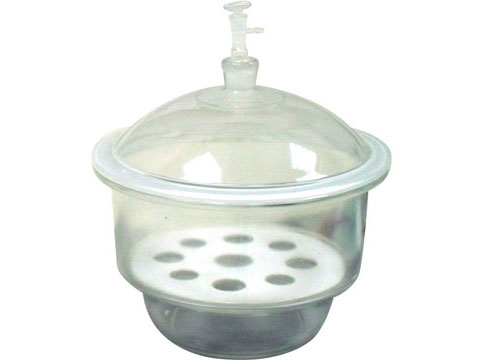
Which liquid is used in desiccator?
A desiccator does not typically use a liquid to absorb moisture. Instead, it uses a desiccant, which is a substance that absorbs moisture from the air. Commonly used desiccants include silica gel, molecular sieve, and calcium oxide.
Silica gel is a granular form of silicon dioxide, which is a highly porous material with a high surface area. It is capable of absorbing a large amount of moisture, and is commonly used in desiccators and other drying applications.
Molecular sieve is a synthetic zeolite, which is a porous, crystalline material with a high affinity for water molecules. It is commonly used as a desiccant in applications where a very low relative humidity is required.
Calcium oxide, also known as quicklime, is a highly reactive material that can absorb moisture from the air when it is exposed to air. It is not as commonly used as a desiccant due to its reactivity and potential for generating heat, but it can be effective in certain drying applications.
Uses of DESICCATORS
Desiccators are essential laboratory equipment used for removing moisture from specimens and protecting hygroscopic materials from humidity. Here are some common uses of desiccators:
Moisture Removal: Desiccators are primarily used to remove moisture from substances. This is critical for experiments and processes where the presence of water could interfere with chemical reactions or the accuracy of measurements.
Storage of Hygroscopic Materials: Materials that readily absorb moisture from the air, such as salts and powders, can be stored in desiccators to keep them dry and free from clumping or chemical degradation.
Sample Preservation: Biological specimens, electronic components, and other sensitive materials can be preserved in desiccators to prevent deterioration due to humidity.
Drying of Glassware: In laboratories, desiccators can be used to dry glassware and other laboratory equipment after cleaning, ensuring that they are completely dry and ready for use in sensitive experiments.
Cooling Down Heated Samples: After heating samples in a drying oven or similar apparatus, placing them in a desiccator allows them to cool down in a moisture-free environment, preventing the reabsorption of water.
Protecting Standards and Reagents: Desiccators can store chemical standards and reagents that must be kept dry to maintain their stability and reliability.
Weighing Samples: In analytical chemistry, desiccators are often used to store samples before weighing them to ensure that the weight measured is not affected by moisture absorption.
Maintaining Anhydrous Conditions: In some experiments, it is crucial to maintain anhydrous (completely dry) conditions. Desiccators help achieve and maintain these conditions.
Preventing Oxidation: Certain substances can oxidize in the presence of moisture. Desiccators provide a dry environment that can help prevent this oxidation.
Vacuum Desicator
A vacuum desiccator is a laboratory tool used to store or dry out samples or substances that are sensitive to moisture. It is similar to a standard desiccator, but it is equipped with a valve and a vacuum pump, which can be used to create a vacuum within the container. By removing the air from the container, the vacuum desiccator can create a very low humidity environment, which can be useful for preserving the integrity and shelf life of moisture-sensitive materials.
Vacuum desiccators are commonly used in scientific and research labs, as well as in industrial and manufacturing settings. They are particularly useful for drying out samples or substances that are sensitive to oxygen, as the vacuum can help to prevent the sample from reacting with or degrading due to exposure to air. They are also useful for creating a low humidity environment for experiments or processes that require precise humidity control.