A dew point meter is a precision instrument used to measure the moisture content of gases by determining the dew point temperature—the temperature at which water vapor condenses into liquid. It plays a vital role in industries such as compressed air systems, natural gas processing, power generation, pharmaceuticals, and environmental monitoring.
This comprehensive guide explains in detail how dew point meters work, their measurement technologies, performance characteristics, calibration procedures, and maintenance requirements.
1. Working Principle
How does a dew point meter determine moisture content in gases?
A dew point meter determines the moisture content by measuring the dew point temperature, which is the temperature at which the gas becomes saturated with water vapor and condensation begins.
- Gas Sample Entry: A small portion of the gas flows into the measuring chamber.
- Sensor Interaction: The sensor detects changes in humidity through physical or optical properties.
- Signal Conversion: The change is converted into an electrical signal proportional to the water vapor pressure.
- Computation: The device calculates the dew point temperature and, in many models, converts it to ppm (parts per million by volume) or relative humidity (%RH).
What is the difference between dew point temperature and relative humidity?
- Dew Point Temperature: The absolute measure of water vapor content in a gas, independent of temperature.
- Relative Humidity (RH): The ratio of actual water vapor pressure to the saturation vapor pressure at a given temperature.
For example:
At 25°C with 50% RH, the dew point is approximately 13°C. If temperature drops to 13°C, condensation begins. Dew point provides a direct measurement of moisture, while RH is relative to temperature.
What are the common technologies used in dew point measurement (chilled mirror, capacitive, polymer, etc.)?
- Chilled Mirror (Optical): Measures condensation on a mirror surface precisely.
- Capacitive (Dielectric): Uses a hygroscopic layer whose capacitance changes with humidity.
- Polymer (Resistive/Impedance): Detects conductivity changes due to absorbed water molecules.
- Aluminum Oxide / Thin Film: Measures resistance across a thin oxide layer sensitive to moisture.
- Quartz Crystal Microbalance (QCM): Monitors mass changes on a quartz crystal as it adsorbs moisture.
Each method differs in accuracy, range, and suitability for specific gases or environments.
How does a chilled mirror dew point meter work?
A chilled mirror dew point meter operates on the direct optical method:
- A small gas sample flows over a highly polished mirror.
- The mirror is cooled gradually by a thermoelectric cooler (Peltier element).
- When condensation first appears, an optical detector senses reflected light intensity change.
- The temperature of the mirror at this point is recorded as the dew point temperature.
Advantages:
- High precision (±0.1°C typical)
- Traceable to international standards (ISO/IEC 17025)
- Ideal for calibration labs and research facilities.
2. Specifications and Performance
What is the typical measurement range of a dew point meter (e.g., -100°C to +20°C)?
Measurement ranges vary depending on sensor type:
| Sensor Type | Typical Range |
| Chilled Mirror | -40°C to +100°C |
| Aluminum Oxide | -100°C to +20°C |
| Capacitive | -80°C to +60°C |
| Polymer | -40°C to +60°C |
Ultra-dry gas applications (e.g., semiconductor manufacturing or high-purity nitrogen) require ranges below -80°C.
What is the accuracy and repeatability of a dew point measurement?
- Accuracy: ±0.2°C (chilled mirror), ±2°C (capacitance or polymer types).
- Repeatability: ±0.1°C to ±0.5°C depending on the sensor and operating conditions.
Accuracy depends heavily on calibration, gas purity, and stable flow conditions.
How fast is the response time of a dew point sensor?
Response times depend on humidity change and gas flow:
- Fast response: <10 seconds (capacitive/polymer sensors).
- Moderate: 30–60 seconds (aluminum oxide).
- Slower: up to 2 minutes (chilled mirror).
Higher flow rates and moderate ambient temperatures improve response time.
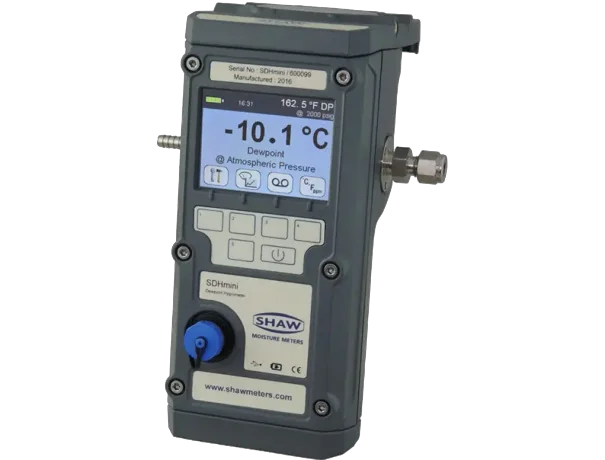
What factors affect the accuracy of dew point readings (pressure, temperature, gas purity)?
- Pressure: Dew point increases with pressure. Meters often provide pressure correction tables or automatic compensation.
- Temperature: Sudden temperature gradients cause condensation or measurement drift.
- Gas Purity: Contaminants (oil, dust, hydrocarbons) degrade sensor performance.
- Flow Rate: Low flow may delay equilibrium; high flow may cool the sensor excessively.
Proper conditioning of gas samples ensures stable and accurate readings.
What is the typical resolution (in °C or ppmv) of modern dew point meters?
Modern digital dew point meters provide:
- Resolution: 0.1°C or 0.01°C.
- Equivalent moisture resolution: 1–10 ppmv.
Advanced models with digital signal processing can detect sub-degree changes for sensitive applications.
3. Calibration and Maintenance
How often should a dew point meter be calibrated?
Most manufacturers recommend annual calibration under controlled humidity standards.
For high-accuracy applications (e.g., calibration labs, aerospace), calibration every 6 months may be required.
What calibration methods are used for dew point meters?
- Two-Point Calibration: Using two reference dew points (e.g., -40°C and 0°C).
- Saturated Salt Solutions: Known equilibrium humidity values (cost-effective but limited).
- Primary Standard Calibration: Using chilled mirror reference instruments traceable to ISO/IEC 17025 standards.
- Dynamic Generation Systems: Blend dry and wet gases to create precise humidity levels.
Can a dew point sensor be recalibrated on-site, or must it be sent to the manufacturer?
- Portable Meters: Often support on-site calibration using reference humidity sources.
- High-Precision Instruments: Require laboratory calibration to ensure traceability and temperature-controlled conditions.
Some modern meters include user-adjustable calibration offsets or USB interfaces for software-based adjustments.
What are the symptoms of sensor drift or contamination?
Common indicators include:
- Slow or unstable readings.
- Consistently high dew point values.
- Large discrepancies between repeated measurements.
- Unexpected response lag or noise in output signal.
Causes: Exposure to oil mist, corrosive gases, or dust particles that coat the sensor surface.
How should the dew point meter be maintained for long-term stability?
- Regular Purging: Use dry, clean gas before and after each measurement.
- Filter Installation: Install inline particulate and coalescing filters (0.1 µm).
- Periodic Verification: Compare readings with a reference standard.
- Sensor Protection: Avoid direct exposure to liquids and corrosive gases.
- Storage Conditions: Keep in a dry environment, preferably below 40°C.
With proper care, sensor lifespan can exceed 5–10 years.
4. Summary Table
| Parameter | Typical Value | Notes |
| Measurement Range | -100°C to +20°C | Depends on sensor type |
| Accuracy | ±0.2°C to ±2°C | Chilled mirror most accurate |
| Repeatability | ±0.1°C | Under stable conditions |
| Response Time | 10–60 seconds | Gas flow and sensor type dependent |
| Calibration Interval | 6–12 months | Traceable to ISO/IEC 17025 |
| Resolution | 0.01°C or 1 ppmv | High-end instruments |
| Typical Use | Gas drying, compressed air, natural gas, laboratories | |
5. Applications
- Compressed air systems: Prevents condensation in pipelines.
- Natural gas processing: Ensures water content meets specification limits.
- Pharmaceutical production: Maintains controlled humidity for product stability.
- Aerospace and defense: Used for environmental chambers and avionics testing.
- Semiconductor manufacturing: Critical for ultra-dry gas monitoring.