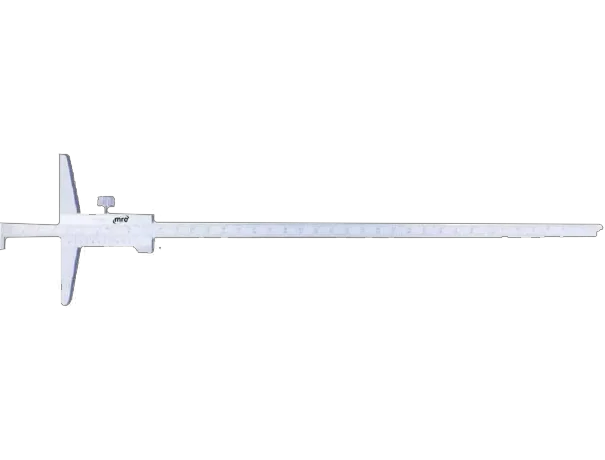
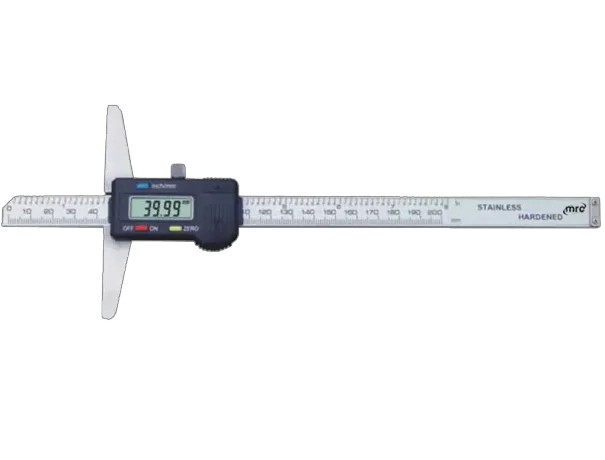
Digital and Vernier Depth Gauges: Complete Technical Q&A Guide
1. What is the measuring range and resolution of a digital depth gauge?
Digital depth gauges typically measure from 0–150 mm, 0–300 mm, or 0–600 mm. Resolution ranges from 0.01 mm to 0.001 mm, depending on model precision and electronic circuitry. High-end gauges for industrial inspection can achieve resolutions as fine as 0.0005 mm (0.5 µm).
2. How does a digital depth gauge differ from a vernier or dial depth gauge?
Digital gauges provide direct electronic readouts without manual scale interpretation. Unlike vernier or dial types, they eliminate parallax and reading errors. Digital versions also feature data output ports and inch/mm conversion, improving speed and traceability.
3. What is the accuracy tolerance of standard digital depth gauges?
Typical accuracy: ±0.02 mm to ±0.03 mm for 150 mm models. Larger models (300–600 mm) may have tolerances up to ±0.05 mm. Accuracy depends on beam straightness, sensor resolution, and calibration.
4. How is zero calibration performed on a digital depth gauge?
Place the base on a precision flat surface, press the ZERO button to set the reference. This defines absolute zero. Many models also feature relative zero to compare depth differences between surfaces.
5. What materials are used for the base and beam?
Common materials include stainless steel and hardened tool steel. The base is often ground and lapped for flatness. Some lightweight models use aluminum alloy beams with protective coatings.
6. Does the digital depth gauge support inch/mm conversion?
Yes. Most units include a dual-unit button for instant inch/mm switching, supporting both metric (mm) and imperial (inch) systems for global use.
7. How does temperature variation affect digital readings?
Thermal expansion of the beam or base alters measured values. Operating range is usually 10–40 °C, with compensation built into higher-grade instruments. A 1 °C deviation can cause up to 1 µm error per 100 mm length.
8. What type of battery is used and how long is the operating life?
Most digital depth gauges use 1.5 V SR44 or LR44 button cells. Battery life ranges from 6–12 months under normal use. Some professional models use CR2032 lithium cells for extended operation.
9. Can digital depth gauges connect to data output systems?
Yes. Many gauges feature RS232, USB, or SPC ports for real-time data logging and integration with quality control software. Wireless models use Bluetooth® or RF modules for digital transfer.
10. How often should a digital depth gauge be recalibrated?
Recommended calibration interval: once per year or after 1,000 measurement cycles, whichever occurs first. For ISO 9001 or ISO/IEC 17025 environments, follow accredited calibration schedules.
11. What are typical IP ratings for dust and water protection?
Industrial models meet IP54 (splash-resistant) or IP67 (waterproof) standards. IP67-rated gauges allow operation in humid or coolant-rich machining environments.
12. How to ensure flat and stable base contact during measurement?
Before each use, inspect the base for burrs or debris. Clean with lint-free cloth and solvent. Always ensure full surface contact with the reference plane for accurate depth readings.
13. What is the difference between standard and electronic depth micrometers?
A digital depth gauge uses a linear scale (often 150–600 mm) while an electronic depth micrometer uses a spindle and micrometer screw for finer resolution (typically 0.001 mm). Depth micrometers are better for narrow slots or holes.
14. Are digital depth gauges traceable to ISO/IEC 17025 calibration standards?
Yes. Certified models include calibration traceability to national or international standards (ISO/IEC 17025, NIST, UKAS). Certificates list measurement uncertainty and test results.
15. How to troubleshoot fluctuating or unstable digital readings?
Possible causes:
- Dirty scale: Clean beam and sensor strip.
- Weak battery: Replace battery immediately.
- Magnetic interference: Keep away from strong magnetic fields.
- Loose base screws: Retighten.
If problems persist, recalibrate and verify accuracy with gauge blocks.
1. What is the standard least count of a vernier depth gauge?
Least count is typically 0.02 mm for metric gauges and 0.001 inch for imperial versions. Some precision models achieve 0.01 mm resolution.
2. How to correctly read measurements from a vernier depth gauge?
Align the main scale with the zero of the vernier. Note the main scale value before zero, then find the vernier line that exactly coincides with a line on the main scale. Add both readings to obtain total depth.
3. What is the accuracy difference between metric and imperial vernier depth gauges?
Metric models (0.02 mm least count) offer slightly higher resolution than imperial ones (0.001 inch ≈ 0.0254 mm). However, both provide equivalent performance when properly calibrated.
4. How to maintain zero alignment and prevent parallax error?
Ensure proper eye alignment perpendicular to the scale when reading. Verify zero alignment by closing the jaws and checking that the zero marks coincide. If not, adjust the vernier plate or set screw.
5. What are standard measuring ranges?
Common measuring ranges:
- 0–150 mm
- 0–300 mm
- 0–600 mm
Custom versions can reach up to 1000 mm for deep cavities.
6. How to check the flatness of the reference base?
Place the base on a granite surface plate and use feeler gauges or optical flat inspection to detect unevenness. Maximum deviation allowed is within 0.005 mm across the surface.
7. What materials are used for vernier scales and bases?
Manufacturers use stainless steel for corrosion resistance. The scale is often etched and chrome-plated for contrast. The base may be hardened steel or carbide-tipped for durability.
8. How often should a vernier depth gauge be calibrated?
Calibrate every 12 months, or sooner in heavy use. Periodic verification using grade-0 gauge blocks ensures continued precision.
9. What are the best practices for cleaning and storing vernier depth gauges?
After each use:
- Wipe clean with oiled cloth to prevent corrosion.
- Avoid solvents that may damage scale markings.
- Store in a padded case in a low-humidity environment.
10. How does wear on the sliding jaw affect measurement accuracy?
Excessive wear introduces backlash or uneven contact. Inspect for looseness; if excessive, replace the jaw or service the instrument. Worn components may cause ±0.03 mm error or more.
11. What is the typical use of fine adjustment screws in high-precision models?
Fine adjustment screws allow controlled movement of the slider for delicate alignment. They improve repeatability in precision inspection setups.
12. Can a vernier depth gauge be used for internal groove depth measurement?
Yes. With narrow jaws or needle-type attachments, vernier gauges can measure groove depths, recesses, and slot depths, though access is limited compared to depth micrometers.
13. What are the standard DIN or ISO standards governing vernier depth gauges?
Relevant standards include:
- DIN 862 (Vernier calipers and depth gauges)
- ISO 13385-1 (Calipers and micrometer accuracy requirements)
- JIS B 7507 (Japanese industrial equivalent)
14. How to verify gauge accuracy using gauge blocks or reference standards?
Stack gauge blocks to known heights and measure the depth. Compare readings with true values. The difference indicates the error or deviation, used for calibration adjustment.
15. What environmental factors most affect vernier readings?
Temperature and humidity cause metal expansion and reading drift. Ideal working conditions: 20 ±1 °C and 45–55% RH. Avoid direct sunlight and drafts during inspection.