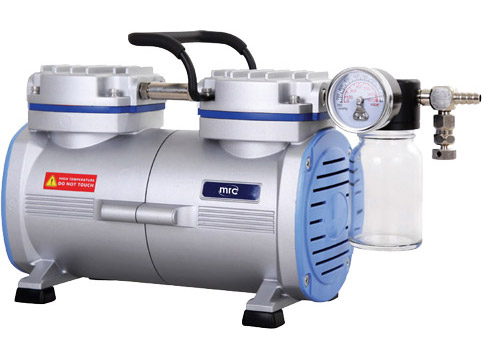
The ultimate vacuum is the deepest vacuum level a pump can achieve when running with no load—basically, the lowest pressure it can pull in an ideal scenario. It’s like a car’s top speed on an empty highway.
Why does this matter? Because the closer your operating vacuum stays to that ultimate vacuum during real use, the more efficiently your system is running.
Types of Laboratory Vacuum Pumps
Different pump types behave differently under stress:
Rotary Vane Pumps
- Great for deep vacuum
- Oil-sealed—so watch out for maintenance
- Sensitive to vapors
Diaphragm Pumps
- Dry, oil-free
- Best for medium vacuum applications
- Excellent chemical resistance
Scroll Pumps
- Quiet and oil-free
- High vacuum capabilities
- Delicate but reliable under light to moderate loads
Turbomolecular Pumps
- Used for ultra-high vacuum systems
- Needs backing pump
- Great for analytical instruments, not for continuous heavy-duty processes
Continuous Operation: What Happens Over Time
Running a pump 24/7 isn’t just a stress test—it’s war.
- Heat build-up can degrade seals or oils.
- Moving parts wear out over time, affecting vacuum levels.
- Some pumps self-regulate better (e.g., dry scrolls), others degrade fast (like older rotary vanes).
Pumps with thermal protection and auto shutoff features survive longer marathons.
Varying Loads = Real-World Chaos
Unlike the clean room conditions of a spec sheet, your pump has to deal with:
- Sudden gas influx during distillation
- Moisture spikes during freeze-drying
- High particle flow during filtration
These cause pressure fluctuations, impacting how close your vacuum stays to its ultimate value.
Does It Hold Ultimate Vacuum… or Not?
Short answer? Rarely at 100%.
In real-world usage:
- Backstreaming from oil pumps adds contamination
- Leaks in the system cause pressure drops
- Heat and humidity influence performance
Even with the best tech, expect a slight deviation from the spec’d “ultimate vacuum.”
Key Performance Drivers
Performance under load depends on:
- Seal quality (think PTFE or FKM)
- Pump design (chamber volume, inlet valve design)
- Oil purity (in rotary vane types)
- Speed control (variable frequency drives help balance loads)
Measuring Efficiency During Use
Don't guess—measure:
- Use a digital vacuum gauge inline with the pump
- Run leak tests regularly
- Log vacuum stability during different phases of operation
This helps predict performance drops and plan preventive maintenance.
Oil-Sealed vs. Dry Pumps
| Feature | Oil-Sealed Rotary Vane | Dry Pumps (Scroll/Diaphragm) |
| Vacuum Depth | Very deep | Moderate to deep |
| Maintenance | High | Low |
| Chemical Resistance | Poor to Moderate | Excellent |
| Stability Under Load | High (if maintained) | Moderate |
| Contamination Risk | Higher | Minimal |
Choose wisely depending on load consistency and sample type.
Common Efficiency Killers
Watch out for:
- Outgassing from chamber walls
- Vapor ingestion, especially solvents
- Dust or particles from filters or drying agents
All these reduce vacuum depth and wear out the pump.
Best Practices to Keep Vacuum Stable
- Use cold traps to prevent vapor damage
- Add regulators to even out load fluctuations
- Stick to maintenance schedules
- Avoid overloading the system
- Clean inlet filters regularly
Real-Life Lab Examples
- Pharmaceuticals use scroll pumps for API drying
- Food tech labs use diaphragm pumps in spray-drying stations
- University chemistry labs rely on rotary vane units for multitasking rigs
Each has a unique “vacuum profile,” but all struggle with load variability at some point.
Future Tech in Vacuum Pumps
Tomorrow’s pumps are getting smarter:
- Self-monitoring sensors
- Predictive maintenance via AI
- Lower-noise dry pumps for sensitive lab environments
Efficiency isn’t just about suction anymore—it’s about intelligent adaptability.
Final Tips for Choosing the Right Pump
When selecting a lab vacuum pump:
- Know your final vacuum needs
- Factor in load fluctuation frequency
- Check for chemical resistance
- Don’t forget after-sales support and spare parts availability