Choosing a laboratory oven begins with the process, not with the oven catalogue.
Two ovens may have the same maximum temperature and similar chamber capacities but perform very differently when processing powders, glassware, electronic components, soils or heat-sensitive materials.
The most suitable oven depends on what must happen inside the chamber:
- Must moisture be removed quickly?
- Must samples be heated without strong airflow?
- Must oxidation be reduced?
- Must every sample experience similar temperatures?
- Will the process release vapours?
- Is the oven being used for routine drying or a controlled test method?
This guide explains how to match laboratory oven technology and performance specifications to the intended application.
Begin by Defining the Required Process
Before selecting an oven type, describe the complete heating process.
A useful process description should include:
- Material or sample type
- Starting and target conditions
- Required operating temperature
- Number and size of samples
- Required heating duration
- Acceptable temperature variation
- Whether moisture or vapours will be released
- Required heating and cooling rates
- Documentation and monitoring requirements
- Frequency of use
For example, drying washed glassware requires a different performance level from curing a technical coating or measuring moisture loss from an aggregate sample.
Which Result Must the Oven Produce?
Laboratory ovens are used for several different purposes. Identifying the required result helps narrow the available options.
Drying
Drying removes moisture or another permitted volatile component from a sample or item.
The process may require:
- High air exchange
- Strong circulation
- Controlled exhaust
- Stable temperature
- Defined drying time
Fast drying does not always produce the most reliable result. Some samples may form a dry surface layer while retaining moisture internally.
Heating and Conditioning
Some samples must be brought to a defined temperature before testing or further processing.
In these applications, temperature uniformity and stability may be more important than rapid moisture removal.
Curing
Curing processes use controlled heat to develop or set coatings, adhesives, polymers or composite materials.
Important parameters may include:
- Ramp rate
- Hold temperature
- Hold time
- Cooling profile
- Airflow
- Process recording
Thermal Ageing and Stability Testing
Thermal ageing exposes materials or components to elevated temperatures for a defined period.
These tests may require long-term stability, reliable over-temperature protection and recorded temperature data.
Heat Treatment
Heat-treatment processes may include annealing, stress relief or controlled thermal processing.
The required temperature and material may determine whether a laboratory oven or higher-temperature furnace is more appropriate.
Dry-Heat Sterilisation
Dry-heat sterilisation requires a suitable steriliser, validated conditions and appropriate materials. A general laboratory oven should not automatically be assumed to provide a validated sterilisation process.
Match the Oven Type to the Application
Choose Natural Convection for Gentle Heating
Natural convection ovens rely on the natural movement of heated air.
Warm air rises while cooler air falls, creating circulation without a mechanical fan.
This design may be suitable when:
- Samples could be disturbed by strong airflow
- Powders or lightweight materials are being processed
- Gentle heating is more important than rapid recovery
- The process does not demand the tightest available uniformity
- Simple operation is preferred
Typical applications may include:
- General drying
- Heating glassware
- Conditioning samples
- Drying lightweight materials
- Routine laboratory heating
Natural convection ovens may take longer to heat and recover because they do not actively circulate air with a fan. The site currently offers natural convection models for general heating, testing and drying applications.
When Natural Convection May Be the Wrong Choice
Natural convection may be unsuitable when:
- Large batches must be heated evenly
- Rapid recovery is required
- Drying time must be minimised
- Samples are densely arranged
- Tight chamber-wide uniformity is essential
Choose Forced-Air Convection for Speed and Uniformity
Forced-air ovens use a fan or blower to move heated air throughout the chamber.
This active circulation can improve heat transfer, recovery after door openings and temperature consistency across suitable loads.
Forced-air ovens may be suitable for:
- Batch drying
- Routine material testing
- Glassware drying
- Heating components
- Thermal conditioning
- Applications requiring faster recovery
- Processes requiring consistent heating across several shelves
When Forced Air May Be the Wrong Choice
Strong airflow may disturb:
- Fine powders
- Lightweight samples
- Loose fibres
- Delicate materials
- Open containers containing materials that could spread
Fan speed and airflow configuration should therefore be considered together with the sample type.
Choose a Horizontal-Airflow Oven for Loaded Chambers
Horizontal-airflow ovens direct heated air across the chamber and around the samples.
This configuration can be useful where trays or products are arranged across multiple shelf levels and consistent airflow across the load is important.
Possible applications include:
- Material testing
- Batch processing
- Component heating
- Repetitive drying processes
- Quality-control applications
The actual performance depends on the load arrangement, sample dimensions and airflow restrictions.
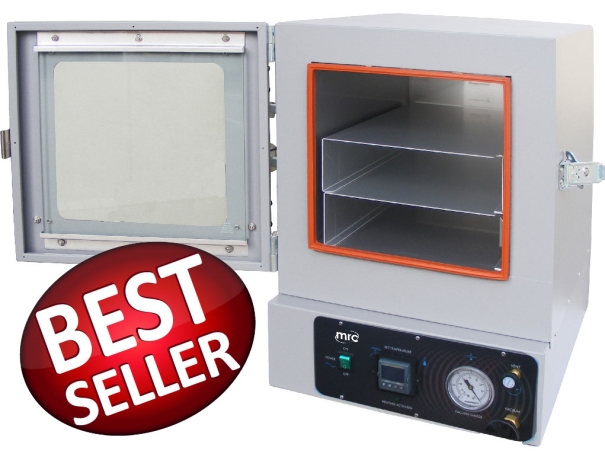
Choose a Vacuum Oven for Low-Pressure Drying
Vacuum ovens reduce the pressure inside the chamber.
Lower pressure can reduce the boiling temperature of liquids, allowing certain materials to dry at lower temperatures than they would under atmospheric conditions.
Vacuum ovens may be considered for:
- Heat-sensitive materials
- Outgassing
- Drying under reduced oxygen conditions
- Removing trapped gases
- Selected electronics processes
- Selected powders and technical materials
A vacuum oven also requires a suitable vacuum pump, compatible tubing, appropriate traps and a safe exhaust arrangement.
Important Safety Limitation
A vacuum oven should not automatically be considered suitable for every solvent or volatile material.
The complete process must be assessed, including:
- Solvent properties
- Vapour quantity
- Pump compatibility
- Trap performance
- Exhaust location
- Chamber construction
- Potential ignition sources
-
Choose a Clean-Room Oven for Contamination-Sensitive Processes
Clean-room ovens are designed for processes where airborne particles and contamination must be controlled.
Depending on the model, they may incorporate filtered airflow and construction features intended to reduce contamination.
They may be suitable for:
- Electronics
- Semiconductor-related work
- Medical-device production
- Controlled manufacturing
- Sensitive component processing
The required oven should be selected according to the clean-room classification, process requirements and contamination-control procedure.
Choose a High-Temperature Oven or Furnace When Standard Ovens Are Insufficient
Standard laboratory ovens are not suitable for every high-temperature process.
Processes such as the following may require specialised high-temperature equipment or a furnace:
- Ashing
- Sintering
- Melting
- Ceramic processing
- High-temperature annealing
- Heat treatment of metals
Do not choose equipment only according to its maximum published temperature. Confirm that the chamber, insulation, controls and heating elements are designed for continuous operation at the required process temperature.
Choose Specialised Safety Equipment for Vapour-Producing Processes
Heating a material can release flammable, toxic or corrosive vapours.
A standard laboratory oven must not be used for a process that creates a hazardous atmosphere unless it has been specifically designed and assessed for that use.
Where flammable liquids or gases are involved, ignition sources must be considered within the risk assessment.
Heating chemicals may also release toxic or hazardous decomposition products, even when the original material does not appear highly volatile.
Before selecting an oven for these applications, determine:
- Which vapours may be produced
- Expected vapour concentration
- Required exhaust rate
- Required air changes
- Whether explosion protection is required
- Whether hazardous-area suitability is required
- Whether emissions require treatment
- Whether the process should occur in different equipment
-
Translate the Application into Oven Specifications
Once the correct general oven type has been identified, the process requirements must be translated into measurable specifications.
Operating Temperature, Not Only Maximum Temperature
The oven's maximum temperature may appear prominently in the product description, but the routine operating range is usually more important.
Ask:
- At what temperature will most processes operate?
- How close is that temperature to the oven's maximum?
- Will the oven operate continuously or occasionally?
- Is additional capacity required for future procedures?
- Does performance change at different setpoints?
An oven that reaches the required temperature is not automatically suitable if its stability, uniformity or recovery are inadequate at that setpoint.
Temperature Uniformity
Uniformity describes the temperature difference between positions inside the chamber.
It is particularly important when several samples must receive comparable thermal exposure.
Uniformity can change according to:
- Operating temperature
- Chamber size
- Airflow
- Number of shelves
- Load size
- Sample placement
- Vent position
- Door openings
Temperature performance assessments may examine uniformity together with gradient, stability, fluctuation and drift.
When comparing models, confirm:
- At which temperature the value was measured
- Whether the chamber was empty or loaded
- How many measurement points were used
- Which section of the chamber is considered usable
- Whether the value represents a typical or guaranteed performance
Temperature Stability
Stability describes how much the temperature changes over time at a defined measurement location.
Good stability is important for:
- Long-duration tests
- Thermal ageing
- Quality-control procedures
- Processes with narrow temperature tolerances
- Repeatable batch processing
Uniformity and stability are different specifications. An oven can be stable at one sensor location while still having temperature differences across the chamber.
Heating Rate and Recovery Time
Heating rate describes how quickly the chamber reaches the required temperature.
Recovery time describes how quickly the oven returns to the required conditions after the door is opened or a new load is introduced.
Fast recovery may be important in high-throughput laboratories, but slower or programmable heating may be preferable for sensitive materials.
Chamber Size and Usable Working Volume
Published chamber capacity does not always equal usable working volume.
Samples require sufficient spacing to support airflow and prevent direct contact with chamber surfaces.
When choosing capacity, consider:
- Largest sample dimensions
- Normal number of samples per batch
- Required space between samples
- Shelf dimensions
- Shelf weight limits
- Airflow paths
- Future capacity requirements
An oversized oven consumes additional space and energy. An undersized or overloaded oven can restrict airflow and reduce process consistency.
Air Exchange and Exhaust
Some drying processes depend on removing moisture-laden air from the chamber.
Air exchange can improve moisture removal, but it can also affect:
- Temperature recovery
- Energy consumption
- Uniformity
- Room ventilation requirements
- Emission control
The required exhaust arrangement should be defined according to the process and substances involved.
Controls and Programme Functions
A basic temperature controller may be sufficient for routine drying at one setpoint.
More complex processes may require:
- Timed operation
- Delayed start
- Temperature ramps
- Multiple dwell stages
- Stored programmes
- User access control
- Alarm history
- Data export
- Remote monitoring
Select control features based on the actual process rather than purchasing functions that will never be used.
Over-Temperature Protection
Independent over-temperature protection helps reduce the risk of uncontrolled heating if the primary controller or sensor fails.
The required safety system depends on:
- Process temperature
- Sample value
- Material hazards
- Unattended operation
- Consequences of overheating
Data Logging and Process Documentation
Some laboratories only need to set and observe the oven temperature.
Other applications require evidence that a defined process was completed correctly.
Relevant documentation may include:
- Setpoint
- Actual chamber temperature
- Cycle duration
- Alarm events
- Programme stages
- User changes
- Independent sensor readings
Where traceable results are required, confirm whether the oven's internal records are sufficient or whether an independent monitoring system is needed.
Calibration and Temperature Mapping
Calibration assesses the performance of the measurement or control system against a reference.
Temperature mapping evaluates conditions at several positions inside the working chamber.
The required frequency and scope depend on the application, laboratory procedures, process risk and quality requirements.
There is no universal rule requiring every laboratory oven to be recalibrated annually. The interval should be determined according to use, performance history, risk and applicable procedures.
Installation Requirements
Before ordering an oven, review:
- External dimensions
- Door and corridor access
- Bench or floor strength
- Electrical supply
- Plug or hard-wiring requirements
- Heat released into the room
- Required ventilation clearance
- Exhaust connection
- Door-opening space
- Service access
- Ambient-temperature limits
Larger or higher-temperature ovens may require additional electrical capacity and ventilation planning.
Application-Based Selection Examples
Scenario 1: Drying Washed Laboratory Glassware
Likely priorities:
- Reliable general heating
- Suitable chamber capacity
- Adjustable shelves
- Adequate air circulation
- Easy cleaning
Possible choice:
Natural convection oven or another system specifically suitable for the powder and process
Scenario 3: Processing Several Trays of Material
Likely priorities:
- Good chamber-wide uniformity
- Effective airflow around the trays
- Fast recovery
- Suitable shelf loading
Possible choice:
Forced-air or horizontal-airflow oven
Scenario 4: Drying a Heat-Sensitive Component
Likely priorities:
- Lower drying temperature
- Reduced oxidation
- Controlled vacuum
- Compatible vacuum system
Possible choice:
Vacuum oven with a correctly selected pump and accessories
Scenario 5: Long-Term Thermal Ageing Test
Likely priorities:
- Temperature stability
- Over-temperature protection
- Reliable long-duration operation
- Data recording
- Alarm functions
Possible choice:
Programmable forced-air oven or specialised test oven
Scenario 6: Processing Contamination-Sensitive Components
Likely priorities:
- Controlled filtered airflow
- Clean internal construction
- Defined contamination-control requirements
Possible choice:
Clean-room oven selected according to the required environment
Scenario 7: Heating Material That Releases Flammable Vapours
Likely priorities:
- Formal risk assessment
- Vapour concentration and exhaust assessment
- Ignition-source control
- Equipment specifically suitable for the process
Possible choice:
A specialised safety oven or alternative process, not a standard laboratory oven
Laboratory Ovens from MUNRO Scientific
MUNRO Scientific supplies laboratory ovens for drying, heating, testing, curing, conditioning and controlled thermal-processing applications.
The available range includes natural convection ovens, forced-air ovens, horizontal-airflow ovens, clean-room ovens and higher-temperature systems.
Contact MUNRO Scientific with details of the material, process temperature, batch size and required performance to identify an appropriate laboratory oven.