Questions and answers about Indicators
1. What are the key performance trade-offs between a mechanical dial indicator and a digital indicator regarding resolution, speed, and environmental resistance (IP rating)?
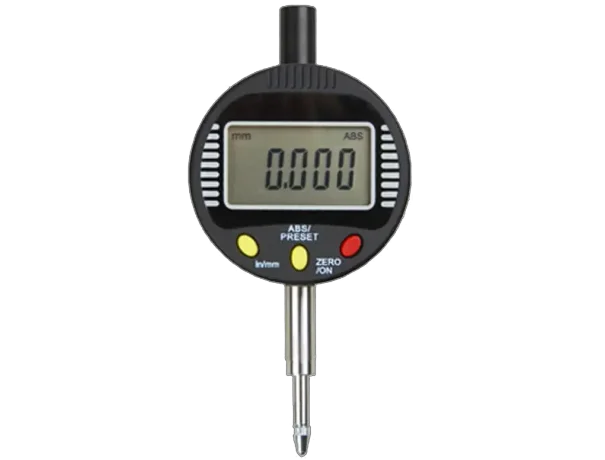
Mechanical dial indicators provide fast visual interpretation, require no batteries, and are robust in oily or dirty environments. Their resolution typically ranges from 0.01 mm to 0.001 mm depending on the gear train quality. Digital indicators often provide higher resolution, commonly 0.001 mm or 0.0005 mm, faster data capture, and features such as preset, tolerance limits, and SPC connectivity. However, electronics increase sensitivity to coolant, dust, vibration, and temperature unless protected by IP54 or IP65 sealing. Mechanical models may survive harsher shop-floor exposure, while digital models excel in precision and automated workflows.
2. For high-volume, automated comparative measurement, is a digital indicator with SPC output or a standard dial indicator with manual data logging more cost-effective and efficient?
Digital indicators with SPC output are more cost-effective long term because they reduce human transcription errors, accelerate data collection, support automated go/no-go screening, and integrate with quality management software. Manual dial indicators require operators to read and record values, slowing throughput and increasing variability. In low-volume shops, manual logging may remain economical, but in automated lines or statistical process control environments, digital output provides higher efficiency and return on investment.
3. How does the measuring force (spindle pressure) vary between different models, and how critical is this factor when measuring highly sensitive or delicate materials?
Measuring force ranges from approximately 0.3 N to 2.5 N depending on spring design, spindle travel, and model size. High-force indicators can deform thin plastics, foil, soft metals, micro components, or optical surfaces, producing false readings. Low-force models, sometimes labeled "soft contact" or "low pressure," are recommended for delicate applications. Measuring force must be consistent with ISO or DIN requirements for the part, and should be verified during calibration.
4. When should a plunger-type dial indicator be used instead of a dial test indicator (lever type) for inspecting geometric tolerances like runout or perpendicularity?
Plunger-type indicators measure linear displacement perpendicular to the spindle axis, making them suitable for flatness, height comparison, parallelism, and fixture alignment. Dial test indicators have a pivoting lever stylus designed for angular or tangential contact, ideal for runout, concentricity, perpendicularity, and small angular deviations on curved or rotational parts. When the measurement direction is not perfectly axial, or when space is limited near rotating features, a test indicator usually provides better compliance and sensitivity.
5. What is the acceptable temperature and humidity range for maintaining the rated accuracy of both analog and digital indicators?
Most indicators are calibrated at 20 °C and should operate between approximately 10 °C and 40 °C with minimal temperature gradients. Relative humidity between 30 percent and 80 percent is generally acceptable, provided condensation does not form. Excess humidity can corrode mechanical gears or circuit boards, while extreme temperatures may affect digital encoder linearity or mainspring elasticity, leading to drift.
6. How is the repeatability specification (e.g., DIN 878, AGD Group 2) determined, and what is the difference between repeatability and accuracy for these instruments?
Repeatability is evaluated by repeatedly contacting a certified master at the same point and measuring the variation of readings. DIN 878 and AGD standards define allowable short-range variation based on instrument class. Repeatability refers to consistency of results under identical conditions, while accuracy refers to closeness of the indication to the true dimensional value across the full measuring range. A gauge may be highly repeatable but inaccurate if nonlinear or improperly calibrated.
7. What specific maintenance or calibration is required to correct hysteresis or zero-drift in a digital indicator's linear encoder system?
Routine cleaning of the spindle, linear scale, and protective wipers prevents debris from obstructing the encoder. Calibration against gage blocks across full travel checks linearity and zero offset. If hysteresis persists, spindle bearings or guide bushings may require replacement. Firmware reset, battery replacement, and encoder re-zeroing are standard corrective actions. Severe drift may indicate encoder wear, prompting factory service.
8. How does the type of bearing (plain vs. jeweled) affect the longevity, sensitivity, and accuracy of a mechanical dial indicator?
Plain bearings provide durability and lower cost but exhibit higher friction and wear over time. Jeweled bearings use polished synthetic rubies that minimize friction, improve sensitivity, and maintain accuracy over extended use. High-end indicators typically use jeweled bearings for delicate measurements or long-term precision, while plain bearings are suitable for rugged industrial handling.
9. What is the standard tolerance or error (MPE - Maximum Permissible Error) allowed over the full measuring range for a digital indicator with 0.001 mm resolution?
Typical MPE values range from ±0.002 mm to ±0.005 mm depending on travel length, encoder type, and manufacturer. Longer measuring ranges increase cumulative error. MPE is verified using certified gage blocks at multiple positions across full travel, ensuring linear accuracy and consistent resolution.
10. What are the thread specifications (e.g., #4-48 UNF) for standard interchangeable contact points, and how does the material (carbide vs. steel) affect wear and measurement?
Most dial indicators use #4-48 UNF threaded contact points, while some European models use M2.5 threads. Steel contact points suit general-purpose inspection, but carbide-tipped points resist abrasion, flattening, and deformation when measuring hardened components, cast surfaces, or abrasive materials. Carbide improves dimensional stability and extends service life.
11. What steps should be taken to minimize "cosine error" when setting up a dial test indicator to measure a surface that is not perfectly perpendicular to the stylus?
The stylus should contact the surface as close to 90 degrees as possible. Aligning the probe axis or lever to the direction of actual displacement eliminates angular travel components. Adjustable indicator holders, articulated arms, and small-angle setup mirrors aid alignment. If slight angularity cannot be avoided, apply cosine correction or reposition for direct normal contact.
12. What are the recommended procedures and masters (e.g., gage blocks, setting rings) for performing an in-house calibration check on a digital indicator across its full travel?
Clean the spindle and contact point, then zero the indicator against a granite reference. Use certified gage blocks at incremental travel points, such as 0 mm, 5 mm, 10 mm, and full scale. For bore or diameter inspection indicators, use setting rings or master plugs. Record deviations, verify repeatability, and compare results to allowable MPE values. Document calibration per ISO 17025 or internal quality procedures.
13. How does the function for finding TIR (Total Indicated Runout) on a digital indicator calculate and hold the reading compared to manually observing the maximum and minimum values on a mechanical dial?
Digital TIR mode continuously samples readings, storing maximum and minimum displacement, then automatically displaying the difference. Mechanical dial indicators require the operator to rotate the part, observe needle extremes, and mentally calculate variation. Digital TIR reduces interpretation error and ensures repeatable results.
14. Are there specific requirements or best practices for the stability and rigidity of the mounting stand (e.g., magnetic base, granite surface plate stand) necessary to achieve the indicator's rated accuracy?
The base must be rigid, vibration-free, and firmly attached to a mass such as a granite surface plate. Magnetic bases should fully contact clean steel surfaces. Articulating arms must be tightened firmly to prevent drift. Flexible or lightweight stands can amplify vibration, compromising readings. Thermal expansion of mounting hardware should also be minimized.
15. How should a mechanical dial indicator be stored to prevent damage to the gear train or mainspring, and what is the typical service life before a full overhaul is required?
Store indicators in padded protective cases with the spindle retracted to reduce spring tension. Keep them clean, dry, and away from coolant mist or ferrous debris. Avoid stacking or placing weight on the bezel. With proper handling and periodic lubrication, service life often exceeds 5 to 10 years before requiring a professional overhaul or gear replacement, particularly in high-use industrial environments.