Selecting the correct laboratory refrigerator is essential for protecting temperature-sensitive samples, reagents, medicines and research materials.
A domestic refrigerator may provide basic cooling, but it is not normally designed to deliver the temperature stability, monitoring, alarm functions and controlled airflow required for professional laboratory storage.
The correct laboratory refrigerator should maintain the required storage conditions throughout the usable chamber, recover efficiently after door openings and provide suitable warning systems if conditions move outside the permitted range.
This guide explains the main factors to consider when selecting a laboratory refrigerator for a UK laboratory, pharmacy, medical facility or research centre.
Begin with the Materials Being Stored
Before comparing refrigerator models, identify exactly what will be stored.
Examples may include:
- Reagents
- Biological samples
- Culture media
- Medicines
- Vaccines
- Blood products
- Diagnostic materials
- Temperature-sensitive chemicals
- Quality-control samples
- Research materials
Each material may have different storage requirements.
Always review the manufacturer's storage instructions, relevant laboratory procedures and applicable quality requirements before selecting a refrigerator.
A refrigerator suitable for general laboratory reagents may not be suitable for vaccines, blood products or flammable materials.
Define the Required Temperature Range
The required temperature range is one of the first specifications to establish.
Many pharmacy and vaccine refrigerators operate within a range of approximately:
+2°C to +8°C
However, this range should not automatically be applied to every laboratory product.
Some materials may require:
- A narrower controlled range
- Storage close to a specific setpoint
- Protection from freezing
- A higher refrigerated temperature
- Frozen or ultra-low temperature storage
The refrigerator must be capable of maintaining the required conditions under the expected laboratory environment and usage pattern.
Temperature Stability, Uniformity and Accuracy
Temperature range alone does not provide enough information to compare laboratory refrigerators.
Three additional characteristics should be assessed.
Temperature Stability
Temperature stability describes how well the refrigerator maintains its temperature over time at a particular location.
A stable system minimises fluctuations around the selected setpoint.
Temperature Uniformity
Temperature uniformity describes the difference between temperatures measured at different locations inside the chamber.
Good uniformity helps reduce the risk of products being exposed to unsuitable hot or cold areas.
Display and Control Accuracy
The displayed temperature should provide a reliable indication of actual chamber conditions.
Where stored materials are critical, independent temperature monitoring may also be required.
Ask the supplier for available performance data and confirm how temperature performance was measured.
Air Circulation
Air circulation affects temperature uniformity and recovery.
Professional laboratory refrigerators may use forced-air circulation to distribute cooled air throughout the chamber.
This can help:
- Reduce temperature variation between shelves
- Improve recovery following door openings
- Support consistent storage conditions
- Reduce localised warm areas
The internal layout should allow air to circulate around stored materials. Avoid blocking vents or tightly packing products against internal walls.
Temperature Recovery After Door Openings
Every door opening introduces warmer ambient air into the refrigerator.
The effect depends on:
- Door-opening frequency
- Duration of each opening
- Ambient laboratory temperature
- Chamber loading
- Airflow design
- Refrigerator capacity
- Door type
A refrigerator used in a busy laboratory or pharmacy should recover efficiently after frequent access.
Before purchasing, ask whether recovery-time performance data is available and whether the model is designed for frequent door openings.
Select the Correct Refrigerator Type
General-Purpose Laboratory Refrigerators
General-purpose laboratory refrigerators are suitable for storing materials that require controlled refrigeration but do not require specialised pharmaceutical, blood-bank or hazardous-material storage.
Typical applications may include:
- Reagents
- Samples
- Culture media
- Non-flammable laboratory materials
- Research products
Confirm that the refrigerator's temperature range, uniformity and alarm functions are suitable for the specific materials.
Pharmacy and Vaccine Refrigerators
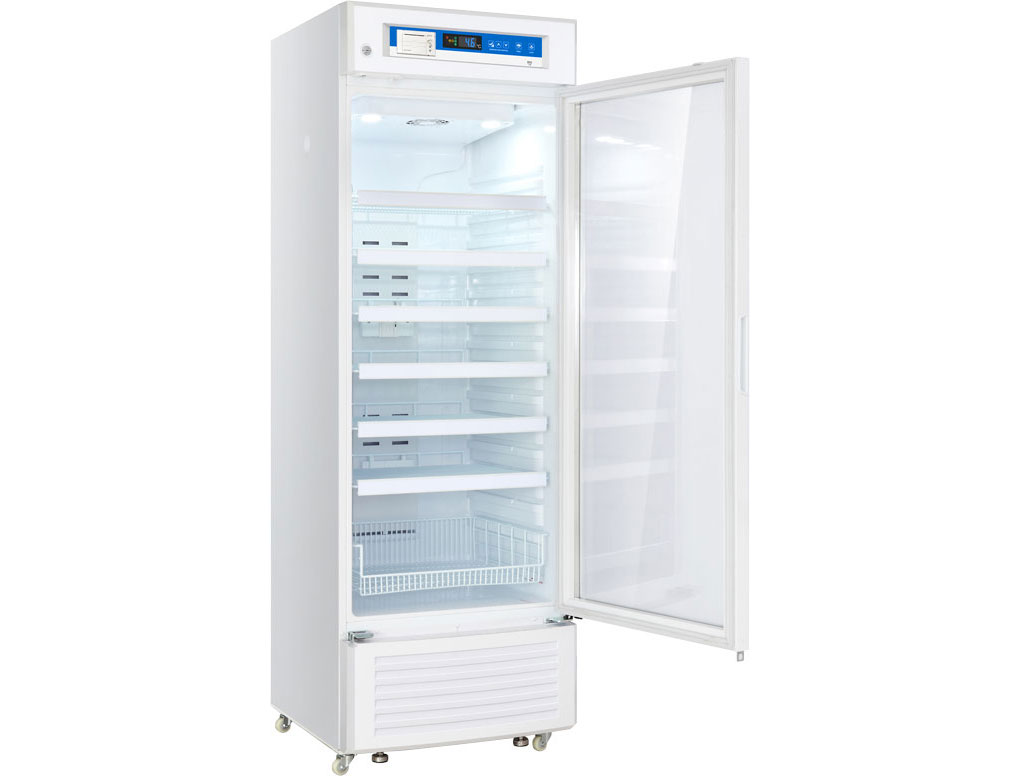
Pharmacy and vaccine refrigerators are designed for medicines and temperature-sensitive pharmaceutical products.
Relevant features may include:
- Controlled
+2°C to +8°C storage - High and low temperature alarms
- Door-open alarms
- Temperature displays
- Data logging
- Remote alarm contacts
- Locks
- Drawers or baskets
- Stable temperature performance
Vaccines must be stored according to their specific product instructions. Many vaccines are stored between +2°C and +8°C and must not be frozen.
Blood-Bank Refrigerators
Blood-bank refrigerators are designed for controlled storage of blood and blood products.
They commonly operate around:
4°C
These units may include specialised monitoring, alarms, storage drawers, temperature recording and access controls.
They should be selected according to the applicable blood-storage procedures and quality requirements.
The MUNRO Scientific range includes blood-bank refrigerator models designed for approximately 4°C storage.
Spark-Free Laboratory Refrigerators
Spark-Free refrigerators are intended to reduce potential ignition sources inside the storage chamber.
They may be appropriate when storing certain volatile or flammable materials inside the refrigerator.
Before selecting a Spark-Free refrigerator, confirm:
- Which materials will be stored
- Their quantity and concentration
- Whether vapours may be released
- Whether the refrigerator will be placed in a hazardous area
- Whether additional certifications are required
A Spark-Free interior does not automatically make a refrigerator suitable for installation in an explosive or hazardous atmosphere.
Combined Refrigerator and Freezer Units
Combined systems provide separate refrigerated and frozen compartments in one unit.
They may be useful where laboratory space is limited or where both refrigerated and frozen storage are required.
Check that each compartment has:
- Independent temperature control
- Suitable alarms
- Adequate capacity
- Appropriate monitoring
- Separate doors where required
MUNRO Scientific lists combined models with refrigerator compartments operating at approximately +2°C to +8°C and freezer compartments operating at lower temperatures.
Laboratory Freezers and Ultra-Low Temperature Freezers
If materials require frozen storage, a laboratory freezer should be selected instead of a refrigerator.
Ultra-low temperature freezers are designed for substantially lower temperatures and should be treated as a separate equipment category.
Do not select a ULT freezer unless the stored materials require those conditions. Lower temperatures generally involve higher energy consumption, greater maintenance requirements and different sample-management procedures.
Choose an Appropriate Capacity
Select the refrigerator according to usable storage requirements rather than external dimensions or total chamber volume alone.
Consider:
- Current storage volume
- Expected future growth
- Product packaging
- Required spacing between materials
- Shelf and drawer configuration
- Maximum shelf loading
- Air circulation
- Inventory-management procedures
A refrigerator should not be permanently filled to maximum capacity.
Leaving suitable space supports airflow, improves access and reduces the time users spend searching with the door open.
Upright, Undercounter or Benchtop Refrigerator
Upright Refrigerators
Upright refrigerators provide higher storage capacity and are suitable where floor space is available.
They may be appropriate for laboratories with large inventories or frequent access requirements.
Undercounter Refrigerators
Undercounter refrigerators fit beneath suitable laboratory benches and can help save space.
Confirm:
- Ventilation clearance
- Door-opening space
- Access to controls
- Available electrical supply
- Heat output
- Bench height
Compact and Benchtop Refrigerators
Compact models may be suitable for small quantities of materials or dedicated storage near a work area.
Small external dimensions do not remove the need for suitable alarms, monitoring and temperature performance.
Solid Door Versus Glass Door
Glass Doors
A glass door allows users to identify stored materials before opening the refrigerator.
This may reduce door-opening time, but the suitability of a glass door depends on the stored materials and required insulation performance.
Solid Doors
Solid doors provide privacy and may offer improved insulation, depending on the design.
They may also be preferable for light-sensitive products.
Consider whether users need visual access, whether materials require protection from light and how frequently the refrigerator will be opened.
Shelves Versus Drawers
Shelves provide flexible general storage and allow different-sized containers to be arranged.
Drawers may improve organisation and reduce the amount of cold air lost during access because users can open only the required section.
When comparing interiors, check:
- Shelf adjustability
- Drawer dimensions
- Weight limits
- Ease of cleaning
- Resistance to corrosion
- Airflow around stored products
Alarm and Safety Features
Laboratory refrigerators should include alarm features appropriate to the value and sensitivity of the stored materials.
Relevant features may include:
- High-temperature alarm
- Low-temperature alarm
- Door-open alarm
- Power-failure alarm
- Sensor-failure alarm
- Audible and visual warnings
- Remote alarm contacts
- Battery-backed alarm display
- Lockable doors
- Password-protected controls
For critical samples, local audible alarms alone may be insufficient. Consider remote alerts or connection to a building-management or monitoring system.
Temperature Monitoring and Data Logging
The refrigerator's internal controller regulates operation, but critical storage may also require independent monitoring.
Possible monitoring options include:
- Built-in data logging
- USB data export
- External data loggers
- Remote monitoring
- Minimum and maximum temperature recording
- Cloud-based alerts
- Alarm-history records
Monitoring should be designed to identify temperature excursions and provide usable records for investigations and audits.
The monitoring sensor should be positioned according to the monitoring plan rather than placed randomly inside the chamber.
Temperature Mapping and Qualification
Temperature mapping measures conditions at multiple locations inside a refrigerator to identify variation across the chamber.
Mapping may be appropriate:
- Before initial use
- After relocation
- Following major repair
- After significant configuration changes
- At defined intervals
- When required by a quality system
The scope of qualification or validation should reflect the intended use and risk.
Where applicable, this may include:
- Installation Qualification
- Operational Qualification
- Performance Qualification
- Temperature mapping
- Alarm verification
- Sensor calibration
- Recovery testing
Not every laboratory refrigerator requires the same qualification process. Requirements should be determined by the stored materials, applicable procedures and quality system.
Consider Ambient Conditions and Installation
A laboratory refrigerator must be installed in a suitable location.
Before ordering, confirm:
- External dimensions
- Doorway and corridor access
- Required ventilation clearance
- Electrical supply
- Ambient operating-temperature limits
- Heat output
- Floor or bench capacity
- Distance from heat sources
- Door-opening clearance
- Access for servicing
Avoid locating the refrigerator next to ovens, radiators, direct sunlight or other heat sources unless the unit is designed for those conditions.
Backup and Emergency Planning
A laboratory should have a documented plan for refrigerator failure, power interruption or temperature excursion.
Consider:
- Backup power
- Alternative storage capacity
- Remote alarms
- Emergency contact procedures
- Out-of-hours response
- Temperature-excursion assessment
- Product-transfer procedures
- Spare monitoring equipment
The appropriate response depends on the value, stability and criticality of the stored materials.
Cleaning and Maintenance
Routine maintenance supports reliable operation and reduces the risk of unexpected failure.
Procedures may include:
- Cleaning internal surfaces
- Checking door seals
- Inspecting alarms
- Reviewing temperature records
- Cleaning condenser components
- Verifying sensors
- Checking ventilation openings
- Testing backup systems
- Scheduling preventive maintenance
Always follow the manufacturer's maintenance and cleaning instructions.
Questions to Ask Before Purchasing
Before selecting a laboratory refrigerator, ask:
- What materials will be stored?
- What temperature range is required?
- What uniformity and stability does the refrigerator provide?
- How quickly does it recover after door openings?
- What usable storage capacity is available?
- Are shelves or drawers more appropriate?
- Is a solid or glass door required?
- Which alarm functions are included?
- Can the refrigerator connect to a remote alarm system?
- Is built-in data logging available?
- Is independent monitoring required?
- Is Spark-Free or hazardous-area suitability required?
- What installation conditions are required?
- What qualification or mapping services are available?
- What maintenance and technical support are provided?
Common Laboratory Refrigerator Purchasing Mistakes
Common mistakes include:
- Selecting a domestic refrigerator for critical laboratory storage
- Choosing a model based only on external size
- Ignoring temperature uniformity
- Assuming all stored materials require
+2°C to +8°C - Overloading the chamber
- Blocking internal airflow
- Confusing Spark-Free with hazardous-area certified equipment
- Failing to plan independent monitoring
- Relying only on a local audible alarm
- Ignoring recovery after door openings
- Failing to plan for power failure
- Purchasing without considering maintenance and servicing
Laboratory Refrigerators from MUNRO Scientific
MUNRO Scientific supplies laboratory refrigerators for research, pharmaceutical, medical and controlled-storage applications in the UK.
The available range includes compact and large-capacity refrigerators, pharmacy refrigerators, blood-bank refrigerators and combined refrigerator-freezer systems.
Available models cover capacities from compact units to large systems and include products designed for approximately +2°C to +8°C and 4°C storage applications.
Contact MUNRO Scientific with details of the materials, required temperature range, storage capacity and monitoring requirements to identify a suitable refrigerator.
FAQ
What is the difference between a laboratory refrigerator and a domestic refrigerator?
A laboratory refrigerator is designed for controlled storage and may provide improved temperature stability, airflow, monitoring, alarms and security features. A domestic refrigerator is designed primarily for food storage and may not be suitable for critical laboratory materials.
What temperature should a laboratory refrigerator operate at?
The required temperature depends on the stored material. Many pharmacy and vaccine refrigerators operate between +2°C and +8°C, but other laboratory products may require different conditions.
What is temperature uniformity in a laboratory refrigerator?
Temperature uniformity describes how consistent the temperature is across different locations inside the refrigerator chamber.
What is the difference between a Spark-Free and an explosion-protected refrigerator?
A Spark-Free refrigerator is designed to reduce ignition sources within its storage chamber. An explosion-protected or hazardous-area refrigerator must meet additional requirements for use in specific hazardous environments.
Does every laboratory refrigerator require IQ, OQ and PQ?
No. Qualification requirements depend on the refrigerator's intended use, the materials being stored and the laboratory's applicable quality or regulatory procedures.
Should laboratory refrigerator temperatures be monitored independently?
Independent monitoring may be appropriate for critical or high-value materials because it provides additional records and alerts beyond the refrigerator's internal controller.