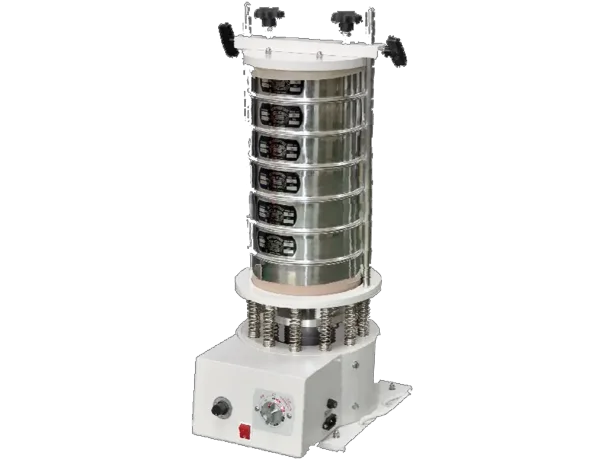
A laboratory sieve shaker is an essential instrument used to determine the particle size distribution of granular or powdered materials. It ensures consistency and accuracy in quality control, research, and production environments across industries such as pharmaceuticals, construction materials, food, and chemicals.
Below are detailed answers to the most common technical questions about laboratory sieve shakers.
1. What is the amplitude range of a laboratory sieve shaker?
The amplitude range refers to the vertical or horizontal movement (vibration intensity) applied to the sieves during operation.
Typically, Laboratory sieve shakers offer an amplitude range between 0.2 mm and 3 mm.
- Low amplitudes (0.2–1.0 mm) are suitable for fine powders and lightweight samples.
- Higher amplitudes (1.5–3.0 mm) are used for coarse or dense materials requiring greater energy to pass through the mesh.
Advanced digital models from MRC LTD allow amplitude adjustment via electronic control for optimal precision.
2. How to adjust vibration frequency on a sieve shaker?
Vibration frequency (measured in strokes per minute or Hz) determines the shaking intensity.
Modern sieve shakers provide variable frequency control, allowing users to set it manually or through a touch-screen interface.
- Typical operating frequency: 1,000–3,000 vibrations per minute (VPM).
- Adjustment is usually done through a dial or digital control on the main panel.
Digital models include feedback systems that maintain a constant frequency, ensuring repeatable results even under varying sample loads.
3. What is the maximum number of sieves that can be stacked?
The number of sieves depends on the sieve diameter, frame height, and the shaker’s clamping system.
Most laboratory sieve shakers accommodate:
- Up to 8–10 standard sieves (200 mm or 8-inch diameter) plus a lid and receiver.
Larger models designed for industrial use may hold up to 12 sieves at once. It’s important not to exceed the manufacturer’s limit, as excessive stacking can reduce vibration efficiency and accuracy.
4. What sieve diameters are compatible with the shaker (e.g., 200 mm, 300 mm, 8-inch)?
Compatibility varies by model. The most common sieve sizes are:
- 200 mm (8-inch) — standard size used worldwide for most particle size analysis.
- 300 mm (12-inch) — for larger samples or coarse materials.
Some compact units are designed for 100 mm sieves (typically used in fine chemical or pharmaceutical labs).
Manufacturers like MRC LTD offer adapters for using different sieve diameters on the same shaker.
5. What is the maximum load capacity of a sieve shaker?
The load capacity refers to the total weight (of sieves plus sample) the shaker can handle without performance loss.
- Typical load capacity: 5–8 kg for standard laboratory models.
- Heavy-duty versions may support up to 15 kg.
Always check the technical data sheet, as overloading may cause motor strain, reduced amplitude, and premature wear.
6. How does the timer control function work in modern models?
Modern sieve shakers are equipped with digital timers that allow users to set test duration precisely—typically from 1 second up to 99 minutes.
Once the programmed time elapses, the shaker automatically stops.
Advanced models include programmable cycles (e.g., intermittent shaking) and auto-repeat modes for consistent testing.
This automation ensures uniform testing conditions and eliminates operator variability.
7. What materials are used for the sieve frame and mesh?
The sieve frame is typically made from stainless steel or brass, chosen for durability and corrosion resistance.
The mesh is most often stainless steel woven wire (AISI 316), ensuring long life and precise aperture control.
For specialized applications (e.g., food or pharmaceutical testing), electroformed nickel meshes or polyurethane meshes may be used for ultra-fine or corrosive samples.
MRC LTD supplies sieves with high-grade stainless-steel construction compliant with ISO and ASTM standards.
8. Which international standards apply to laboratory sieve shakers (e.g., ISO 3310, ASTM E11)?
Laboratory sieve shakers and test sieves must comply with recognized international standards to ensure uniformity of results.
Key standards include:
- ISO 3310-1 / ISO 3310-2 – Test sieves of metal wire cloth and perforated plate.
- ASTM E11 – Specification for woven wire test sieve cloth and test sieves.
- BS 410 – British Standard for test sieves.
These standards define the tolerances, aperture sizes, and calibration procedures required for accurate and reproducible particle size analysis.
9. What are the calibration procedures for a sieve shaker?
Calibration ensures that both the shaker’s motion and the sieve apertures conform to specifications.
Standard calibration steps include:
- Visual inspection of sieve frames and mesh for damage.
- Verification of aperture size using certified calibration spheres or optical measurement.
- Measurement of vibration amplitude and frequency with an accelerometer or test sensor.
- Functional test with a standard reference material to confirm reproducibility.
Calibration should be documented, and certificates should be issued in compliance with ISO 9001 quality systems.
10. How often should a sieve shaker be serviced or validated?
Routine maintenance and validation are essential for reliable performance.
- Service frequency: every 6–12 months, depending on usage intensity.
- Calibration verification: recommended at least once per year.
During service, check for loose clamps, worn gaskets, damaged wires, and vibration irregularities.
Regular cleaning and lubrication also extend the shaker’s operational life.
11. How to ensure reproducibility and accuracy in sieve analysis?
To maintain consistency across tests, follow these best practices:
- Use certified test sieves compliant with ISO/ASTM standards.
- Maintain consistent amplitude, frequency, and duration settings for all tests.
- Ensure uniform sample loading and drying before analysis.
- Calibrate the shaker and sieves regularly.
- Avoid overloading and ensure proper clamping.
- Record environmental conditions (humidity, static, etc.) that may influence results.