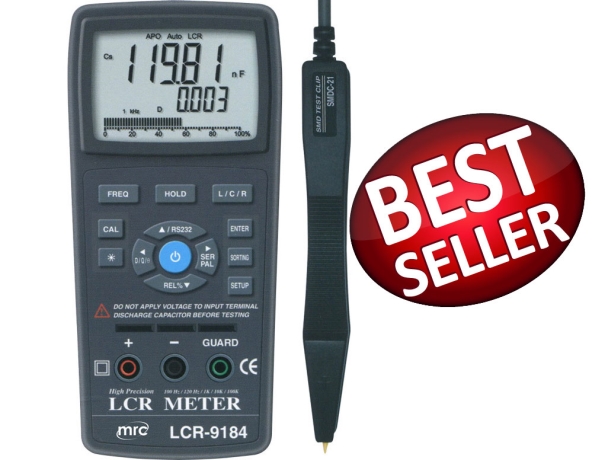
LCR meters are vital instruments in electronics, enabling precise measurement of inductance (L), capacitance (C), and resistance (R).
An LCR meter is a sophisticated electronic measuring instrument designed to evaluate the inductance, capacitance, and resistance of components with exceptional accuracy. The device applies an AC signal to the component under test (DUT) and calculates its electrical properties by analyzing the resulting current and voltage waveforms. Modern LCR meters often include advanced features such as frequency sweep, phase angle measurement, and equivalent series resistance (ESR) analysis.
How LCR Meters Work
LCR meters operate by sending a small AC signal to the DUT and observing the response. The key principles of their operation are:
- Impedance Measurement: Impedance is calculated from the relationship between voltage and current. The instrument uses this data to derive the inductance, capacitance, and resistance values.
- Frequency Range: The accuracy of LCR meters varies with the test frequency. High-end models support frequencies ranging from a few hertz to several megahertz, catering to a wide array of components.
- Display and Analysis: Results are displayed in numerical form, often accompanied by graphical representations for in-depth analysis.
Purposes of LCR Meters
LCR meters are indispensable tools in electronics, utilized across numerous applications, including:
1. Component Testing
Electronic components such as capacitors, inductors, and resistors are tested for compliance with design specifications. LCR meters ensure these components meet the required standards before integration into circuits.
2. Quality Control in Manufacturing
Manufacturers use LCR meters to verify the consistency and reliability of components during production. This helps maintain product quality and reduces the likelihood of failures in end-use applications.
3. Research and Development (R&D)
R&D teams employ LCR meters to study the behavior of materials and components under various conditions. Insights from these tests drive innovation and improve product designs.
4. Maintenance and Troubleshooting
Technicians rely on LCR meters to identify faulty components and troubleshoot circuit issues, ensuring efficient repairs and minimizing downtime.
How to Choose
Selecting the right LCR meter depends on several factors, ensuring it aligns with your specific requirements. Here are the critical aspects to evaluate:
1. Measurement Accuracy and Resolution
- Accuracy: High accuracy is essential for precise measurements. Look for meters with low measurement uncertainty.
- Resolution: A higher resolution enables detection of minute changes in component properties, crucial for advanced applications.
2. Test Frequency Range
Consider the frequency range supported by the meter. A broader frequency range accommodates diverse testing scenarios, from low-frequency audio components to high-frequency RF circuits.
3. Impedance Range
Ensure the meter can handle the expected range of impedances. Components with extremely high or low impedance values require specialized models.
4. Display and Interface
Modern LCR meters feature user-friendly interfaces, including:
- High-resolution displays for clear result visualization.
- Touchscreen controls for intuitive operation.
- USB or wireless connectivity for data transfer and remote operation.
5. Additional Measurement Parameters
Advanced meters offer additional features such as:
- ESR Measurement: Evaluates the series resistance in capacitors, critical for high-performance applications.
- Phase Angle Analysis: Assesses the phase difference between current and voltage.
- Equivalent Circuit Analysis: Models the DUT as a combination of ideal components for detailed insights.
6. Portability and Build Quality
Handheld LCR meters are ideal for fieldwork, while benchtop models provide superior performance for lab environments. Consider build quality and durability, especially for industrial use.
Effective Usage Tips for LCR Meters
Maximizing the utility of your LCR meter involves adhering to best practices:
- Calibration: Regular calibration ensures consistent accuracy.
- Connection Quality: Use proper test leads and connectors to minimize noise and errors.
- Environmental Control: Conduct measurements in stable temperature and humidity conditions.
- Component Preparation: Ensure components are free of dust and corrosion for reliable results.