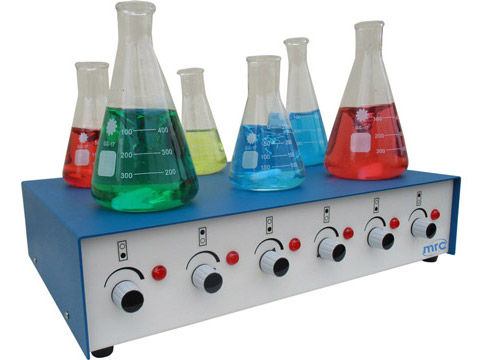
There are several models of magnetic stirrers, so picking the best one for your application might be difficult. Several laboratory procedures call for mixing. It can be difficult to choose the best lab stirrer for your qualitative or quantitative laboratory, given the range of kinds and specifications on the market. Your samples will work best with either an overhead stirrer or a magnetic stirrer based on volume and viscosity.
You should choose the appropriate magnetic stirrer for the particular application to guarantee that your solutions are spun as efficiently as possible. Spend time and effort sifting through the various magnetic stirrer models to get the ideal one for your investigations.
For applications in chemistry, biology, or microbiology, a magnetic stirrer is superior to an overhead stirrer due to its low noise, higher efficiency, and lesser mechanical parts that can break or wear out. This stirrer typically uses bars, which function well with glass containers, for diverse chemical processes.
Before you purchase a magnetic stirrer for your laboratory, you should consider the following key points to take into account from this simple guide.
Kinds of magnetic stirrers
You'll be able to choose your unit more quickly and easily if you are familiar with the various alternatives offered. From the list of applications, pick the one that best suits your requirements. Below is a list of many magnetic stirrers, along with a brief description of each kind.
- Hotplate and Stirrers- Digital:
With the help of digital hotplates and stirrers, it is simple to achieve the desired target temperature because they show rotation speed and temperature on LCD or LED displays. Constant speed maintenance is also ensured by the electronic speed control on these digital units.
- Hotplate and Stirrers- Analog:
Even when the sample loads change, hotplates and stirrers with analog speed controllers maintain a steady speed. The temperature stability of analog hotplates and stirrers is typically poor. If you want a product that is both affordable and long-lasting, an analog hotplate stirrer with excellent magnetic stickiness can be the best option for you.
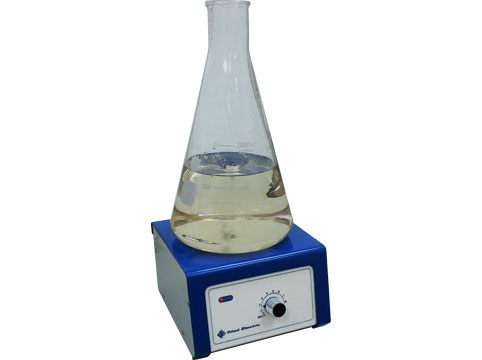
Uses of Magnetic Stirrers
Magnetic Stirrers used to make a stir bar, immerse in a liquid, quickly spin, or stirring or mixing a solution
What aspect does your application require?
- RPM Prerequisites:
Consistent rotations per minute are crucial to heating your liquids. Although powerful variants can reach up to 2000 rpm, magnetic hotplate stirrers typically have a minimum speed of roughly 1000 rpm. Generally, units with RPMs between 1000 and 15000 should be used in laboratories.
- Experiment Type:
For research requiring the monitoring of the pH of buffered systems, it can be coupled to pH probes. In case your experiment requires adjustments in the middle of the night, you can also get units with remote control features or pre-programmable functions.
The use of heating blocks or water baths in place of Hotplate with Magnetic Stirrers may be a better choice if you require very precise temperatures or little variation in temperatures.
- Use frequency and temperature specifications:
Before purchasing, consider your lab's daily routine and requirements. What sort of solutions do you employ in your research? A magnetic stirrer and a separate hot plate are sufficient if you rarely heat and stir samples.
Magnetic hotplate stirrers are an alternative for labs where materials are routinely heated and stirred. Make sure to take note of the solution's temperature as well as the amount of power required to get there. Laboratory Hot plates composed of metal or ceramic can reach temperatures 350°C to 500°C. The best hotplate stirrers for heating liquids uniformly are those that let you use heating bricks.
- The volume of the liquid and its viscosity:
When performing experiments or working with small samples, they are advised. Before buying the device, make sure to check its capacity. With the majority of models having a 3-liter capacity, it is possible to utilize a compact magnetic stirrer for at least 1 liter of surfactant solutions and 250 ml of emulsions.
A mechanical stirrer can be used instead of an overhead stirrer if you are working with large numbers of samples, liquids that are more viscous, or thicker suspensions.