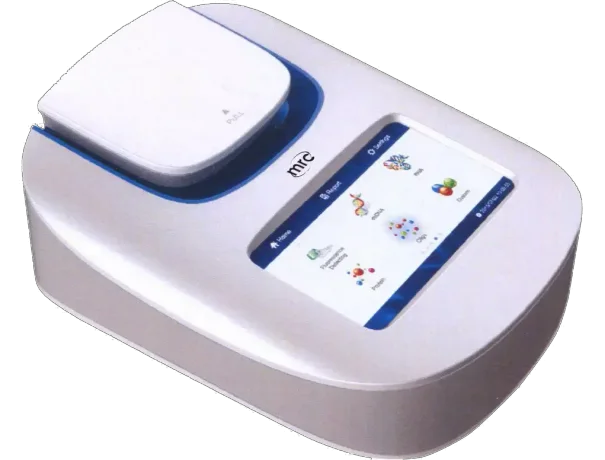
Portable Fluorometer – Questions and Answers You Need to Know
How does a portable fluorometer detect fluorescence intensity in liquid or solid samples?
A portable fluorometer detects fluorescence by illuminating a sample with light at a specific excitation wavelength and measuring the emitted light at a longer wavelength. When the excitation photons strike fluorescent molecules, they absorb energy and emit photons at lower energy. The instrument’s optical system separates excitation and emission paths, ensuring only the fluorescence signal reaches the detector. Portable fluorometers often use LED or laser diodes as excitation sources and photodiodes or photomultiplier tubes for detection.
What excitation and emission wavelengths are used in fluorescence measurement?
Typical excitation wavelengths range from 250 nm to 700 nm depending on the target fluorophore. Emission wavelengths are usually 20–150 nm longer than excitation wavelengths due to the Stokes shift. For example:
- Chlorophyll-a: Excitation ~430 nm, emission ~670 nm
- Quinine sulfate: Excitation ~350 nm, emission ~450 nm
- Rhodamine B: Excitation ~550 nm, emission ~580 nm
How does the photodetector convert emitted light into measurable signals?
The photodetector converts photon energy into electrical current proportional to the fluorescence intensity. In portable fluorometers, silicon photodiodes are common due to their compactness and stability. The signal is amplified, filtered, and digitized, allowing quantitative fluorescence measurement even in low-light conditions.
What is the difference between single-channel and multi-channel fluorometers?
Single-channel fluorometers measure one excitation/emission pair at a time. They are simple and cost-effective for dedicated measurements such as chlorophyll or hydrocarbon detection. Multi-channel fluorometers, by contrast, use multiple optical filters or detectors to measure several fluorophores simultaneously. This enables multiplexed analysis and more comprehensive sample characterization.
How does the optical filter or monochromator affect measurement selectivity?
Optical filters or monochromators determine which wavelengths reach the detector. Bandpass filters allow specific excitation and emission ranges while blocking background light. High-quality interference filters minimize spectral overlap, improving selectivity and signal-to-noise ratio. Monochromators offer tunable wavelength selection for flexible applications, though at the cost of portability and power consumption.
What is the typical detection limit (LOD) for a portable fluorometer?
Detection limits depend on the fluorophore and optical sensitivity. Typical LODs range from parts per billion (ppb) to parts per trillion (ppt). For example, chlorophyll-a can be detected at <0.01 µg/L, and polycyclic aromatic hydrocarbons (PAHs) at ppt levels in clean water.
What is the dynamic range for fluorescence intensity measurements?
Most portable fluorometers have a dynamic range of 4 to 6 orders of magnitude (10⁴–10⁶), allowing accurate measurement across wide concentration ranges without saturation or distortion.
How is fluorescence quantum yield related to concentration?
Fluorescence quantum yield (Φf) is the ratio of emitted to absorbed photons. At low concentrations, fluorescence intensity is proportional to concentration (I ∝ Φf × C). However, at high concentrations, self-quenching and reabsorption cause deviation from linearity.
What is the linearity range of fluorescence vs. concentration?
Linearity typically holds up to optical densities (OD) <0.05 at the excitation wavelength. Beyond this, inner-filter effects cause signal reduction. Most portable fluorometers maintain linearity over 3–4 orders of magnitude.
How is background noise or stray light compensated?
Background correction involves dark-current subtraction and optical filtering. Some instruments employ modulated excitation (lock-in amplification) to distinguish fluorescence from ambient light. Internal reference channels may also normalize for fluctuations in excitation intensity.
3. Applications in Industry
How is a portable fluorometer used in water quality monitoring (e.g., chlorophyll-a, CDOM, hydrocarbons)?
In environmental monitoring, portable fluorometers measure natural or anthropogenic fluorophores:
- Chlorophyll-a for algal biomass and eutrophication assessment.
- CDOM (Colored Dissolved Organic Matter) for tracking organic pollution and carbon cycling.
- Hydrocarbons and PAHs for oil spill detection and contamination mapping.
These measurements are fast, in-situ, and non-destructive, requiring no reagent or lab preparation. -
How is fluorescence applied in chemical, pharmaceutical, or food industries?
In chemistry and pharmaceuticals, fluorometers quantify active compounds, monitor reaction kinetics, and validate purity. In food processing, they detect vitamins (e.g., riboflavin), contaminants, and oxidation states in oils. Their high sensitivity enables trace analysis in quality control.
Can portable fluorometers measure oil contamination or biological activity in field samples?
Yes. Portable fluorometers equipped with specific optical channels can measure oil fluorescence (aromatic hydrocarbons) or biological markers such as chlorophyll, NADH, or proteins. They are widely used in marine oil spill monitoring and microbial activity assessments.
What industrial processes benefit from in-situ fluorescence analysis?
Industries benefiting include:
- Water treatment: Monitoring organic load and disinfection by-products.
- Petrochemical: Tracking oil-in-water contamination.
- Biotechnology: Measuring cell density and metabolic activity.
- Pharmaceutical: Ensuring process consistency and contamination control.
How often should a portable fluorometer be calibrated?
Calibration frequency depends on usage and environmental conditions. For reliable results, monthly or quarterly calibration is recommended, or after any optical cleaning or hardware replacement.
What standards are used for calibration (e.g., quinine sulfate, rhodamine B)?
Common reference standards include:
- Quinine sulfate (emission ~450 nm) – general fluorescence reference.
- Rhodamine B – for red emission range.
- Fluorescein – for green spectral region.
- Uranine – for dye tracing in hydrology.
Standards are typically prepared in acidic or neutral aqueous solutions of known concentration. -
What is the measurement accuracy and reproducibility?
Accuracy typically lies within ±2–5% of reading, with reproducibility better than ±1%. These values depend on optical alignment, detector stability, and calibration consistency.
How do environmental conditions (temperature, humidity, ambient light) affect accuracy?
Fluorescence intensity decreases with increasing temperature due to non-radiative relaxation. Humidity can affect optical components, and ambient light introduces background noise. Modern instruments compensate with temperature correction, optical shielding, and digital background subtraction.
Can calibration curves be stored and recalled for different sample types?
Yes. Advanced portable fluorometers include memory for multiple calibration curves corresponding to different fluorophores or matrices. Users can select stored profiles for rapid field switching between measurement types such as chlorophyll, CDOM, or oil detection.