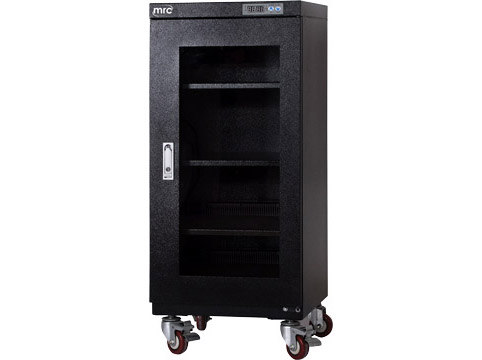
Below is an in-depth Q&A covering technical, functional, and practical aspects of dry cabinets.
1. What are the typical relative humidity (RH) ranges a dry cabinet can achieve and maintain?
Most modern dry cabinets can maintain a relative humidity (RH) level between 1% and 50%, depending on their design and purpose.
- Ultra-low humidity cabinets achieve <1% RH, used for highly moisture-sensitive devices (MSDs).
- Standard electronic storage cabinets maintain 5%–10% RH consistently.
- General-purpose cabinets typically control RH at 20%–50%, suitable for optical lenses, cameras, and archival materials.
The exact range depends on the dehumidification technology, internal volume, and environmental conditions.
2. How do different desiccant materials (e.g., zeolite, silica gel) compare in terms of their moisture absorption capacity and regeneration efficiency?
- Silica Gel
- Absorbs up to 40% of its weight in moisture.
- Cost-effective and widely available.
- Regeneration requires heating at 120–150 °C.
- Efficiency decreases after repeated cycles.
- Zeolite (Molecular Sieves)
- Absorbs moisture at extremely low RH levels (<1%).
- Faster absorption compared to silica gel.
- Regenerates at lower energy cost, typically 200–250 °C but with higher efficiency.
- More expensive but longer-lasting.
In dry cabinets, zeolite is preferred for precision RH control, while silica gel may be used for budget or passive storage solutions.
3. Explain the working principle of a thermoelectric cooling (Peltier) dehumidification system often found in dry cabinets.
A thermoelectric (Peltier) dehumidification system works by creating a temperature differential when electric current passes through semiconductor modules.
- One side becomes cold, condensing moisture from the air.
- The condensed water is collected and drained away.
- The hot side dissipates heat through a heat sink and fan system.
This method is efficient, vibration-free, and requires no refrigerants, making it ideal for low-maintenance electronic dry cabinets.
4. What is the power consumption (in kWh/day) of a standard 150-liter dry cabinet under continuous operation?
A standard 150-liter active dry cabinet typically consumes between 0.2 and 0.6 kWh/day, depending on insulation quality, ambient humidity, and the type of dehumidification system (desiccant-based or thermoelectric).
For comparison:
- Passive desiccant cabinets: nearly zero ongoing power consumption (only for regeneration cycles).
- Active cabinets: low daily energy cost, often less than a household light bulb.
5. Describe the function of a humidity sensor and its accuracy specifications in a dry cabinet.
The humidity sensor monitors the internal RH and provides real-time feedback to the control system. It ensures automatic regulation by triggering dehumidification or regeneration cycles.
- Typical Accuracy: ±2–3% RH.
- Response Time: Within seconds to minutes, depending on sensor type.
- Calibration: High-quality cabinets allow periodic calibration for long-term accuracy.
Accurate sensors are crucial to maintain compliance with IPC/JEDEC J-STD-033 standards for moisture-sensitive devices.
6. How does the seal integrity of the door and the material of the cabinet body (e.g., steel, acrylic) affect long-term humidity control?
- Seal Integrity: A poor door seal allows humid air to leak inside, forcing the dehumidification system to work harder, leading to instability and higher energy use.
- Cabinet Material:
- Steel with powder coating → Excellent for long-term airtight storage, high durability.
- Acrylic/Glass panels → Good visibility but less effective insulation, prone to scratches and air leakage.
For long-term precision control, steel cabinets with tight seals are preferred in industrial applications.
7. What are the primary applications of dry cabinets in the electronics and semiconductor industries?
- Storage of moisture-sensitive devices (MSDs) like ICs, BGAs, PCBs.
- Prevention of popcorning effect during reflow soldering.
- Safe storage of optoelectronics, optical lenses, and cameras.
- Protection of semiconductor wafers, photomasks, and precision tools.
- Long-term archiving of laboratory samples, films, and sensitive documentation.
8. What are the key differences between passive (desiccant-based) and active (electronic) dry cabinets?
- Passive Cabinets:
- Use desiccants (silica gel, zeolite).
- Require manual or periodic regeneration.
- Low cost, no electricity (except during regeneration).
- Slower humidity recovery after door openings.
- Active Cabinets:
- Use electronic dehumidifiers (Peltier, compressor, or dynamic desiccant).
- Automatically regenerate desiccant without manual handling.
- Faster recovery and more precise RH control.
- Higher cost but greater convenience and stability.
9. How should dry cabinets be properly maintained to ensure optimal performance and longevity?
- Regularly check door seals for cracks or wear.
- Clean humidity sensors and recalibrate annually.
- For passive cabinets, regenerate desiccant at recommended intervals.
- Keep cabinet in a stable environment (avoid direct sunlight, heat sources).
- Monitor RH levels frequently to ensure consistent performance.
10. What are the risks of storing moisture-sensitive components without a controlled-humidity environment?
- Moisture absorption → Components swell, delaminate, or corrode.
- Popcorning during soldering → Entrapped moisture expands rapidly, cracking components.
- Reduced shelf life → Early degradation of electronic parts.
- Data loss → In storage media or photographic films.
Ultimately, uncontrolled humidity can lead to expensive failures in manufacturing and research.
11. When should one consider a dry cabinet over a traditional desiccator or sealed bag with desiccant packs?
- When large volumes of components must be stored.
- When long-term storage is required with stable RH control.
- When compliance with industry standards (e.g., JEDEC) is mandatory.
- When frequent access to components is needed without losing humidity stability.
Dry cabinets are more reliable and cost-effective in the long run compared to sealed bags or basic desiccators.
12. Which features are most important when selecting a dry cabinet for a laboratory setting?
- RH control range and accuracy (typically 1–10%).
- Recovery speed after door openings.
- Internal capacity (50L to >1000L, depending on usage).
- Type of dehumidification system (active vs passive).
- Material & sealing quality for durability.
- Digital monitoring & alarms for compliance and safety.
- Energy efficiency for continuous operation.
For laboratories, a steel-bodied, electronically controlled, low-RH cabinet is usually the best choice.