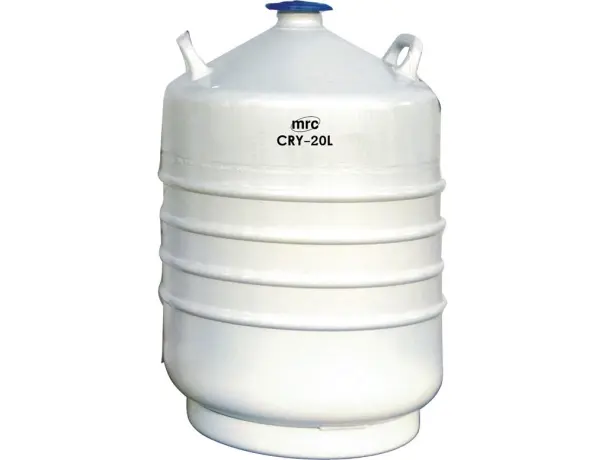
1.What are the primary insulation mechanisms employed in laboratory cryogenic containers (e.g., vacuum insulation, multi-layer insulation) and how do their efficiencies compare for different cryogens?
Primary Insulation Mechanisms in Laboratory Cryogenic Containers
Vacuum Insulation
- Description: The space between the inner and outer vessels is evacuated to a high vacuum (typically 10⁻³ to 10⁻⁶ torr).
- Function: Eliminates convective and conductive heat transfer by removing air molecules.
- Efficiency: Highly effective for all cryogens. Vacuum is especially important for cryogens with low boiling points like liquid helium (4.2 K).
Multi-Layer Insulation (MLI)
- Description: Consists of multiple layers (10–30) of reflective metalized films (e.g., aluminized Mylar) separated by spacers (e.g., glass fiber or polyester).
- Function: Minimizes radiative heat transfer between surfaces.
- Efficiency: Most effective when used in combination with vacuum insulation. Particularly important for liquid helium and hydrogen due to their extremely low boiling points and high sensitivity to heat.
Comparison by Cryogen:
| Cryogen | Boiling Point (K) | Insulation Need | Efficiency Ranking |
| Liquid Nitrogen | 77.3 K | Medium | Vacuum > MLI |
| Liquid Oxygen | 90.2 K | Medium | Vacuum > MLI |
| Liquid Hydrogen | 20.3 K | Very High | MLI + Vacuum |
| Liquid Helium | 4.2 K | Extremely High | Super-insulated (MLI + High Vacuum) |
|
2. What materials are typically used for the inner and outer vessels of cryogenic dewars, and what are the specific material properties required to withstand cryogenic temperatures and pressures? Materials Used for Cryogenic Dewars: Inner Vessel: - Material: Austenitic stainless steel (e.g., 304L, 316L)
- Properties Needed:
- Low thermal conductivity
- Excellent toughness at cryogenic temperatures
- Resistance to cryogenic embrittlement
- Compatibility with cryogens (non-reactive)
Outer Vessel: - Material Options:
- Stainless Steel (for rugged, pressure-resistant designs)
- Aluminum (lightweight portable dewars)
- Fiber-reinforced plastics (in some portable, low-pressure models)
- Properties Needed:
- Mechanical durability
- Low permeability to gases (for vacuum integrity)
- Resistance to environmental corrosion
Supports and Spacers: - Materials: G-10 (glass-epoxy composite), fiberglass, or low-conductivity ceramics
- Purpose: Structural support with minimal heat conduction
3. How are vacuum integrity and thermal performance verified during the manufacturing process of laboratory cryogenic containers? Vacuum Integrity & Thermal Performance Verification Vacuum Integrity Testing: - Helium Leak Detection: Helium is introduced and detected with a mass spectrometer to ensure no leakage (sensitivity up to 10⁻⁹ mbar∙L/s).
- Pressure Rise Testing: Measures pressure over time in the vacuum space to evaluate outgassing or leaks.
Thermal Performance Testing: - Boil-Off Rate Test: Measures the evaporation rate of a cryogen under static conditions.
- Cold Shock Cycling: Verifies mechanical stability by repeatedly cooling and warming the vessel.
4. What are the design considerations for neck tubes in cryogenic containers to minimize heat leak while allowing sample access? Key Design Goals: - Minimize Heat Ingress: The neck is a major path for thermal conduction.
- Maintain Access: Must allow sample withdrawal and refill.
Design Features: - Narrow Diameter: Smaller cross-section reduces heat transfer.
- Material Selection: Low thermal conductivity materials (e.g., G-10 or phenolic resin)
- Radiation Shields: Reflective baffles inside the neck to reduce radiative heat transfer
- Neck Plugs or Caps: Often foam or composite materials that help minimize convective loss
5. What types of pressure relief devices (e.g., burst discs, relief valves) are incorporated into cryogenic containers, and what are the standards governing their sizing and operation? Common Devices: - Pressure Relief Valves (PRVs): Automatically open to release gas when pressure exceeds a set limit.
- Burst Discs: One-time-use safety device that ruptures at a designated pressure to prevent explosion.
Design Standards & Codes: - ASME Boiler and Pressure Vessel Code
- CGA (Compressed Gas Association) Guidelines
- ISO 21013-3 – Pressure-relief devices for cryogenic vessels
- EN 13458 / EN 13530 (Europe-specific standards)
|
|
|
|
6.What are the key technical specifications to consider when selecting a laboratory cryogenic container for long-term sample storage (e.g., static holding time, evaporation rate, neck diameter, capacity)?
When selecting a container for long-term cryogenic storage:
| Specification | Importance |
| Static Holding Time | Indicates insulation efficiency |
| Evaporation Rate | Affects long-term operating cost |
| Usable Capacity | Determines number of samples/volume |
| Neck Diameter | Impacts access and thermal loss |
| Weight (Empty/Full) | Important for portability |
| Vapor vs. Liquid Storage Capability | For sample viability and safety |
| Material Compatibility | Especially for biomedical samples |
| Temperature Range | Cryogen-specific stability |
7. How does the volume of a cryogenic container impact its static holding time and overall cryogen consumption?
Impact of Volume on Holding Time and Cryogen Consumption
- Larger Volume Containers:
- Lower surface-to-volume ratio, reducing heat leak per liter
- Longer static holding times due to reduced boil-off rate
- More efficient cryogen usage
- Smaller Dewars:
- Higher evaporation rate per liter
- More suitable for portability, not long-term storage
8. What are the typical boil-off rates for liquid nitrogen and liquid helium in standard laboratory dewars of varying capacities?
| Cryogen | Container Size | Typical Boil-Off Rate (% per day) |
| Liquid Nitrogen | 5 L | 0.5–1.5% |
| Liquid Nitrogen | 50 L | 0.2–0.5% |
| Liquid Helium | 100 L | 0.5–1.0% (requires superinsulation) |
| Liquid Helium | 500 L | 0.2–0.3% |
9. What are the advantages and disadvantages of vapor phase versus liquid phase storage in large-scale cryopreservation tanks in terms of sample viability and cryogen consumption?
Vapor Phase vs. Liquid Phase Storage
Liquid Phase Storage:
- Pros:
- Ensures sample is always at cryogenic temperature
- Simpler to maintain uniform conditions
- Cons:
- Risk of cross-contamination if samples leak
- Samples immersed directly in cryogen (requires compatible vials)
Vapor Phase Storage:
- Pros:
- Samples are kept above liquid, reducing contamination risk
- Safer for biological specimens
- Cons:
- Requires accurate monitoring to avoid warming
- May have slightly warmer temperatures at the top of the chamber
Use Case: For biobanks, vapor phase is increasingly preferred for safety and regulatory reasons.
10. How do integrated liquid level monitoring systems (e.g., ultrasonic sensors, differential pressure sensors) function, and what is their accuracy and reliability in cryogenic environments?
Ultrasonic Sensors:
- Function: Send sound waves down into the dewar; time-of-flight gives liquid level.
- Advantages:
- Non-contact
- Real-time monitoring
- No moving parts
- Limitations:
- Accuracy can be affected by frost or tank shape
- May require calibration for different cryogens
Differential Pressure Sensors:
- Function: Measures pressure difference between bottom and top of the vessel to estimate liquid head height.
- Advantages:
- Accurate for larger vessels
- Can integrate with automated control systems
- Limitations:
- Requires sealed pressure ports
- Needs recalibration if cryogen type changes
Typical Accuracy:
- ±2–5% of full-scale level depending on tank geometry and sensor type.