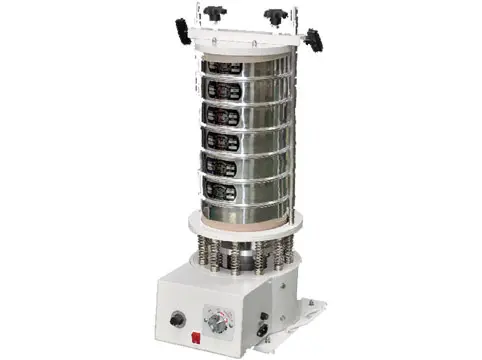
Questions and Answers of Sieve Shakers
1. What is the recommended sieving time for different particle sizes?
The recommended sieving time can depend on the particle size and the type of material being sieved. Generally:
- For coarse particles (larger than 100 microns), a shorter sieving time of around 5-10 minutes is typically sufficient.
- For fine particles (smaller than 100 microns), the sieving time can be extended to 15-30 minutes, as fine particles tend to take longer to pass through the sieve mesh.
- Some specific tests or standards may require longer sieving times, so always check any applicable guidelines or standards (like ASTM or ISO standards) for the material you are working with.
2. How do you determine the optimal amplitude and frequency for a sieve shaker?
The amplitude and frequency of a sieve shaker are determined by several factors:
- Amplitude: It refers to the extent of the sieve's movement. For effective particle separation, higher amplitude (larger motion) is usually needed for coarser materials. Finer materials, on the other hand, may require a lower amplitude to prevent blinding or clogging of the sieve mesh.
- Frequency: The frequency of oscillation (or vibration) can affect how particles move and sift through the sieve mesh. Higher frequency tends to increase the separation speed and improve finer particle separation, but it should be balanced with amplitude to prevent overloading the sieve.
- The optimal settings can often be found by trial and error or based on manufacturer recommendations, but starting with moderate amplitude and frequency is a good practice for general use.
3. What are the effects of vibration intensity on particle separation efficiency?
Vibration intensity directly impacts the efficiency of particle separation.
- High intensity (strong vibrations) can cause coarse particles to separate quickly but may lead to the fines blinding the mesh or clumping together if the material is too fine.
- Low intensity can result in incomplete separation, especially for finer particles, as the particles may not be agitated enough to pass through the mesh. The goal is to balance the vibration intensity: Strong enough to promote effective separation, but not so intense that it disrupts the material flow or causes blinding of sieves.
4. What is the standard operating procedure (SOP) for using a sieve shaker?
A standard operating procedure (SOP) for using a sieve shaker typically includes:
- Preparation: Ensure that the shaker and sieves are clean and free of any residue from previous use.
- Sample Preparation: Weigh the sample before sieving, ensuring it’s evenly distributed on the sieve stack.
- Set Up: Assemble the sieve stack with the largest sieve at the top and the finest sieve at the bottom. Secure them in the sieve shaker.
- Adjust Settings: Set the appropriate vibration amplitude and frequency, based on the material type and particle size.
- Sieving Process: Start the shaker and allow the sieving to continue for the recommended time.
- Post-Sieving: After sieving, remove the sieve stack, weigh the contents in each sieve, and calculate the particle size distribution.
- Cleaning: Clean all sieves and the shaker to remove any residue from the sieved material.
5. How does a sieve shaker ensure uniform particle distribution?
A sieve shaker ensures uniform particle distribution through controlled vibration, which:
- Promotes random movement of the particles, ensuring that they move across the entire sieve surface.
- Helps loosen clumped particles and prevents any segregation or aggregation that could result in uneven sieving.
- Uniform shaking action ensures that particles are evenly distributed and have equal exposure to the sieve mesh, helping fine particles pass through the appropriate mesh while retaining larger ones on top.
- Amplitude and frequency settings help fine-tune this distribution by controlling the speed and intensity of particle movement, optimizing the separation process.
6. What types of materials can be analyzed using a sieve shaker?
Used for particle size analysis in a wide range of materials, including:
- Powders and Granules: Common in pharmaceuticals, chemicals, and food processing.
- Soils and Sediments: Used in geology, construction, and environmental studies.
- Aggregates and Cement: Important for construction material quality control.
- Metal Powders: Essential in metallurgy and additive manufacturing.
- Plastics and Polymers: Used for quality assessment in manufacturing.
- Food Products: Such as flour, sugar, and grains for texture consistency.
7. How does a sieve shaker help in particle size analysis in the pharmaceutical industry?
In the pharmaceutical industry, They are used to ensure:
- Consistent particle size distribution in powders and granules, which affects drug dissolution rates and bioavailability.
- Quality control of excipients (e.g., lactose, starch) used in tablet formulation.
- Uniformity in blending to avoid dosage variations in final products.
- Compliance with industry standards (e.g., USP, BP, and ASTM) for particle size analysis.
8. What is the role of sieve shakers in the food and agriculture industry?
Sieve shakers are widely used in food and agriculture to:
- Classify grains and flours to ensure proper texture and processing efficiency.
- Analyze soil samples for nutrient content and consistency in agricultural research.
- Ensure uniformity in powdered food products, such as spices and baking ingredients.
- Monitor contamination levels in food production by separating unwanted particles.
9. How are sieve shakers used in cement and aggregate testing?
- Grading aggregates to ensure proper distribution of sand, gravel, and crushed stone in concrete mixtures.
- Assessing cement fineness, which affects the setting time and strength of concrete.
- Conducting ASTM C136 and EN 933-1 tests to determine particle size distribution in aggregates.
- Quality control in asphalt and concrete production to ensure compliance with industry standards.
-
10. What are the applications of sieve shakers in powder metallurgy?
In powder metallurgy, They are used to:
- Classify metal powders used in additive manufacturing (3D printing) and sintering processes.
- Ensure uniform particle size for improved material strength and density.
- Control porosity and flowability of metal powders for efficient mold filling and compaction.
- Perform quality checks in industries like aerospace, automotive, and biomedical implant manufacturing.