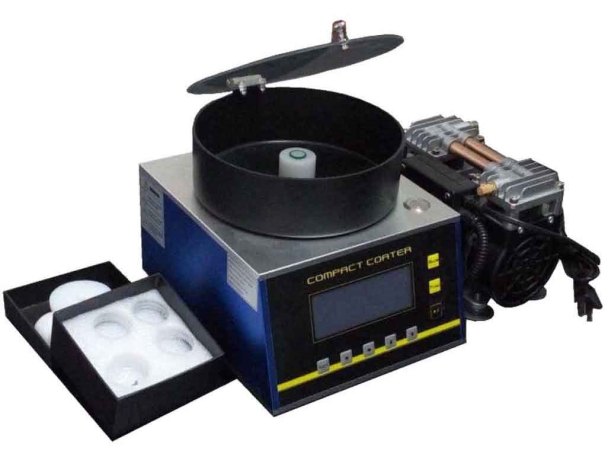
A spin coater is an essential laboratory device used to create thin, uniform films on a substrate. This technique, called spin coating, involves depositing a liquid solution on a surface and spinning it at high speeds to spread and evenly coat the material. Spin coaters are widely used in research, material development, and manufacturing due to their simplicity, precision, and cost-effectiveness.
Uses
Spin coaters are used for:
Creating Thin Films:
- Applying consistent layers of materials such as polymers, photoresists, and nanoparticles.
Surface Functionalization:
- Depositing films that alter surface properties like hydrophobicity or conductivity.
Material Research:
- Developing and testing novel thin-film materials for various applications.
Etching and Patterning:
- Preparing substrates for processes like photolithography.
Why is the device important?
Semiconductor Industry:
- Fabrication of integrated circuits and microelectronic devices.
- Coating of photoresists for lithography.
Optics:
- Manufacturing anti-reflective and protective coatings for lenses and displays.
Biomedical Research:
- Creating thin films for biosensors, drug delivery systems, and tissue engineering.
Solar Energy:
- Producing thin-film solar cells and applying perovskite layers.
Nanotechnology:
- Developing nanostructured materials and coatings for advanced applications.
Industries Using Spin Coaters
Electronics:
For microfabrication and electronic component development.
Renewable Energy:
For thin-film solar cells and other energy storage technologies.
Healthcare:
For medical device coatings and biomaterial research.
Aerospace:
For creating lightweight, durable coatings.
Optoelectronics:
For LEDs, lasers, and other light-sensitive devices.
Advantages
- Uniformity: Produces highly consistent film thicknesses.
- Precision: Allows control over thickness by adjusting speed and solution properties.
- Efficiency: Rapid coating process, suitable for both small and large substrates.
- Versatility: Compatible with a wide range of materials and applications.
Kinds
Manual Spin Coaters:
- Basic models requiring manual operation.
- Cost-effective for small-scale or occasional use.
Semi-Automatic Spin Coaters:
- Include some automated features like speed control and timing.
- Suitable for medium-scale laboratories.
Fully Automatic Spin Coaters:
- Offer complete automation, including solution dispensing, speed programming, and process control.
- Ideal for high-throughput research and industrial applications.
Vacuum Spin Coaters:
- Incorporate a vacuum chuck to secure substrates, ensuring uniform coating even for irregular shapes.
Customizable Spin Coaters:
- Designed to handle specific materials, processes, or substrates.
- Common in advanced research facilities.
How Spin Coaters Work
Substrate Preparation:
- A substrate (e.g., silicon wafer, glass slide) is cleaned to remove impurities.
- The substrate is secured on the spin coater's rotating chuck.
Solution Application:
- A small volume of coating solution is dispensed onto the substrate's center.
Spinning:
- The spin coater rotates the substrate at high speeds, typically 1,000–10,000 rpm.
- Centrifugal force spreads the liquid across the surface, forming a uniform film.
Drying:
- The solvent in the coating evaporates due to the airflow and rotational motion, leaving a thin, solid layer.