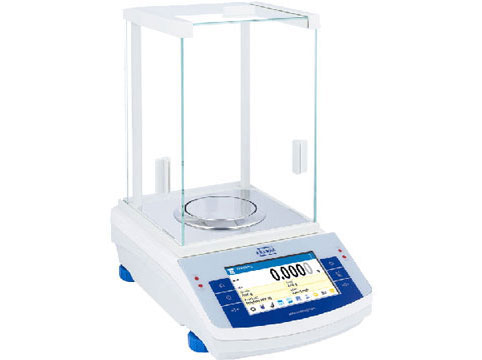
Selecting the right laboratory balance is essential for accurate weighing, repeatable results and reliable laboratory work.
A balance should not be chosen only by price, brand or maximum capacity. The correct model depends on what will be weighed, how small the sample is, what accuracy is required and where the balance will be used.
A balance that is suitable for weighing bulk materials may be completely unsuitable for analytical chemistry. A highly sensitive analytical balance may be unnecessary for routine production weighing. A moisture balance is required when the objective is to measure moisture content rather than mass alone.
This guide explains the main steps used in selecting the right laboratory balance.
Step 1: Define the Weighing Application
Start by identifying what the balance must do.
Ask:
- What materials will be weighed?
- What is the smallest sample weight?
- What is the largest sample weight?
- How accurate must the result be?
- Will the balance be used for routine weighing or analytical work?
- Will powders, liquids, solids or biological samples be weighed?
- Will the balance be used in a laboratory, classroom, production area or field location?
- Will results need to be recorded, printed or exported?
- Are there quality-system or regulatory requirements?
Typical applications include:
- Chemical weighing
- Reagent preparation
- Pharmaceutical formulation
- Quality control
- Sample preparation
- Research weighing
- Education
- Density determination
- Parts counting
- Checkweighing
- Moisture analysis
- Pipette calibration
The application should always be defined before selecting capacity or readability.
Step 2: Choose the Correct Balance Type
Different types of laboratory balances are designed for different levels of sensitivity and capacity.
Analytical Balances
Analytical balances are designed for measuring small masses with high sensitivity.
They commonly include a draft shield to protect the weighing pan from air movement and are used in applications where small weight differences matter.
Typical uses include:
- Analytical chemistry
- Pharmaceutical research
- Sample preparation
- Reagent weighing
- Formulation work
- Research laboratories
MUNRO’s analytical balance range includes models with readability such as 0.1mg and 0.01mg, which are suitable for highly sensitive weighing applications.
Analytical balances are suitable when accuracy and fine readability are more important than high weighing capacity.
Precision Balances
Precision balances, also called top-loading balances, usually offer higher capacity than analytical balances but lower readability.
They are widely used for:
- Routine laboratory weighing
- Quality control
- Education
- Industrial weighing
- Production support
- Larger sample preparation
MUNRO’s laboratory balances category describes precision balances as having capacities from around 150g to more than 10kg, with common readability options such as 0.1g, 0.01g and 1mg.
A precision balance is usually the better choice when the sample is larger and ultra-fine readability is not required.
Moisture Balances
A moisture balance is used when the goal is to determine moisture content or loss on drying.
It combines a weighing system with a heating unit and calculates moisture from the change in mass during drying.
Use a moisture balance when the question is:
How much moisture is in this sample?
Do not use a standard laboratory balance for moisture analysis unless a separate drying method and calculation procedure are being used.
Microbalances and Semi-Microbalances
Microbalances and semi-microbalances are used for very small sample quantities where extremely fine readability is required.
They require careful environmental control and are normally used in specialist analytical laboratories.
Portable and Compact Balances
Portable balances may be suitable for fieldwork, teaching laboratories or simple weighing tasks where high sensitivity is not required.
They should not be selected for critical analytical measurements unless their performance is suitable for the application.
Step 3: Determine the Required Capacity
Capacity is the maximum mass the balance can weigh.
When selecting capacity, consider:
- The sample mass
- The container mass
- Tare weight
- Accessories placed on the pan
- Maximum expected load
- Future applications
- Safety margin
For example, if the sample weighs 300g but the container weighs 700g, a 500g balance will not be sufficient.
The balance must handle the total mass placed on the pan, not only the material being measured.
Avoid Excessive Capacity
Do not automatically choose the highest-capacity balance.
Higher capacity often comes with lower readability. A 10kg balance may not be suitable for weighing 20mg quantities accurately.
The best balance is the one that provides enough capacity while still offering the readability and performance required for the smallest sample.
Step 4: Select the Correct Readability
Readability is the smallest increment shown on the display.
Examples:
0.1g
0.01g
0.001g
0.0001g
0.00001g
A balance with 0.001g readability displays results to 1 milligram.
A balance with 0.0001g readability displays results to 0.1 milligram.
However, readability is not the same as accuracy.
A display that shows more decimal places does not automatically guarantee that the result is accurate enough for the method.
Practical Readability Examples
| Application | Possible readability requirement |
|---|
| Routine sample weighing | 0.1g or 0.01g |
| General laboratory reagents | 0.01g or 0.001g |
| Analytical chemistry | 0.0001g or finer |
| Pharmaceutical formulation | Depends on method and minimum weight |
| Parts counting | Depends on individual part weight |
| Moisture analysis | Depends on sample size and required moisture resolution |
These are general examples only. The correct readability must match the method, sample size and permitted uncertainty.
Step 5: Consider Minimum Sample Weight
Minimum sample weight is one of the most overlooked balance-selection factors.
If the sample is too small relative to the balance performance, the weighing error may become too large for the intended method.
This is especially important in:
- Pharmaceutical weighing
- Analytical chemistry
- Potent compound preparation
- Research methods
- Micro-sample weighing
- Regulated laboratories
A simple rule:
The smaller the sample, the more important minimum weight becomes.
When weighing very small quantities, do not select a balance only by readability. Ask whether the model is suitable for the minimum sample size and required tolerance.
Step 6: Understand Accuracy, Repeatability and Linearity
A good balance specification includes more than capacity and readability.
Important performance terms include:
Repeatability
Repeatability describes how closely repeated measurements of the same item agree under the same conditions.
This is important when the same sample is weighed multiple times.
Linearity
Linearity describes how accurately the balance performs across its weighing range.
A balance may perform well at one mass but show different behaviour at another.
Sensitivity
Sensitivity describes how the balance responds to small changes in mass.
This is especially important in analytical balances.
Stabilisation Time
Stabilisation time is how quickly the balance reaches a stable reading.
A faster stabilisation time may improve workflow in busy laboratories, but speed should not come at the expense of reliable measurement.
Step 7: Evaluate the Weighing Environment
The more sensitive the balance, the more important the environment becomes.
Before choosing a balance, check whether the weighing area has:
- Air currents
- Vibration
- Temperature changes
- Direct sunlight
- Air-conditioning vents
- Nearby doors
- Static electricity
- Dust
- Magnetic fields
- Unstable benches
- Heavy foot traffic
Analytical balances are particularly sensitive to air movement and vibration. MUNRO’s analytical balance content notes that even small movements or air currents can affect readings.
Good Balance Placement
A balance should ideally be placed:
- On a stable weighing bench
- Away from doors and windows
- Away from ventilation outlets
- Away from vibration-producing equipment
- Away from direct sunlight
- In a temperature-stable area
- On a level surface
For analytical work, a dedicated weighing table may be required.
Step 8: Decide Whether a Draft Shield Is Needed
A draft shield protects the weighing pan from air currents.
It is especially important when using an analytical balance or weighing very small samples.
A draft shield may be needed when:
- Readability is 0.001g or finer
- Samples are very small
- The room has air movement
- Results fluctuate
- The balance is used for analytical work
- Static-sensitive powders are weighed
Analytical balances commonly include a draft shield as part of their design.
Step 9: Check Calibration Requirements
Calibration helps confirm that the balance performs within acceptable limits.
Before purchasing, check:
- Does the balance use internal or external calibration?
- Are calibration weights included?
- What class of calibration weights is required?
- How often should calibration be checked?
- Is adjustment automatic or manual?
- Is traceable calibration required?
- Are calibration records needed?
- Does the balance support GLP/GMP documentation?
Internal Calibration
Internal calibration uses a built-in weight mechanism.
It may be useful when:
- The balance is used frequently
- Temperature changes occur
- Users need simple routine adjustment
- Documentation is required
External Calibration
External calibration uses separate certified weights.
It may be suitable when:
- The laboratory already has calibration weights
- Procedures require external verification
- A simpler balance is acceptable
- Lower equipment cost is preferred
MUNRO’s laboratory balance content notes that analytical balances may offer external test-weight calibration or automatic motorised internal calibration.
Step 10: Review Weighing Functions and Software
Modern laboratory balances may include built-in functions that improve workflow.
Useful features may include:
- Tare
- Parts counting
- Percentage weighing
- Checkweighing
- Formulation
- Density determination
- Animal weighing
- Dynamic weighing
- Peak hold
- Unit conversion
- Statistical weighing
- User profiles
- Password protection
- Data export
- Printer connection
- USB, RS-232, Ethernet or Wi-Fi connectivity
The current article correctly notes that users should consider whether functions such as formulation or checkweighing are needed and whether other equipment will be connected.
Do not pay for advanced features unless they support the actual workflow.
Step 11: Consider Pan Size and Sample Handling
The weighing pan must be suitable for the items being weighed.
Check:
- Pan diameter or dimensions
- Container size
- Sample shape
- Whether tall vessels will fit
- Whether accessories are needed
- Whether the sample must be protected from air movement
- Whether the pan is easy to clean
- Whether spills can be managed safely
A large container placed on a small pan can reduce stability and increase weighing error.
For powders and liquids, consider whether the balance area allows safe handling and easy cleaning.
Step 12: Consider Cleaning and Contamination Risk
Laboratory balances may be exposed to powders, liquids, corrosive materials, biological samples or sticky residues.
Before selecting a balance, consider:
- Is the pan removable?
- Are surfaces easy to clean?
- Is spill protection available?
- Are weighing chambers easy to access?
- Are chemicals compatible with the balance materials?
- Is an anti-static solution required?
- Will the balance be used for hazardous materials?
- Are disposable weighing boats or liners needed?
Analytical balances require careful cleaning because dust, spills and residue can affect performance.
Step 13: Check Power, Portability and Installation
Some balances are intended for fixed laboratory use, while others may be portable.
Check:
- Power supply
- Battery option
- Warm-up time
- Footprint
- Bench space
- Levelling system
- Display visibility
- Printer or computer connection
- Environmental limits
- Installation requirements
Portable balances can be useful for teaching or fieldwork, but they may not provide the stability required for high-precision analytical work.
Step 14: Compare Total Cost of Ownership
The purchase price is only one part of the cost.
Consider:
- Balance price
- Calibration weights
- Calibration service
- Draft shield or accessories
- Printer or software
- Anti-static accessories
- Maintenance
- Repair costs
- Spare parts
- Downtime
- Training
- Expected lifespan
A cheaper balance may become more expensive if it requires more manual work, lacks service support or does not meet the laboratory’s accuracy requirements.
Laboratory Balance Selection Table
| Requirement | What to check |
|---|
| Application | Routine weighing, analytical work, formulation, moisture analysis |
| Maximum load | Sample plus container plus tare weight |
| Smallest sample | Minimum sample weight and required tolerance |
| Readability | Smallest displayed increment |
| Accuracy need | Method tolerance and permitted error |
| Environment | Airflow, vibration, temperature, static |
| Balance type | Analytical, precision, moisture, portable, microbalance |
| Calibration | Internal, external, traceable, documented |
| Pan size | Container and sample dimensions |
| Functions | Tare, checkweighing, formulation, density, data export |
| Documentation | GLP/GMP records, printer, USB, software |
| Maintenance | Cleaning, servicing, calibration frequency |
Common Mistakes When Selecting a Laboratory Balance
Common mistakes include:
- Choosing by price only
- Choosing capacity without considering readability
- Confusing readability with accuracy
- Ignoring minimum sample weight
- Buying an analytical balance for routine large samples
- Buying a precision balance for micro-samples
- Ignoring air currents and vibration
- Forgetting the container’s tare weight
- Choosing a pan that is too small
- Ignoring calibration requirements
- Overlooking data-export needs
- Using a standard balance when a moisture balance is required
- Failing to plan cleaning and maintenance
Laboratory Balances from MUNRO Scientific
MUNRO Scientific supplies laboratory balances for routine weighing, analytical measurements, precision weighing, moisture analysis, educational laboratories, quality control and research applications.
The available range includes analytical balances, precision balances, moisture balances and models with different capacities, readability levels and calibration options. The site also provides dedicated categories for laboratory balances, analytical balances and precision balances.
Contact MUNRO Scientific with details of your sample weight, required readability, application and laboratory environment to identify a suitable laboratory balance.
How do I choose the right laboratory balance?
Choose a laboratory balance according to the weighing application, maximum load, smallest sample size, required readability, accuracy requirements, calibration needs and laboratory environment.
What is the difference between readability and accuracy?
Readability is the smallest increment shown on the balance display. Accuracy describes how close the measurement is to the true value.
Should I choose an analytical balance or a precision balance?
Choose an analytical balance for very small samples and high-sensitivity measurements. Choose a precision balance for larger samples where higher capacity is more important than ultra-fine readability.
Why does the weighing environment matter?
Air currents, vibration, temperature changes, static electricity and unstable benches can affect weighing results, especially when using analytical balances.
What is minimum sample weight?
Minimum sample weight is the smallest sample amount that can be weighed while still meeting the required measurement tolerance.
When should a moisture balance be used?
A moisture balance should be used when the objective is to determine moisture content or loss on drying, rather than measuring mass alone.