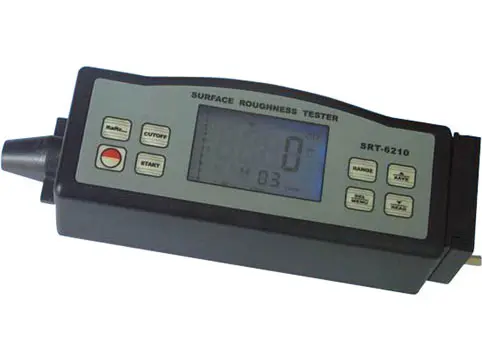
A surface roughness tester is a precision instrument used to measure the texture or topography of a material’s surface. Surface roughness refers to the small, finely spaced deviations from the nominal surface that form the pattern of surface irregularities. These variations are critical in determining how a part will interact with other components, particularly in mechanical, electronic, and aesthetic contexts.
How Does a Surface Roughness Tester Work?
Surface roughness testers work by traversing a stylus or probe across the test surface. The stylus moves vertically in response to surface irregularities and records these movements, which are then translated into roughness parameters. Common parameters include:
Ra (arithmetical mean deviation)
Rz (mean peak-to-valley height)
Rt (total height of the roughness profile)
There are two main types of roughness testers:
1. Contact-type testers – Utilize a physical stylus to scan the surface.
2. Non-contact-type testers – Use laser or optical technology for sensitive or delicate surfaces.
Applications of Surface Roughness Testers
Surface roughness testing is essential in industries where surface finish affects performance, safety, or aesthetics. Common applications include:
Machining and manufacturing quality control
Automotive part inspection (e.g., engine components, gears, bearings)
Medical device production (e.g., implants, surgical tools)
Semiconductor and electronics industries
Aerospace components
Tool and die production
Coating and paint adhesion tests
Industries That Use Surface Roughness Testers
Automotive and Aerospace – Ensuring components meet stringent tolerance and friction requirements.
Medical – For smooth, biocompatible surfaces on implants.
Metalworking and Tooling – Monitoring wear and ensuring performance of cutting tools and dies.
Electronics – Inspecting wafers, PCBs, and housings.
Construction and Civil Engineering – Checking texture of concrete and asphalt surfaces.
Optics – Evaluating lens surfaces for clarity and quality.
Advantages Compared to Other Methods
Compared to visual inspection or manual methods, surface roughness testers offer:
Quantitative precision – Provides repeatable, numeric values, reducing subjectivity.
High resolution – Can detect minute surface variations.
Speed – Rapid testing with immediate results.
Portability – Many modern testers are handheld, ideal for on-site use.
Versatility – Compatible with various surfaces: metal, plastic, ceramics, glass, coatings, etc.
Compared to Alternative Technologies:
Over visual or manual comparators: Testers are objective and do not rely on operator experience.
Compared to microscopy or SEM: Roughness testers are faster and more practical for routine QA/QC.
Compared to profilometers: Roughness testers may be more cost-effective and user-friendly for standard industrial needs.