A laboratory spray dryer is a type of drying equipment that is commonly used in research and development environments to dry solutions, suspensions, and emulsions into a powder form. This type of dryer uses a high-velocity hot air stream to rapidly evaporate the water or solvent in the sample, resulting in the formation of a free-flowing, dry powder.
Types of Laboratory spray Dryers
There are several different types of laboratory spray dryers available, including rotary atomizers, nozzle atomizers, and centrifugal atomizers. Each type has its own unique set of features and capabilities, making them suitable for different applications.
Rotary atomizers use a rotating disc to break up the liquid sample into fine droplets, which are then dried by the hot air stream. Nozzle atomizers use a high-pressure nozzle to spray the sample into the drying chamber, while centrifugal atomizers use a spinning disc to generate the droplets.
One of the main advantages of using a laboratory spray dryer is the ability to produce a consistent, uniform powder with a narrow particle size distribution. This is important for many applications, as it allows for more precise control over the final product.
In addition to their use in research and development, They are also commonly used in the production of pharmaceuticals, food and beverage products, and chemical intermediates.
There are a number of factors to consider when selecting a laboratory spray dryer, including the size and nature of the sample, the desired final product properties, and the available budget. It is important to choose a dryer that is capable of meeting the specific needs of the application, as well as being reliable and easy to maintain.
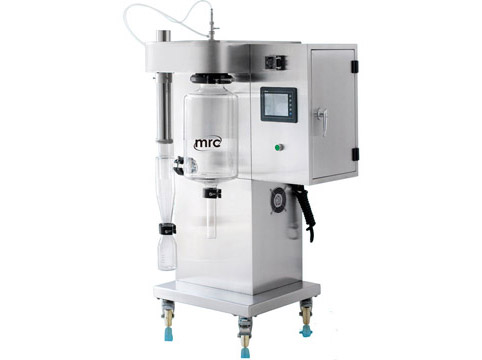
Laboratory spray dryers are used in a wide range of industries, including:
Food and Beverage: Used in the production of instant food and beverage products, such as instant coffee, infant formula, and instant soup mixes. They are also used to produce dry seasoning blends, dairy products, and fruit juices.
Spray dryers are commonly used in the food industry, particularly in the production of instant food and beverage products. Some examples of food products that may be produced include:
Instant coffee
Infant formula
Soup mixes
Seasoning blends
Dairy products
Fruit juices
Dehydrated vegetables
In the food industry, They are used to produce dry powders that have a long shelf life and are easy to transport and store. They are also used to produce powders with specific properties, such as a narrow particle size distribution or a specific flow rate.
Pharmaceutical: Used in the production of a wide range of pharmaceutical products, including tablets, capsules, and powders. They are particularly useful for producing highly pure, low-moisture active ingredients and excipients.
Spray dryers are commonly used in the pharmaceutical industry to produce a wide range of products, including tablets, capsules, and powders. In the pharmaceutical industry, They are used to produce highly pure, low-moisture active ingredients and excipients. They are also used to produce dry intermediates and reference standards for use in drug development and quality control.
Some of the advantages of using a spray dryer in the pharmaceutical industry include the ability to produce a consistent, uniform product with a narrow particle size distribution, the ability to control the drying rate and final product properties, and the ability to handle a wide range of feed materials.
Chemical: Used in the production of a variety of chemicals, including catalysts, pigments, and intermediates. They are also used to produce dry chemical reagents and laboratory reference standards.
They are commonly used in the chemical industry to produce a wide range of products, including pigments, catalysts, and intermediates. In the chemical industry, They are used to produce dry chemicals with specific properties, such as a narrow particle size distribution or a specific flow rate.
Some specific applications of spray dryers in the chemical industry include:
Production of catalysts: Used to produce dry catalysts with a narrow particle size distribution and a high surface area, which are used in a variety of chemical reactions.
Production of pigments: Used to produce dry pigments with a narrow particle size distribution and a specific flow rate, which are used in the production of paints, inks, and other colorants.
Production of intermediates: Used to produce dry chemical intermediates, which are used in the production of a wide range of chemicals and materials.
Production of dry chemical reagents: Used to produce dry chemical reagents for use in research and development, as well as in quality control and testing.
In addition to the chemical industry, spray dryers are also used in the production of pharmaceuticals, food and beverage products, and a variety of other products.
Environmental: Used in the treatment of wastewater and the production of solid fuel from waste materials.
Other industries: Used in the production of ceramics, cement, and other construction materials, as well as in the production of cosmetics, personal care products, and animal feed.
A spray dryer works by atomizing a liquid feed into a fine spray of droplets, which are then dried by contact with a stream of hot air. The liquid feed can be a solution, suspension, or emulsion, and can contain a wide range of materials, including pharmaceuticals, food products, chemicals, and more.
The spray drying process typically consists of the following steps:
Preparation of the feed: The feed is prepared by dissolving or suspending the desired material in a suitable solvent or carrier. The feed may also need to be filtered or homogenized to remove any impurities or particles that could clog the atomizing nozzle.
Atomization: The feed is atomized into a fine spray of droplets using an atomizing nozzle, a spinning disc, or a rotating wheel. The droplets are typically in the range of 50 to 500 microns in diameter.
Drying: The atomized droplets are dried by contact with a stream of hot air, which is usually generated by a gas burner or an electric heating element. As the droplets pass through the hot air, the water or solvent in the droplets evaporates, leaving behind a dry powder.
Collection: The dry powder is collected in a cyclone separator or a bag filter, from which it can be easily recovered for further processing or packaging.
The drying rate and the final properties of the powder depend on a number of factors, including the temperature and flow rate of the hot air, the size and shape of the droplets, and the properties of the feed. By carefully controlling these variables, it is possible to produce a consistent, high-quality powder with a narrow particle size distribution.
MUNRO is a well-known manufacturer of laboratory spray dryers and other drying equipment. Some potential advantages of Buchi spray dryers include:
High-quality construction: MUNRO spray dryers are known for their robust, reliable design, which is built to withstand the demands of continuous operation in a laboratory environment.
Wide range of models: MUNRO offers a variety of spray dryer models to suit different needs and applications, including tabletop models for small-scale drying and larger, freestanding models for high-volume production.
Flexible operation: MUNRO spray dryers are equipped with a range of features that allow users to adjust and fine-tune the drying process to suit the specific needs of their application. These features may include adjustable air flow, temperature, and atomization settings, as well as automatic control systems for precise process control.
Easy maintenance: Designed for easy maintenance, with features such as removable atomizing nozzles, easy-to-clean drying chambers, and user-friendly controls.
Wide range of applications: MRC spray dryers are suitable for a wide range of applications, including the drying of pharmaceuticals, food and beverage products, and chemical intermediates.
Global service network: MUNRO has a global network of service centers and technical support personnel, making it easy for users to get the help they need in case of any issues with their equipment.