Full questions and answers about Carbon Dioxide (CO2) Meters
1. How does a CO₂ meter work?
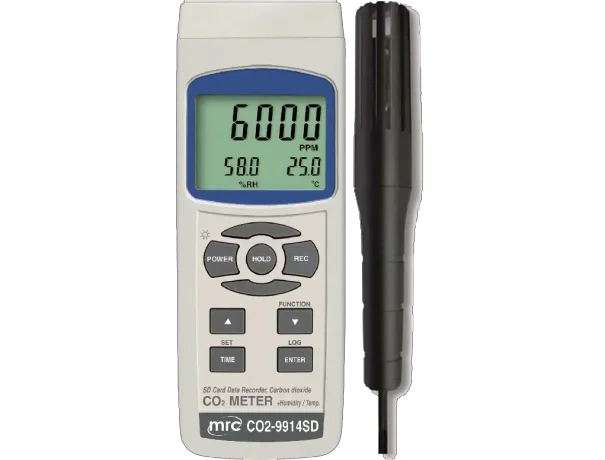
A CO₂ meter is a device that measures the concentration of carbon-dioxide gas (CO₂) in air (or a gas stream) and reports it in parts per million (ppm) or percent. Fundamentally it draws a sample of air (via diffusion or pumped flow) into a sensing volume, interacts with the gas to produce an electrical or optical signal that varies with CO₂ concentration, then the electronics convert that into the displayed value.
Steps in a typical CO₂ meter:
- Air enters the sensor chamber (or the sensor is exposed to ambient air)
- CO₂ molecules in the air interact with the sensing mechanism (absorb IR, change conductivity, etc)
- The sensor produces a raw signal (voltage, current, or optical intensity) proportional to CO₂ concentration
- This raw signal is processed (compensated for temperature/humidity/pressure drift, calibrated, filtered)
- The meter outputs a reading (ppm or %) and often alarms or interfaces for data logging.
Different technologies exist (NDIR, electrochemical, thermal conductivity, etc). The most common accurate type for CO₂ is NDIR (non-dispersive infrared).
Primary usage contexts: indoor air quality (IAQ) monitoring, HVAC control, greenhouse/plant growth CO₂ enrichment, safety in confined spaces, process control, incubators, cold-storage, and many industrial applications.
2. What is the working principle of an NDIR CO₂ sensor?
“NDIR” stands for Non-Dispersive InfraRed. The working principle is based on the fact that CO₂ molecules absorb infrared (IR) light of specific wavelengths. The sensor monitors how much IR light is absorbed by the gas sample. The greater the CO₂ concentration, the more IR absorption and the lower the transmitted light intensity. Nano Environmental Technology S.r.l.+1
Main components of an NDIR sensor:
- IR light source (lamp or LED)
- Optical chamber or gas cell through which the sample air flows or diffuses
- Wavelength filter(s) tuned to the absorption band of CO₂ (for example ~4.26 µm) and often a reference band where CO₂ does not absorb. akm.com+2heimannsensor.com+2
- IR detector (photodiode, thermopile etc) that measures the intensity of IR light after passing through the gas sample. heimannsensor.com+1
- Signal processing electronics that apply the Beer-Lambert law (transmittance related to concentration) and convert to concentration reading. figaro.co.jp+1
More detailed: The incident IR intensity I0I_0I0 is known (or referenced), after passing through the gas sample the transmitted intensity III is measured. According to the Beer-Lambert law:
T=II0=e−εcdT = \frac{I}{I_0} = e^{-ε c d}T=I0I=e−εcd
where
- εεε = absorption coefficient of CO₂ at the wavelength
- ccc = concentration of CO₂
- ddd = optical path length
Hence by measuring III, knowing I0,ε,dI_0, ε, dI0,ε,d, you compute ccc. figaro.co.jp
Single-wavelength vs dual-wavelength (or dual-channel) designs: Many sensors include a reference channel (wavelength where no CO₂ absorption occurs) to compensate for drift in IR source intensity, optical window ageing, temperature effects etc. blog.amphenol-sensors.com+1
Advantages of NDIR for CO₂: good selectivity, long life, stable calibration, minimal chemical degradation (since CO₂ is not consumed by the sensor). disruptive-technologies.com
3. What is the accuracy of a CO₂ meter in ppm?
Accuracy of CO₂ meters depends on technology, calibration, environmental conditions, and range. Typical data from commonly used modules:
- Example: Module “K30 10,000 ppm CO₂ Sensor Module” specification: accuracy ± 30 ppm ± 3% of measured value within specifications. CO2 Meter
- Example: Sensor CRIR M1: accuracy ± 40 ppm ± 3% of reading over range 400 ppm to 2000 ppm (and extended to 10,000 ppm). prod-edam.honeywell.com
- In lower cost/consumer CO₂ meters: accuracy quoted as ± 100 ppm or ± 5% (whichever is greater) for 0-50,000 ppm range. pureairemonitoring.com
Thus as a guideline for a good quality NDIR CO₂ meter used for indoor air quality: you might expect ± 30-50 ppm plus a percentage (2-5%) of reading under specified conditions. In higher ranges or less controlled conditions, error could increase (± 100 ppm or more).
In addition, repeatability and drift over time are important. For example repeatability >97% for one sensor. prod-edam.honeywell.com
It is important to check the specification sheet of the particular meter you are using: the quoted accuracy often applies under calibration conditions (specified temperature/humidity/pressure). Outside these, error may increase.
4. How often should a CO₂ meter be calibrated?
Calibration frequency depends on application, regulatory requirements, sensor technology, desired accuracy, and operating environment. For NDIR CO₂ meters in indoor air-quality / building ventilation use, calibration might be required less often because of built-in baseline correction and stable sensing. But for high precision/process control applications, more frequent calibration may be required.
Key points:
- Many NDIR sensors include “automatic background calibration” (ABC) or “auto-baseline correction” which uses periods of presumed fresh air exposure (e.g., overnight) to reset baseline. sentera.eu+1
- Some manufacturer guidelines: If the sensor is used continuously in normal indoor environment, calibration might be required annually or every few years. If used in harsh or variable conditions (e.g., humidity extremes, greenhouse CO₂ enrichment, industrial exposure), check twice a year or more.
- For very high accuracy tasks (scientific measurement, trace monitoring) calibration may be required each session or before/after measurement campaign.
Because your use case may be industrial or precision, it is good practice to inspect calibration logs, run a known reference check at intervals (e.g., every 12 months or more frequently if drift is observed) and re-calibrate when error exceeds acceptable limit.
In summary: a general practical recommendation: calibrate at installation, then check annually; in more critical or variable usage environment consider every 6 months or quarterly. Also verify baseline from fresh air or known zero/span conditions periodically.
5. What factors affect the accuracy of CO₂ readings (temperature, humidity, pressure)?
Several environmental and operational factors affect CO₂ meter readings and sensor accuracy. Good meters include compensation for many of these, but they must still be considered.
Temperature
- Sensor components (IR source, detector, optics) may drift with temperature. The absorption coefficient may vary with temperature.
- Some sensors have built-in temperature compensation. Example: CRIR M1 has temperature compensation. prod-edam.honeywell.com
- Large temperature swings can affect the accuracy beyond spec unless the device is within its specified operating range.
Humidity
- Water vapor can absorb IR light in nearby wavelengths, cause scattering, or change optical path characteristics.
- Some sensors incorporate humidity compensation, or advise avoiding condensation or very high RH.
- In environments such as greenhouses or cold storage, high humidity / condensation may degrade measurement.
Pressure / Altitude
- Gas absorption (Beer-Lambert law) is path-length and concentration and pressure dependent. Some sensors assume a reference barometric pressure (1013 mbar). If installing at altitude or in varying pressure environment, correction may be required. For example: “In normal use, close to 1013 mbar, the reading will vary by ~0.1% of reading for each mbar change in barometric pressure.” processsensing.cn+1
- If used in hypobaric or hyperbaric environments (e.g., altitudes) compensation is needed.
Optical path and contamination
- Dust, condensation, aging of optical windows, reflective surfaces in the cell may degrade signal.
- Aerosols or oil vapour may coat optics and cause drift.
Sensor drift, ageing
- IR lamp intensity may diminish over time. Optical path or filter drift may occur. Compensation via reference channel helps but drift still happens. blog.amphenol-sensors.com+1
- For example a paper (2024) shows sensor drift is a significant issue for low-cost NDIR CO₂ sensors. arXiv
Flow / sample method
- Diffusion vs pumped sample: if airflow is insufficient or the sensor chamber stale, readings may lag or be inaccurate.
- Response time and tubing/filter length may introduce delay or bias.
Cross-sensitivity
- Although CO₂ has specific absorption, interference from other gases or water vapour may affect reading (especially cheaper sensors).
- Some sensors apply filters or algorithms to correct for cross-interference. heimannsensor.com
Warm-up / stabilization
- After power on the sensor must warm up to stable state; readings during warm-up may be inaccurate. Example warm-up times vary (see later).
- Sudden changes (temperature/humidity) may require re-stabilization.
In summary, to maintain accuracy you must install the sensor in the right ambient conditions, ensure proper airflow, keep optics clean, calibrate at intervals, and account for temperature/humidity/pressure variations.
6. What is the detection range of standard CO₂ meters (0–5000 ppm, 0–10,000 ppm, etc.)?
CO₂ meters and sensors come in a variety of ranges, depending on the application. Here are common detection ranges:
- Indoor Air Quality / HVAC: 0-5000 ppm (or 400-2000 ppm typical)
- Extended indoor/building/greenhouse: 0-10,000 ppm (or up to 15,000 ppm)
- Industrial / process: 0-50,000 ppm (5 %) or higher (sometimes up to 100,000 ppm)
- High concentration CO₂ enrichment / fermentation: 0-100,000 ppm (10 %) or higher
From manufacturer examples:
- The K30 module: range 0 – 10,000 ppm, and -- the spec sheet notes “0-5,000 ppm within specifications”. CO2 Meter
- CRIR M1: standard range 400-2000 ppm, extended up to 10,000 ppm. prod-edam.honeywell.com
- A typical user manual: Measurement Range 0-50,000 ppm (5 %). pureairemonitoring.com
When selecting a CO₂ meter you must ensure the range covers your expected concentrations. Using a meter with range 0-5,000 ppm in an environment where peaks go to 10,000 ppm may saturate the sensor or reduce accuracy. Conversely, using a 0-100,000 ppm range sensor in 0-2000 ppm environment may reduce resolution or sensitivity.
7. What is the warm-up time for NDIR CO₂ sensors?
Warm-up time is the period after powering the sensor until it reaches its specified accuracy and stability. The time depends on the sensor design, IR lamp/LED, temperature compensation, and electronics.
Examples:
Therefore as a rule of thumb: give 1-5 minutes for basic stability; for high-accuracy measurement allow 10-15 minutes for full stabilization (especially after power off/on or large ambient temperature change). Always consult the manufacturer’s data sheet for exact warm-up time.
8. How do dual-beam (dual-channel) NDIR CO₂ sensors differ from single-beam types?
Single-beam or single-channel NDIR sensors: They typically use one IR wavelength (through a filter) tuned to CO₂ absorption and detect transmitted light. They rely on a known baseline and calibration to compute concentration. They may include firmware compensation for drift but no dedicated reference channel. They are simpler and generally lower cost. blog.amphenol-sensors.com
Dual-beam (or dual-wavelength/dual-channel) NDIR sensors: They include two optical paths or two filters/detectors: one tuned to the CO₂ absorption band (measurement channel) and one reference channel (wavelength where CO₂ does not absorb). The reference channel tracks IR source intensity changes, window ageing, dust/optical loss, and thus compensates for drift, ageing effects, and environmental changes. This improves long-term stability, reduces calibration frequency, and enhances accuracy in challenging environments. Sensirion AG+1
Summary of differences:
| Feature | Single‐Channel | Dual‐Channel |
| Complexity/Cost | Lower | Higher |
| Drift compensation | Basic, via calibration | Better, via reference channel |
| Suitable for | Environments where baseline fresh-air exposure is regular | Continuous occupancy, no return to baseline, demanding environment |
| Calibration frequency | More frequent | Less frequent |
| Typical applications | Office IAQ, classrooms | Hospitals, greenhouses, 24/7 operation, high precision |
Hence for high-reliability or demanding applications (greenhouse enrichment, controlled environment, industrial safety) a dual channel NDIR CO₂ sensor is preferable.
9.1 How to calibrate a CO₂ meter using fresh air or calibration gas?
Using fresh air (automatic or manual baseline)
When you assume that fresh outdoor air has a known CO₂ concentration (typically ~400 ppm, but varies regionally). Steps:
- Place the sensor in fresh outside air under stable temperature/humidity for a period (e.g., >10-15 minutes).
- Trigger zero (or baseline) calibration. For example, the command “G” for zeroing in fresh air in some modules. processsensing.cn
- Let the sensor adjust its baseline so the reading is set to the assumed fresh air concentration.
- After calibration, place the sensor back into monitoring location.
Using calibration gas (zero and span calibration)
For higher accuracy:
- Use certified calibration gas of known CO₂ concentration (e.g., 0 ppm CO₂ in nitrogen for zero; e.g., 2000 ppm, 5000 ppm or 10,000 ppm certified mix in air balance for span).
- Expose the sensor to the calibration gas in a controlled environment (flow of gas through chamber or bag). Ensure temperature/humidity stable, gas stable.
- First perform zero calibration (0 ppm CO₂) then span calibration (known ppm). Some devices do only zero then internal electronics handle span; others allow full two-point calibration.
- Adjust calibration settings in sensor via commands or interface (e.g., command “X” for known concentration calibration) as per manufacturer. processsensing.cn
- After calibration flush sensor with clean air and verify reading returns to ambient expected value.
- Document calibration date, results, adjustments.
9.2 What is the difference between manual and automatic baseline calibration (ABC)?
Manual baseline calibration: The user actively exposes the sensor to a known reference (fresh air or calibration gas) and executes the calibration procedure manually (zero or span) via commands or interface. This gives full control but requires user effort, scheduling, and oversight.
Automatic baseline calibration (ABC) or Auto Background Correction: The sensor firmware automatically identifies periods of presumed fresh air (lowest CO₂ concentration over a period) and uses that to adjust its baseline (set that to ~400 ppm or defined default). Example: Some sensors record lowest value in e.g. 180 hours and assume that is fresh air, then adjust. sentera.eu
Benefits: Less user intervention, good for continuous indoor monitoring where CO₂ will periodically drop to baseline (e.g., overnight).
Limitations: Only valid if the environment actually drops to fresh‐air baseline occasionally. If sensor is in continuously occupied space with elevated CO₂ (never reaches baseline), ABC will miscalibrate (setting baseline at higher value). In such cases manual calibration or dual-channel sensor is needed.
9.3 What calibration gas concentration is required for CO₂ meter calibration?
Calibration gas selection depends on the sensor range and intended application. Good practice: use at least two points (zero and span) within or near the measurement range.
- Zero gas: CO₂-free gas (typically nitrogen or synthetic air with 0 ppm CO₂) or fresh air if used for baseline.
- Span gas: a certified concentration within the upper region of the expected measurement range (e.g., for a 0-10,000 ppm sensor use 2000-5000 ppm calibration gas; for higher range use 10,000 ppm mix).
For example: The CRIR M1 states calibration gas uncertainty is ±1% of mixture. prod-edam.honeywell.com
Important: The calibration gas must be certified, traceable to standards, and matched to the sensor’s measurement range.
In many IAQ sensors daylight, manufacturers supply recommended calibration interval and gas (e.g., 400 ppm fresh air + 2000 ppm span). Always follow the device’s user manual.
9.4 How often should a CO₂ sensor be replaced?
Replacement interval depends on life expectancy, operating environment, and cost of drift vs calibration. For quality NDIR sensors:
- Many specify life >10 or >15 years under normal indoor conditions. Example: K30 module says sensor life expectancy >15 years. CO2 Meter
- However in harsh or industrial conditions (high humidity, dust, corrosive gases) the usable life may be less.
- Even though sensor may still operate, after a certain age drift, wear of optics, IR source degradation, and calibration becomes more burdensome; replacement may be more cost-effective.
- A practical policy: plan for replacement every 8-15 years for standard indoor IAQ sensors; monitor drift, increased calibration frequency may trigger earlier replacement.
9.5 How to troubleshoot CO₂ sensor drift or inaccurate readings?
Common troubleshooting steps:
- Check power supply and ensure correct voltage and stabilization.
- Verify that the sensor has been warmed up (see warm-up time).
- Review calibration history. If readings are trending or baseline drifting upward or downward, perform calibration (zero/span).
- Expose sensor to fresh air (or known reference gas) and check if reading matches expected (e.g., ~400 ppm fresh outdoor air). If significantly off, zero baseline may be incorrect.
- Verify environmental conditions: ensure temperature, humidity, pressure are within sensor’s specification. If outside range, expect error.
- Check for optical contamination: dust, water condensation, oil vapour in optical chamber may reduce IR transmission. Clean or replace filter/windows if needed.
- Check sample flow method: ensure diffusion or pump sampling is working, no blockage or tubing contamination, sensors not placed in stagnant or stratified air zone.
- Evaluate cross-sensitivity/interference: if used in environment with high humidity or other gases, check whether those conditions may bias readings.
- If drift persists despite calibration and environment is controlled, sensor aging may be occurring (IR source degradation, window degradation). Consider replacement.
- Document: log readings over time, calibration results, environmental conditions, and use this data to establish maintenance schedule.
10. Environmental and Application-Specific Queries
10.1 What CO₂ concentration is considered safe for indoor air quality?
There is no absolute “safe” single threshold for CO₂ as physiological effects and ventilation/occupancy factors vary. However typical guidelines:
- Outdoor ambient CO₂: ~ 400-450 ppm (varies by region and time)
- Indoor CO₂ below ~1000 ppm is often used as a target for good indoor air quality, indicating adequate ventilation. Some building standards aim for <1000–1200 ppm.
- When levels rise above ~1500 ppm or more, occupant discomfort (drowsiness, reduced cognitive performance) may occur. Some studies link elevated CO₂ with reduced productivity. disruptive-technologies.com
- For safety: very high CO₂ (>5,000 ppm) may pose physiological effects (headache, increased respiration, etc). OSHA (US) sets permissible exposure of 5,000 ppm (0.5%) for 8-hour TWA for general workplace air.
Thus for ventilation control, reading <1000–1200 ppm is a practical indicator of adequate fresh air. Monitoring higher values signals need to increase ventilation or reduce occupancy load.
10.2 How do CO₂ meters perform in high-humidity environments (e.g., greenhouses)?
High-humidity environments pose special challenges: condensation, fog, water droplets, dust, plant aerosols can coat optical windows or affect diffusion flow. Additional considerations:
- Ensure the sensor is rated for high humidity (e.g., 0-95% RH non-condensing). For example, CRIR M1 spec: 0 %RH to 90 %RH non‐condensed. prod-edam.honeywell.com
- Avoid placing the sensor where water vapor will condense on optics or tubing; condensation severely degrades accuracy.
- In greenhouse enrichment applications where CO₂ may be elevated (2000–3000 ppm or more) the sensor range must accommodate this.
- Some sensors designed for greenhouse use include flow head, desiccant or hydrophobic filter to protect the optics.
- High humidity may accelerate ageing of optical components and thus increase drift—frequent calibration may be needed.
In summary, CO₂ meters can work in high humidity if designed for it and installed properly, but performance and maintenance requirements are higher.
10.3 Can a CO₂ meter be used in cold storage or incubators?
Yes—provided the sensor specification covers the temperature/humidity/pressure conditions of the environment. Considerations:
- Temperature range: Some CO₂ meters are rated for 0 °C to +50 °C (or wider). For cold storage below freezing or near 0 °C you must verify spec. Example CRIR M1 operating temp 0 °C to 50 °C. prod-edam.honeywell.com
- In incubators (often higher humidity, 37-70 °C, 95 % RH) the sensor must handle high RH, possible condensation, and heating cycles. Choose sensor rated for high humidity and temperature.
- Cold environments may slow down diffusion (if sensor relies on diffusion) and response time may increase.
- Ensure sample airflow is sufficient and condensation is avoided on sensor optics or tubing.
- Pressure might differ (e.g., vacuum or freezer). Ensure compensation.
So yes, it is feasible but attention must be paid to the environmental conditions and appropriate sensor choice.
10.4 What is the operating temperature range of CO₂ meters?
Operating temperature range varies by model/manufacturer. Typical ranges:
- Many indoor IAQ sensors: 0 °C to +50 °C (sometimes +70 °C)
- Some industrial sensors: −10 °C to +60 °C or −20 °C to +70 °C
- High temperature process sensors: up to +100 °C or beyond (but require special design)
Example: CRIR M1: Operating temperature range 0 °C to 50 °C. prod-edam.honeywell.com
It is important to verify the sensor's datasheet for both operating and storage conditions (storage often a much wider range). Operating outside the specified range will likely reduce accuracy, increase drift, or damage the sensor.
10.5 How do CO₂ levels correlate with ventilation efficiency or occupancy?
CO₂ levels in an indoor space are widely used as a proxy indicator of ventilation adequacy and occupancy because humans exhale CO₂. The relationship:
- In a space with given occupancy and ventilation, CO₂ concentration rises over time when ventilation is inadequate (fresh air supply low relative to CO₂ generation).
- The steady-state CO₂ concentration in a room can be approximated by the balance of CO₂ generation (from occupants) and removal (via ventilation). A simplified equation:
C=Coutdoor+GVC = C_{\text{outdoor}} + \frac{G}{V}C=Coutdoor+VG
where
CCC = indoor CO₂ concentration,
CoutdoorC_{\text{outdoor}}Coutdoor = outdoor CO₂ concentration (≈ 400 ppm),
GGG = CO₂ generation rate (ppm·m³/h or mass/h),
VVV = ventilation rate (m³/h).
Thus higher CO₂ indicates lower ventilation (for given occupancy). Many buildings use CO₂ sensors to trigger demand controlled ventilation (DCV) – increasing fresh air when CO₂ rises, reducing when low.
Empirical correlations: Studies show improved cognitive performance, comfort, productivity when indoor CO₂ is kept lower (e.g., <1000 ppm) compared to higher levels (1500-2000 ppm). disruptive-technologies.com
In summary: monitoring CO₂ gives a rapid, low-cost indicator of ventilation adequacy and occupancy load, especially in spaces such as classrooms, offices, auditoria. Interpreting the readings: if CO₂ rises significantly above baseline (400 ppm) and remains elevated, ventilation likely not adequate for the occupancy. Conversely, stable moderate CO₂ suggests ventilation is roughly matching occupancy.
11. Summary & Recommendations
- Use an NDIR CO₂ meter for best combination of stability, selectivity and long life.
- Select sensor range appropriate for your application (e.g., 0-5000 ppm for IAQ, 0-10,000 ppm for greenhouses).
- Check accuracy specification: for good quality sensors expect ±30-50 ppm + some % of reading.
- Ensure warm-up time has elapsed before taking critical measurements.
- Factor in environmental influences (temperature, humidity, pressure) and maintain correct installation (airflow, no condensation, clean optics).
- Decide on calibration strategy: manual (zero/span) if high accuracy is needed, automatic baseline calibration (ABC) if environment allows fresh-air returns to baseline.
- Plan calibration frequency and sensor replacement: typical replacement 8-15 years under normal indoor conditions; calibrate at baseline at least annually (or more often in harsh conditions).
- Use CO₂ measurement as a proxy for ventilation and occupancy: target indoor CO₂ <1000-1200 ppm in typical commercial buildings.
- In specialized environments (greenhouses, incubators, cold storage) check that sensor specification covers humidity, temperature, and range conditions; apply protective measures if needed.