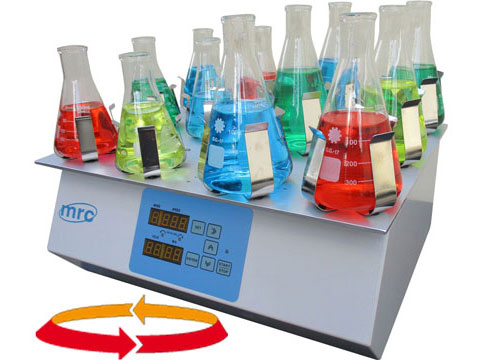
The orbit of an orbital shaker (the circular path the platform follows during shaking) has a major impact on the behavior of plant cell and tissue cultures,
especially on oxygen transfer, shear stress, and mixing uniformity.
Here’s a detailed breakdown:
What “Orbit” Means
The orbit (also called amplitude or stroke) is the diameter of the circular path that the shaker platform moves through — typically measured in millimeters (e.g. 3 mm, 19 mm, 25 mm, or 50 mm).
A small orbit = short circular path → gentle mixing.
A large orbit = wider circular path → stronger agitation and higher liquid movement.
How Orbit Affects Plant Tissue & Cell Cultures
A. Oxygen Transfer and Mixing
Large orbit (e.g. 25–50 mm):
Increases turbulence and oxygen transfer.
Beneficial for fast-growing or oxygen-demanding plant cells.
Reduces sedimentation of cell aggregates.
Enhances nutrient distribution throughout the medium.
Small orbit (e.g. 3–10 mm):
Provides gentle, laminar flow with minimal shear.
Preferred for fragile cells or delicate tissue suspensions, where excessive motion may cause mechanical damage.
Mixing is slower, which may create gradients in nutrients or oxygen in dense cultures.
Rule of thumb:
→ Larger orbit = higher oxygen transfer (kLa) but higher shear.
→ Smaller orbit = lower shear but potentially lower oxygen supply.
B. Shear Stress and Cell Integrity
Plant cells are larger and more fragile than microbial cells.
A too-large orbit at high speed can damage cell walls and membranes by shear forces or collisions with the flask surface.
A smaller orbit provides a smoother motion that minimizes damage — ideal for callus or suspension cultures that need long-term gentle shaking.
C. Aggregation and Suspension Behavior
Large orbit keeps heavier or aggregated cells suspended.
Small orbit may allow clumping or settling at the bottom, leading to uneven growth.
Choosing the right orbit depends on whether your goal is to encourage aggregation (for differentiation studies) or maintain single-cell suspensions (for growth studies).
D. Medium Evaporation and Wave Formation
With large orbits, surface waves and splashing can increase, accelerating evaporation — undesirable for long-term cultures in flasks.
Smaller orbits maintain steadier meniscus and lower evaporation rate.
3. Interaction with Shaking Speed (RPM)
Orbit and speed always interact — it’s not the orbit alone that matters, but the combination of orbit and speed, which determines the relative centrifugal force (RCF) experienced by the liquid.
Mixing intensity ∝ Orbit × (RPM)²
So, for the same mixing effect:
A larger orbit needs a lower speed.
A smaller orbit needs a higher speed.
4. Typical Ranges Used in Plant Tissue Culture
| Application | Typical Orbit | RPM Range | Notes |
| - | - | -- | - |
| Fragile cell suspensions (e.g. tobacco BY-2, carrot) | 10–19 mm | 80–120 rpm | Prevents shear damage |
| Compact aggregates / denser suspensions | 19–25 mm | 100–150 rpm | Improves oxygenation |
| Large-scale suspension culture in 1–2 L flasks | 25–50 mm | 80–100 rpm | For strong mixing and aeration |
| Delicate organ or tissue pieces | 3–10 mm | 60–90 rpm | Gentle motion, prevents tearing |
5. Practical Example
For example, tobacco BY-2 suspension cultures (a model plant cell line) are typically grown at 120 rpm on a shaker with 25 mm orbit, because that combination balances oxygenation and low shear.
If the orbit were reduced to 10 mm, the same mixing would require increasing speed to ~200 rpm, which might overheat the culture or cause foaming.
6. Summary Table
| Orbit Size | Mixing | Oxygen Transfer | Shear | Best For |
| - | -- | | -- | - |
| 3–10 mm | Gentle | Low | Minimal | Fragile tissues |
| 19–25 mm | Moderate | Medium | Moderate | Suspension cells |
| 50 mm | Vigorous | High | High | Dense / high-volume cultures |
Large orbit = better aeration and mixing → for robust or dense plant cell suspensions.
Small orbit = gentler motion → for sensitive tissues or early-stage callus.
Too large an orbit or too high RPM can destroy cells by shear stress or cavitation.
Munro supplies a wide range of Orbital Shakers