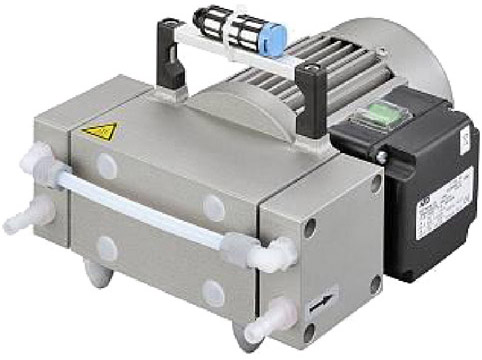
Laboratory vacuum pumps are used to remove air, vapours or gases from a system so that a lower-pressure environment can be created and maintained.
They support many common laboratory processes, including filtration, aspiration, rotary evaporation, vacuum drying, freeze drying, degassing, desiccation, manifolds, reactors and vacuum ovens.
Not every laboratory vacuum pump works in the same way. Some pumps are dry and oil-free. Some use oil for sealing and lubrication. Some are designed for chemical vapours. Others are intended for clean vacuum or deeper vacuum applications.
Choosing the right pump type is important because the wrong pump can cause poor performance, sample contamination, solvent damage, oil backstreaming, excessive maintenance or shortened pump life.
This guide compares the main types of laboratory vacuum pumps and explains where each type is most useful.
What Does a Laboratory Vacuum Pump Do?
A laboratory vacuum pump reduces pressure in a connected system.
This may be done to:
- Pull liquid through a filter
- Remove solvent vapour
- Lower the boiling point of a liquid
- Dry samples under reduced pressure
- Support a rotary evaporator
- Operate a vacuum oven
- Assist freeze drying
- Remove air from a desiccator
- Degas liquids
- Support aspiration or suction applications
- Create controlled low-pressure conditions
Munro’s vacuum pump category lists laboratory applications such as rotary evaporators, vacuum ovens, reactors, filtration, gel dryers, freeze dryers, concentrators, manifolds, cell culture and aspiration.
The Three Questions That Separate Pump Types
Before comparing pump technologies, it helps to ask three practical questions.
1. How Deep Must the Vacuum Be?
Some applications need only rough vacuum.
Examples:
Other applications need deeper vacuum.
Examples:
- Vacuum ovens
- Freeze drying
- Schlenk lines
- Some evaporative concentration methods
- High-vacuum systems
2. What Will Pass Through the Pump?
The pump may be exposed to:
- Air
- Water vapour
- Solvent vapour
- Acid vapour
- Corrosive gases
- Oil mist
- Biological aerosols
- Particles
- Condensable vapours
Chemical exposure is often the deciding factor in a laboratory.
3. Is Oil Acceptable?
Oil-sealed pumps can achieve deeper vacuum, but they require oil maintenance and may be damaged by solvent vapours if not protected.
Oil-free pumps avoid oil contamination and can reduce maintenance in many routine laboratory applications.
Main Types of Laboratory Vacuum Pumps
1. Diaphragm Vacuum Pumps
A diaphragm vacuum pump is a dry, oil-free pump.
It uses a flexible diaphragm that moves back and forth to draw gas into the pump chamber and push it out through valves.
Because the pumped gas does not contact oil, diaphragm pumps are popular in laboratories where clean operation and low maintenance are important.
The current Munro article correctly describes diaphragm pumps as dry pumps that move air through opening and closing valves, without requiring oil.
Best suited for:
- Vacuum filtration
- Aspiration
- Rotary evaporation
- Desiccators
- Degassing
- Gel drying
- Cell culture aspiration
- General laboratory vacuum
Main advantages:
- Oil-free operation
- Low maintenance
- Clean vacuum
- Good for many routine lab applications
- Can be chemically resistant when built with suitable materials
- No oil mist
- No oil changes
Main limitations:
- Usually not suitable for very high vacuum
- Pulsating flow may need damping in some applications
- Performance depends strongly on valve and diaphragm condition
- Strong solvent vapour exposure may still require a condenser or trap
Chemical-resistant diaphragm pumps
Chemical-resistant diaphragm pumps often use PTFE or similar chemically resistant wetted parts. This makes them useful for solvent vapours and corrosive laboratory environments.
They are often a strong choice for rotary evaporators, vacuum manifolds and chemical filtration when the required vacuum level is within their range.
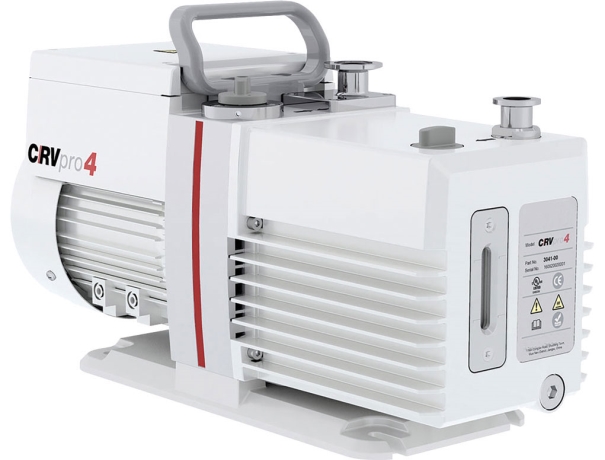
2. Rotary Vane Vacuum Pumps
A rotary vane vacuum pump is usually an oil-sealed pump.
It uses rotating vanes inside a chamber to compress and move gas from the inlet to the exhaust.
Oil helps seal, lubricate and cool the pump.
Rotary vane pumps are widely used because they can reach deeper vacuum than many dry diaphragm pumps. External vacuum technology references commonly describe rotary vane pumps as robust pumps used where deeper vacuum is required.
Best suited for:
- Vacuum ovens
- Freeze dryers
- Schlenk lines
- Degassing
- Deep vacuum drying
- Some analytical or industrial laboratory systems
- Applications needing stronger vacuum than a diaphragm pump can provide
Main advantages:
- Deeper vacuum capability
- Good pumping performance
- Widely available
- Suitable for many medium-to-deep vacuum tasks
- Robust when used correctly
Main limitations:
- Requires oil changes
- Oil can become contaminated by solvents or acids
- May produce oil mist if not filtered
- Not ideal for clean oil-free applications
- Needs traps or condensers when vapours are present
- More maintenance than many dry pumps
When rotary vane pumps work well
A rotary vane pump is often appropriate when the laboratory needs deeper vacuum and the pumped vapours can be controlled.
For solvent-rich applications, a cold trap, inlet trap or suitable protection system may be needed to prevent contamination of the oil.
3. Scroll Vacuum Pumps
A scroll vacuum pump is a dry pump that uses two spiral scrolls to compress gas.
One scroll remains fixed while the other moves in an orbital motion. This movement traps and compresses gas toward the exhaust.
Scroll pumps are oil-free and can provide deeper vacuum than many diaphragm pumps.
They are often used where clean vacuum is required without oil contamination.
Best suited for:
- Clean laboratory vacuum
- Analytical instruments
- Vacuum drying
- Vacuum ovens, depending on required vacuum level
- Glovebox support
- Backing pumps for high-vacuum systems
- Laboratories wanting oil-free operation with stronger vacuum than diaphragm pumps
Main advantages:
- Oil-free operation
- Cleaner than oil-sealed pumps
- Lower contamination risk
- Good vacuum performance
- Relatively quiet operation
- Lower oil-related maintenance
Main limitations:
- Higher purchase cost
- Tip seals wear and require replacement
- Not ideal for heavy solvent vapour loads unless protected
- Particles and condensable vapours can reduce performance
- Not always necessary for simple filtration or aspiration
Scroll pumps are useful when the laboratory needs clean dry vacuum but also requires stronger vacuum performance than a simple diaphragm pump.
4. Piston Vacuum Pumps
A piston vacuum pump uses a piston moving inside a cylinder to draw in and compress gas.
Some piston pumps are oil-free and are used for rough vacuum or general laboratory suction.
Best suited for:
- General laboratory vacuum
- Filtration
- Aspiration
- Educational laboratories
- Low to medium vacuum tasks
- Applications where oil-free operation is useful
Main advantages:
- Simple pumping principle
- Can be oil-free
- Useful for routine suction
- Often compact
- May be suitable for general-purpose vacuum
Main limitations:
- Usually not suitable for corrosive vapours unless designed for them
- Can be noisier or more pulsating than some alternatives
- Not ideal for deep vacuum
- Performance depends on seals and piston wear
Piston pumps can be useful for basic laboratory vacuum tasks, but they should be selected carefully if chemical vapours are present.
5. Water Aspirator Vacuum Pumps
A water aspirator creates vacuum using flowing water.
Water passes through a narrow section, creating suction that draws gas from the connected system.
Water aspirators are simple and inexpensive, but they are not ideal for many modern laboratory settings.
Best suited for:
- Simple educational demonstrations
- Occasional low-vacuum tasks
- Situations where water use and contamination risk are acceptable
Main advantages:
- Simple design
- No motor
- Low initial cost
- Easy to understand
- Useful for basic applications
Main limitations:
- Wastes water
- Vacuum level depends on water pressure and temperature
- Can contaminate drains with chemicals
- Risk of backflow into the apparatus
- Limited vacuum performance
- Poor control
- Often less suitable than modern dry pumps
For many laboratories, a diaphragm pump is a safer, cleaner and more controllable alternative to a water aspirator.
6. Dry Screw Vacuum Pumps
Dry screw vacuum pumps use two screw-shaped rotors to move gas through the pump without oil in the pumping chamber.
They are more common in industrial, process and demanding vacuum applications than in routine small laboratory tasks.
Best suited for:
- Process laboratories
- Larger vacuum systems
- Continuous operation
- Vapour handling, depending on design
- Applications needing robust dry pumping
- Scale-up environments
Main advantages:
- Dry pumping path
- Can handle larger gas loads
- Suitable for continuous duty
- No oil in pumping chamber
- Robust for demanding applications
Main limitations:
- Higher cost
- Larger footprint
- Often excessive for small benchtop tasks
- Needs correct specification for vapours and particles
- More complex than simple diaphragm or rotary vane pumps
A dry screw pump is normally selected for demanding laboratory or pilot-scale work rather than basic filtration.
7. Turbomolecular and High-Vacuum Pumps
Turbomolecular pumps and similar high-vacuum pumps are used when very low pressures are needed.
They use high-speed rotating blades to move gas molecules and are typically used with a backing pump.
Vacuum pump technologies are often grouped into positive displacement, momentum transfer and entrapment pumps. Momentum transfer pumps, such as turbomolecular pumps, are used with backing pumps to achieve high vacuum.
Best suited for:
- Mass spectrometry
- Electron microscopy
- Surface analysis
- Thin-film deposition
- High-vacuum research systems
- Semiconductor and materials research
Main advantages:
- Achieves high or ultra-high vacuum
- Essential for specialist instruments
- Clean high-vacuum performance
- Suitable for advanced research systems
Main limitations:
- Requires backing pump
- Expensive
- Sensitive to particles and improper operation
- Not suitable for ordinary filtration or aspiration
- Requires specialist installation and maintenance
High-vacuum pumps are not general laboratory vacuum pumps. They are selected for instruments and systems that require high or ultra-high vacuum.
Comparison Table: Laboratory Vacuum Pump Types
| Pump type | Oil-free? | Typical vacuum level | Good for | Main limitation |
|---|
| Diaphragm vacuum pump | Yes | Rough to medium vacuum | Filtration, aspiration, rotary evaporation, desiccators | Not for very deep vacuum |
| Rotary vane vacuum pump | No, usually oil-sealed | Medium to deeper vacuum | Vacuum ovens, freeze dryers, Schlenk lines | Oil maintenance and vapour sensitivity |
| Scroll vacuum pump | Yes | Medium to deeper vacuum | Clean vacuum, analytical systems, dry vacuum applications | Higher cost and seal maintenance |
| Piston vacuum pump | Often | Rough vacuum | General suction, filtration, basic lab use | Limited chemical resistance and depth |
| Water aspirator | Yes, water-driven | Rough vacuum | Simple low-vacuum tasks | Water waste, poor control, drain contamination risk |
| Dry screw vacuum pump | Yes | Rough to medium, model dependent | Process labs, continuous duty, larger systems | Cost and size |
| Turbomolecular pump | Yes, but needs backing pump | High to ultra-high vacuum | Mass spectrometry, electron microscopy, research systems | Not for routine lab suction |
Choosing by Application
Vacuum filtration
For vacuum filtration, a diaphragm vacuum pump is usually the best starting point.
It is oil-free, clean and suitable for many aqueous or solvent filtration tasks.
If the vapour load is corrosive, use a chemical-resistant diaphragm pump.
Rotary evaporation
For rotary evaporation, the pump must match the solvent and required boiling conditions.
A chemical-resistant diaphragm vacuum pump is often suitable for many rotary evaporator applications because it is oil-free and can handle solvent vapours better when properly protected.
For higher-boiling solvents or deeper vacuum needs, another pump type may be required.
Vacuum ovens
Vacuum ovens may require deeper vacuum than simple filtration.
Rotary vane pumps, scroll pumps or selected dry pumps may be suitable depending on the required pressure, vapour load and contamination risk.
Munro’s vacuum pump category notes that oil vacuum pumps can be suitable for vacuum ovens and freeze drying.
Freeze drying
Freeze drying usually requires deeper vacuum and careful vapour management.
Rotary vane pumps are commonly used, but they should be protected from water vapour and condensables.
Scroll pumps or dry pumps may be considered where oil-free operation is required and the system design supports it.
Desiccators
For desiccators, a diaphragm pump is often sufficient.
The pump does not need to be oversized unless faster evacuation or deeper vacuum is required.
Aspiration
For aspiration and cell culture suction, oil-free diaphragm or piston pumps are common options.
If biological material is involved, use suitable collection flasks, overflow protection and filters according to the laboratory procedure.
Schlenk lines
Schlenk line work often needs deeper vacuum and chemical resistance.
Rotary vane pumps are commonly used, usually with cold traps and protection systems.
Why Chemical Resistance Matters
Chemical resistance is one of the most important differences between laboratory vacuum pumps.
Solvent vapours, acids and corrosive gases can damage seals, diaphragms, oil, valves and internal surfaces.
When chemical vapours are expected, check:
- Wetted materials
- Diaphragm and valve materials
- Solvent compatibility
- Acid resistance
- Vapour handling
- Inlet trap requirement
- Exhaust management
- Condenser requirement
- Maintenance interval
A pump that works well with air may fail quickly when exposed to aggressive vapours.
Oil-Free vs Oil-Sealed Pumps
Oil-free pumps
Oil-free pumps include diaphragm pumps, many piston pumps, scroll pumps and dry screw pumps.
They are useful when:
- Oil contamination must be avoided
- Maintenance should be reduced
- Exhaust oil mist is not acceptable
- The application involves routine lab suction
- Clean operation is important
Oil-sealed pumps
Oil-sealed pumps, such as many rotary vane pumps, are useful when deeper vacuum is required.
They are useful when:
- The application needs lower pressure
- Vapour exposure can be controlled
- Oil maintenance is acceptable
- Traps and exhaust filters can be used
- The pump is matched to the process
The decision is not simply “oil-free is better” or “oil pumps are stronger”. The correct choice depends on the application.
Common Mistakes When Selecting a Laboratory Vacuum Pump
Common mistakes include:
- Choosing only by ultimate vacuum
- Ignoring pumping speed
- Using an oil pump with heavy solvent vapours and no trap
- Using a water aspirator for chemical vapours that may enter drains
- Choosing a pump that is not chemically resistant
- Oversizing a pump for simple filtration
- Using a diaphragm pump where deeper vacuum is needed
- Ignoring exhaust management
- Forgetting noise level in shared laboratories
- Not checking tubing and connection sizes
- Ignoring condensation and liquid carryover
- Treating all vacuum pumps as interchangeable
- Forgetting maintenance costs