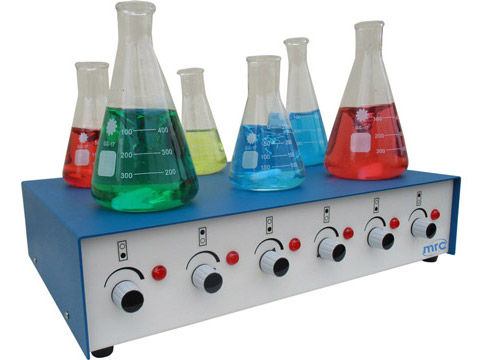
A magnetic stirrer is one of the most common mixing devices used in laboratories.
It uses a rotating magnetic field to spin a small magnetic stir bar inside a liquid. As the stir bar rotates, it mixes the contents of the vessel without requiring a mechanical shaft to enter the liquid.
Magnetic stirrers are widely used in chemistry, biology, education, quality control, sample preparation and routine laboratory work.
Although the basic principle is simple, not all magnetic stirrers are the same. The right model depends on the liquid volume, viscosity, required speed control, heating requirement, vessel size and number of samples being processed.
This guide compares the main types of magnetic stirrers and explains when each one is most suitable.
How a Magnetic Stirrer Works
A magnetic stirrer has a magnet or electromagnetic drive inside the base.
A coated magnetic stir bar is placed inside the liquid vessel. When the drive magnet rotates, it causes the stir bar to rotate inside the liquid.
This creates a vortex or circulation pattern that mixes the liquid.
A magnetic stirrer is commonly used for small to medium liquid volumes, especially where manual stirring is impractical or where continuous mixing is required.
A magnetic stirrer uses a rotating magnetic field to make a stir bar spin inside the liquid; the rotating field may be generated by a rotating magnet or by stationary electromagnets beneath the vessel.
1. Basic Magnetic Stirrer
A basic magnetic stirrer is designed for stirring only, without heating.
It is suitable for simple mixing tasks where temperature control is not required.
Best suited for:
- Mixing aqueous solutions
- Dissolving powders
- Buffer preparation
- Routine laboratory mixing
- Education laboratories
- Low-viscosity liquids
- Short or medium-duration stirring
Advantages:
- Simple to operate
- Usually compact
- Lower cost than heated models
- Suitable for everyday laboratory use
- Less heat-related risk
Limitations:
- No heating function
- Limited performance with viscous liquids
- Less suitable for temperature-dependent reactions
- May not provide advanced speed control
A basic magnetic stirrer is often the right choice when the laboratory only needs mixing, not heating.
2. Mini Magnetic Stirrer
A mini magnetic stirrer is a compact unit designed for small vessels and limited bench space.
It is useful when the sample volume is small, the workspace is crowded or multiple small workstations need simple stirring.
The existing MUNRO article correctly notes that mini stirrers are relatively small and work on the same basic principle as larger magnetic stirrers: a rotating magnetic field drives a stir bar inside the liquid.
Best suited for:
- Small beakers
- Small-volume samples
- Teaching laboratories
- Portable setups
- Limited bench space
- Routine low-viscosity mixing
Advantages:
- Saves bench space
- Easy to move
- Simple operation
- Useful for small containers
Limitations:
- Lower stirring capacity
- Limited torque
- Not ideal for viscous liquids
- Not suitable for large vessels
A mini stirrer is practical when the sample is small and the mixing requirement is not demanding.
3. Magnetic Stirrer with Timer
A magnetic stirrer with a timer allows the user to set a defined mixing duration.
When the programmed time ends, the stirrer stops automatically or completes the set operation according to the model design.
The current article mentions a magnetic stirrer with built-in timer, but the wording should be corrected and made more technical.
Best suited for:
- Repeated mixing procedures
- Timed dissolution
- Quality-control routines
- Teaching labs
- Sample preparation workflows
- Procedures requiring consistent mixing time
Advantages:
- Improves repeatability
- Reduces manual monitoring
- Useful for routine methods
- Helps avoid over-mixing or under-mixing
Limitations:
- Timer alone does not control mixing quality
- Still depends on stir bar size, vessel shape and viscosity
- Not a replacement for process monitoring in critical work
A timer is useful when the laboratory repeats the same mixing step many times.
4. Digital Magnetic Stirrer
A digital magnetic stirrer provides clearer control over speed and, depending on the model, time, programmes or operating status.
Instead of a simple dial, it usually includes a digital display.
Best suited for:
- Repeatable laboratory methods
- Quality-control procedures
- Work requiring defined speed settings
- Longer mixing operations
- Laboratories needing better process control
Advantages:
- More precise speed setting
- Easier to repeat methods
- Clearer display
- Better for documented procedures
- May include alarms or safety features
Limitations:
- Higher cost than analogue units
- More controls than needed for simple tasks
- Performance still depends on torque and magnetic coupling
Digital control is useful when consistency matters more than basic manual operation.
5. Hotplate Magnetic Stirrer
A hotplate magnetic stirrer combines stirring with heating.
This is one of the most useful and common laboratory configurations. It allows a liquid to be mixed while being heated on the same unit.
Hotplate stirrers are widely used because they integrate a heating element with a magnetic stirring system, allowing simultaneous heating and mixing of liquid samples.
Best suited for:
- Dissolving solids with heat
- Chemical reactions
- Sample preparation
- Buffer preparation
- Media preparation
- Temperature-assisted mixing
- Low to medium viscosity liquids
Advantages:
- Heating and stirring in one unit
- Saves bench space
- Improves temperature distribution in liquids
- Useful for many routine lab processes
- Can reduce hot spots when stirring is effective
Limitations:
- Plate temperature is not always the same as liquid temperature
- Not suitable for all flammable solvent work
- Requires correct vessel size and stir bar
- Heating viscous samples may require more torque
- Some applications need external temperature probe control
When selecting a hotplate stirrer, consider liquid volume, viscosity, maximum temperature, vessel dimensions and required temperature accuracy.
6. Multi-Position Magnetic Stirrer
A multi-position magnetic stirrer allows several vessels to be stirred at the same time.
Some units provide the same speed across all positions, while more advanced models allow independent control for each position.
Multi-point magnetic stirrers are available with different numbers of stirring points, such as 4, 6, 15 or 60 positions, depending on laboratory throughput requirements.
Best suited for:
- Parallel sample preparation
- Repetitive testing
- Screening work
- Teaching laboratories
- Quality control
- Multiple small-volume vessels
Advantages:
- Saves bench space
- Improves throughput
- Helps standardise repeated procedures
- Can process several samples together
- Useful for routine repetitive work
Limitations:
- Less flexible for large vessels
- Position-to-position performance must be checked
- Some models do not allow independent control
- Heating versions may require careful temperature uniformity checks
A multi-position stirrer is useful when the laboratory needs to process many similar samples at the same time.
7. Heavy-Duty Magnetic Stirrer
A heavy-duty magnetic stirrer is designed for larger volumes, higher viscosity or longer operating periods.
It uses a stronger magnetic drive and more robust motor system to maintain coupling between the stir bar and the drive.
The current article mentions powerful stirrers that use stronger magnetic drive systems and robust motors for challenging conditions, but this section needs a proper heading and cleaner structure.
Best suited for:
- Larger liquid volumes
- More viscous liquids
- Production support
- Pilot laboratory work
- Long-duration stirring
- Larger vessels
- Applications requiring stronger torque
Advantages:
- Stronger stirring performance
- Better for larger volumes
- More durable for intensive use
- Lower risk of stir bar decoupling under load
- Suitable for demanding laboratory workflows
Limitations:
- Larger footprint
- Higher cost
- May be excessive for small samples
- Requires correct vessel and stir bar selection
Heavy-duty stirrers should be chosen when standard compact stirrers cannot maintain stable mixing.
8. Motorless or Inductive Magnetic Stirrer
Some magnetic stirrers use motorless or inductive drive systems rather than traditional mechanical motor rotation.
These designs can be useful when quiet operation, low wear or compact construction is important.
Best suited for:
- Long-duration stirring
- Quiet laboratories
- Compact benches
- Low-maintenance applications
- Controlled environments
- Incubators or water baths, depending on model suitability
Advantages:
- Quiet operation
- Fewer moving parts
- Low wear
- Compact design
- Useful for continuous mixing
Limitations:
- May have lower torque than heavy-duty models
- Not suitable for every vessel or liquid
- Model specifications must be checked carefully
This type is useful when continuous reliable stirring is needed without high mechanical wear.
Magnetic Stirrer Comparison Table
| Type of magnetic stirrer | Best for | Main advantage | Main limitation |
|---|
| Basic magnetic stirrer | Routine mixing | Simple and economical | No heating |
| Mini magnetic stirrer | Small volumes | Saves space | Limited torque |
| Stirrer with timer | Repeated timed mixing | Better repeatability | Timer does not ensure mixing quality |
| Digital magnetic stirrer | Defined methods | Accurate speed setting | Higher cost |
| Hotplate magnetic stirrer | Heating and mixing | One unit for heat and stir | Needs temperature and safety control |
| Multi-position stirrer | Several samples | Higher throughput | Less flexible for large vessels |
| Heavy-duty stirrer | Larger or viscous samples | Stronger magnetic coupling | Larger and more expensive |
| Motorless stirrer | Quiet continuous work | Low wear | Check torque limitations |
Choosing by Laboratory Scenario
Scenario 1: Preparing Buffers
A basic or digital magnetic stirrer is usually suitable.
If heating is needed to dissolve the components, a hotplate magnetic stirrer may be better.
Scenario 2: Heating a Chemical Solution
A Laboratroy hotplate magnetic stirrer is usually the most practical option.
For better temperature control, use a model with external probe compatibility.
Scenario 3: Running Several Samples at Once
A multi-position magnetic stirrer is the better choice.
If each sample needs different speeds or temperatures, choose a model with independent control.
Scenario 4: Working with Small Volumes
A mini magnetic stirrer may be enough.
Check that the vessel sits securely and that the stir bar is the correct size.
Scenario 5: Mixing Viscous Liquids
A heavy-duty magnetic stirrer may be required.
If the liquid is very viscous, an overhead stirrer may be more appropriate than a magnetic stirrer.
Scenario 6: Continuous Stirring for Long Periods
A digital, heavy-duty or motorless stirrer may be suitable, depending on sample volume and viscosity.
Check duty cycle, motor type and heat generation.
Important Selection Factors
Stirring Volume
The published stirring volume is often based on water.
A stirrer rated for 10 litres of water may not stir 10 litres of viscous liquid effectively.
Viscosity
Higher viscosity requires stronger torque.
If the stir bar stops spinning, jumps or loses coupling, the stirrer may be underpowered for the liquid.
Vessel Shape
Flat-bottom vessels usually work better than vessels with curved or uneven bases.
The vessel should sit centrally on the stirring position.
Stir Bar Size
The stir bar must match the vessel and volume.
A stir bar that is too small may not mix effectively. A stir bar that is too large may become unstable.
Speed Range
Higher speed is not always better.
Excessive speed can create splashing, vortexing, air bubbles or loss of magnetic coupling.
Heating Requirement
If heating is needed, choose a hotplate stirrer rather than a stirrer-only model.
For temperature-sensitive work, consider external probe control.
Chemical Resistance
The top plate and housing must tolerate the expected chemical exposure.
Ceramic or coated surfaces may be useful for chemical resistance and cleaning.
Common Mistakes When Choosing a Magnetic Stirrer
Common mistakes include:
- Choosing a mini stirrer for a large vessel
- Selecting by maximum volume without checking viscosity
- Assuming water-based capacity applies to all liquids
- Using a stir bar that is too small
- Using a vessel that is not suitable for magnetic stirring
- Buying a hotplate stirrer when no heating is required
- Heating flammable solvents without suitable controls
- Expecting one stirrer to handle every vessel size
- Ignoring whether speed control must be digital or analogue
- Choosing a multi-position unit without checking independent control
- Using magnetic stirring when an overhead stirrer is needed