Research and development laboratories in the food, cosmetics, medical and other industries need professional, efficient and reliable storage, refrigeration and freezing means. Various companies manufacture refrigerators and freezers designed for research laboratories - what are the standards and requirements by which the refrigerators are measured, while refrigerators for research laboratories exist on the market - about this in the following lines.
Safety Standard For Refrigerators
Different materials need different storage conditions, and when it comes to materials for research purposes in the food, cosmetics, and medical industries, adherence to appropriate refrigeration and freezing storage procedures is essential to maintaining standards of hygiene, public health, and research integrity. For this purpose, it must be purchased in accordance with a standard that defines the conditions for storage, cooling and transportation of preparations and pharmaceuticals in industry, retail chains, pharmacies and research laboratories.
A Variety of Refrigerators and Freezers
Laboratory equipment companies and manufacturers specializing in the production of refrigerators and freezers offer a variety of models of refrigerators and freezers with different volumes and cooling temperatures, as needed. The models differ from each other in cooling temperature, storage volume and design, with advanced cooling technologies enabling control and monitoring of the temperature in the storage compartments Among other things, you will find refrigerators adapted for blood storage, freezers for deep freezing at temperatures of up to minus 60 degrees Celsius, compact refrigerators, and refrigerators adapted for storing delicate materials, which require particularly controlled and stable storage conditions.
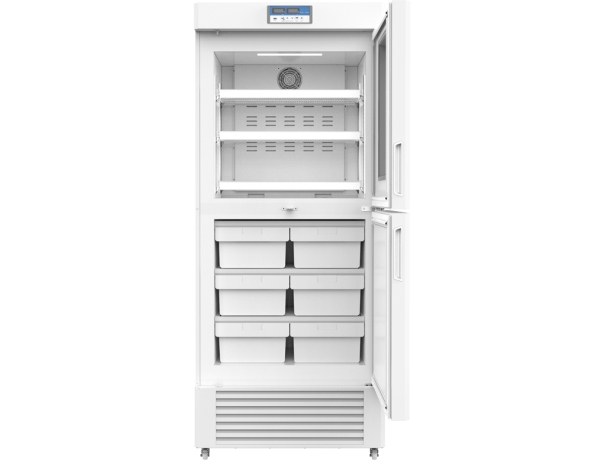
1. Laboratory Refrigerators (General-Purpose)
-
Temperature Range: 2°C to 10°C
-
Use: General storage of reagents, samples, and media not requiring ultra-low temps.
-
Features: Adjustable shelves, temperature alarms, and glass or solid doors.
-
Typical Applications: Biological samples, reagents, vaccines, and buffers.
2. Flammable Material Refrigerators (Explosion-Proof / Spark-Free)
-
Use: Storage of flammable or volatile substances.
-
Safety Features: No internal sparks; components isolated to prevent ignition.
-
Regulations: Comply with OSHA, NFPA, and other safety standards.
-
Types:
-
Explosion-Proof (External & Internal) – Can be placed in hazardous environments.
-
Flammable-Safe (Internal Only) – Only safe for storage, not external ignition resistance.
3. Blood Bank Refrigerators
-
Temperature Range: 2°C to 6°C
-
Use: Storage of blood, plasma, and blood components.
-
Standards: AABB, FDA, and CDC compliance.
-
Features: Forced-air cooling, digital temperature controls, and chart recorders.
4. Pharmacy / Vaccine Refrigerators
-
Temperature Range: 2°C to 8°C
-
Use: Storage of vaccines, drugs, and sensitive pharmaceuticals.
-
Standards: CDC and WHO guidelines.
-
Features: Uniform temperature distribution, temperature data logging, alarms.
5. Undercounter / Compact Lab Refrigerators
6. Dual Temperature Refrigerators / Fridge-Freezer Combos
7. Ultra-Low Temperature Refrigerators (for High Precision)
Validation
All laboratory refrigerators for use in laboratories must meet a safety standard, as well as pass validation tests - documented proof, confirmation that they meet the standards, required conditions, and product description. Refrigerators and freezers for laboratories must pass validation tests, there are several tests, among them three necessary validation tests:
IQ - Validation for installation of the device
OP - Validation of system activity
PQ - Validation for system performance.
When purchasing refrigerators for your research lab, purchase refrigerators that meet safety standards, and IQ, OQ, and PQ tests. If the vendor can not provide certificates confirming compliance with validation standards, look for another vendor.
In conclusion, the advanced cooling technologies available today allow research laboratory operators to purchase refrigerators and freezers that are specifically tailored to the needs of the laboratory, and to store the materials used by the research team. Appropriate refrigeration and freezing equipment allows the team to store the materials in optimal conditions, thus conducting quality and reliable research. Laboratory refrigerators allow researchers to store research materials in ideal conditions, while maintaining stable storage temperature and storage conditions.