Laboratory stirring is not one single technique.
A small tube of reagent, a beaker of buffer, a viscous polymer solution and a rack of cell culture flasks do not require the same mixing equipment.
Some samples need gentle agitation. Others need strong mechanical torque. Some need heating while being mixed. Others must be mixed quickly in small tubes or kept moving for long periods under controlled conditions.
This guide explains the main types of laboratory stirrers and mixers, how they differ, and which applications they are best suited for.
Start with the Sample, Not the Stirrer
The best way to choose a laboratory stirrer is to begin with the material being mixed.
Ask:
- Is the sample liquid, suspension, gel, powder mixture or emulsion?
- What is the sample volume?
- How viscous is it?
- Does it need heating?
- Does it need gentle or vigorous mixing?
- Is the sample in a tube, beaker, flask, bottle or microplate?
- Is one sample being processed or many samples at once?
- Is continuous mixing required?
- Is the sample fragile, biological or shear-sensitive?
- Does the process need repeatable speed and time settings?
A magnetic stirrer may be ideal for a low-viscosity liquid in a beaker.
An overhead stirrer may be better for a large or viscous sample.
A vortex mixer is useful for quick mixing in small tubes.
A shaker is often better when many flasks or tubes need continuous agitation.
1. Magnetic Stirrers
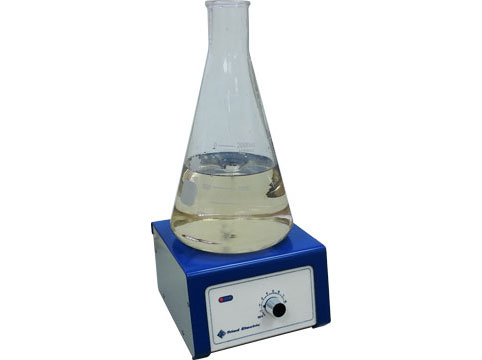
A magnetic stirrer uses a rotating magnetic field to spin a magnetic stir bar inside a vessel.
The stir bar rotates in the liquid and creates circulation or a vortex.
Magnetic stirrers are widely used in chemistry and biology because they provide simple, clean and continuous mixing without a mechanical shaft entering the sample. A magnetic stirrer uses a rotating magnetic field to move a stir bar, also called a flea, inside the liquid.
Best suited for:
- Aqueous solutions
- Buffers
- Reagents
- Low-viscosity liquids
- Dissolving solids
- Titrations
- Routine sample preparation
- Small to medium beaker volumes
Main advantages:
- Simple to use
- Clean mixing method
- No stir shaft enters the liquid
- Suitable for many routine applications
- Available with or without heating
- Can be compact and economical
Main limitations:
- Not ideal for very viscous liquids
- Stir bar may lose coupling at high speed
- Vessel shape affects performance
- Not suitable for every sample volume
- Not ideal for materials that contain large solids
Magnetic stirrers are often the first choice for routine liquid mixing, but they are not universal mixers.
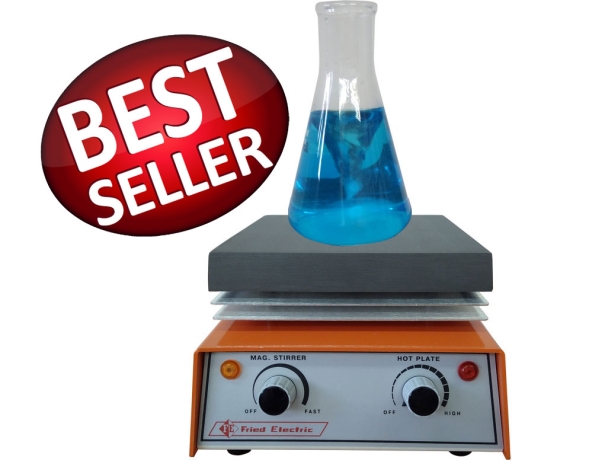
2. Hotplate Magnetic Stirrers
A hotplate magnetic stirrer combines two functions:
- Heating
- Magnetic stirring
It allows the user to heat a liquid while mixing it continuously.
This is useful when a solid dissolves faster at higher temperature, when a reaction requires heat, or when a solution must be kept warm during mixing.
Best suited for:
- Heating solutions
- Dissolving solids
- Buffer preparation
- Chemical reactions
- Media preparation
- Temperature-assisted mixing
- Low to medium viscosity liquids
Main advantages:
- Heating and stirring in one unit
- Saves bench space
- Helps improve heat distribution
- Useful for routine laboratory preparation
- Can support more repeatable procedures when temperature is controlled
Main limitations:
- Plate temperature is not always liquid temperature
- Flammable solvents require risk assessment and ventilation
- Stirring may not be enough for viscous samples
- External probe control may be needed for accurate liquid temperature
A Laboratory hotplate stirrer is suitable when both heat and mixing are needed. If the task is only mixing, a non-heated stirrer may be simpler and safer.
3. Overhead Stirrers
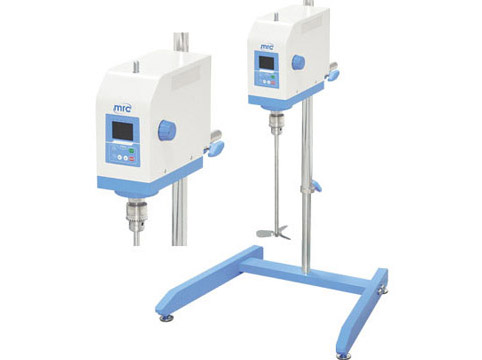
An overhead stirrer uses a motor mounted above the vessel.
A shaft and impeller extend down into the liquid and mechanically stir the sample.
This makes overhead stirrers more powerful than magnetic stirrers for larger volumes and higher viscosities.
Overhead stirrers are commonly used when a magnetic stir bar is not strong enough. Supplier and distributor references describe overhead stirrers as suitable for larger volumes, viscous liquids, formulations, emulsions and polymer solutions.
Best suited for:
- Viscous liquids
- Gels
- Emulsions
- Suspensions
- Polymer solutions
- Larger volumes
- Formulations
- Pilot laboratory mixing
- Samples requiring stronger torque
Main advantages:
- Stronger mixing power
- Works with higher viscosity materials
- Different impellers can be used
- Better for larger vessels
- More suitable for formulation work
- Can handle processes where magnetic stir bars fail
Main limitations:
- Requires stand, clamp and proper setup
- Shaft enters the sample
- More cleaning is required
- More mechanical safety considerations
- Incorrect impeller choice can give poor mixing
Choose an overhead stirrer when the sample is too viscous, too large or too demanding for magnetic stirring.
4. Vortex Mixers
A vortex mixer is used for rapid mixing of small tubes or vials.
The user presses a tube onto a rubber cup or platform. The off-centre motion creates a vortex inside the tube and mixes the contents quickly.
Vortex mixers are common in bioscience laboratories and are used for small vials or tubes of liquid.
Best suited for:
- Microcentrifuge tubes
- Test tubes
- Small vials
- PCR preparation
- Resuspending pellets
- Quick reagent mixing
- Small-volume biological samples
- Short mixing steps
Main advantages:
- Very fast mixing
- Simple operation
- Useful for small tubes
- Touch mode or continuous mode
- Compact bench footprint
- Common in biology labs
Main limitations:
- Not suitable for large volumes
- Not designed for long-term mixing of large vessels
- Can create foaming
- May not be suitable for fragile samples
- Mixing intensity depends on tube size and user technique
Use a vortex mixer for quick small-volume mixing, not for sustained beaker or flask mixing.
5. Platform Shakers
A platform shaker moves an entire platform, tray or flask holder.
Instead of stirring a liquid from inside the vessel, it agitates the whole container from the outside.
Platform shakers are used to mix, blend or agitate substances in tubes, flasks or beakers by shaking them.
Best suited for:
- Erlenmeyer flasks
- Bottles
- Beakers
- Culture vessels
- Multiple samples
- Long-duration agitation
- Biological cultures
- Staining or washing procedures
Main advantages:
- Can mix several vessels at once
- Useful for flasks and bottles
- Good for continuous agitation
- Can be gentler than direct mechanical stirring
- Many platform options are available
Main limitations:
- Requires correct clamps or platforms
- Less suitable for very viscous materials
- Not as strong as overhead stirring
- Occupies more bench or incubator space
- Motion type must match the application
Platform shakers are often better than stirrers when many vessels need to be agitated at the same time.
6. Orbital Shakers
An orbital shaker moves the platform in a circular motion.
This motion is useful for keeping liquids moving in flasks, bottles or plates.
Orbital shakers are commonly used for biological and chemical applications where continuous, controlled agitation is required. General laboratory references describe orbital shakers as using circular shaking motion, often at low to moderate speeds.
Best suited for:
- Cell culture flasks
- Microbial culture
- Solubility testing
- Washing procedures
- General sample agitation
- Incubated shaking when combined with temperature control
Main advantages:
- Good for multiple vessels
- Suitable for long runs
- Controlled agitation
- Common in biology and chemistry labs
- Can be used with clamps, trays and flask holders
Main limitations:
- Not intended for high-viscosity mixing
- Requires secure vessel holding
- Can spill if speed is too high
- Not suitable when direct strong shear is needed
Orbital shakers are often selected when the sample should be kept moving without placing a stir bar or shaft inside it.
7. Rocking and 3D Shakers
Rocking and 3D shakers provide gentle tilting or wave-like motion.
They are useful when the sample needs movement but not vigorous mixing.
Best suited for:
- Blot washing
- Gel staining
- Gentle biological mixing
- Containers with shallow liquid layers
- Sample washing
- Incubation steps
- Fragile samples
Main advantages:
- Gentle motion
- Good surface coverage
- Useful for staining and washing
- Reduces aggressive shear
- Can handle trays and shallow containers
Main limitations:
- Not suitable for dissolving difficult solids
- Not designed for viscous materials
- Slower mixing than vortex or overhead stirring
- Limited to certain vessel formats
Choose a rocking or 3D shaker when gentle, even movement is more important than strong mixing force.
8. Rotators and Tube Rollers
Rotators and tube rollers mix samples by slowly rotating tubes, bottles or vessels.
They are useful where samples must stay suspended without aggressive agitation.
Best suited for:
- Blood tubes
- Biological samples
- Hybridisation tubes
- Gentle reagent mixing
- Cell suspensions
- Tube-based incubation
- Samples that should not foam
Main advantages:
- Gentle continuous mixing
- Good for tubes
- Lower shear than vortexing
- Useful for long incubation steps
- Can reduce settling
Main limitations:
- Slow mixing
- Not suitable for rapid dissolution
- Limited vessel compatibility
- Not suitable for high-viscosity materials
Rotators and rollers are useful when the sample must remain mixed gently over time.
9. Homogenizers and Dispersers
A homogenizer or disperser is not a simple stirrer.
It is used when the goal is to break down, disperse, emulsify or homogenise a sample.
These instruments generate stronger mechanical action than ordinary stirring.
Best suited for:
- Tissue disruption
- Emulsions
- Suspensions
- Particle size reduction
- Sample preparation
- Food, cosmetic or pharmaceutical formulations
- Dispersing powders into liquids
Main advantages:
- Strong mechanical action
- Better for difficult dispersions
- Can reduce particle size
- Useful for emulsification
- Suitable for demanding sample preparation
Main limitations:
- More shear
- Can heat the sample
- More cleaning required
- Not suitable for delicate samples
- May require vessel shielding or safety controls
Use a homogenizer when the goal is more than mixing, such as breaking material down or creating a fine dispersion.
Quick Selection Table
| Laboratory task | Better equipment choice | Why |
|---|
| Mixing a buffer in a beaker | Magnetic stirrer | Simple continuous liquid mixing |
| Heating and dissolving a solid | Hotplate magnetic stirrer | Heat and stirring together |
| Mixing a viscous gel | Overhead stirrer | Stronger torque |
| Quick mixing in a microtube | Vortex mixer | Fast small-volume mixing |
| Agitating several flasks | Orbital shaker | Handles multiple vessels |
| Gentle blot washing | Rocking or 3D shaker | Gentle surface movement |
| Keeping blood tubes mixed | Tube roller or rotator | Gentle continuous rotation |
| Preparing an emulsion | Homogenizer or disperser | Strong mechanical action |
| Mixing many similar beakers | Multi-position magnetic stirrer | Parallel sample processing |
Magnetic Stirrer vs Overhead Stirrer
This is one of the most common decisions.
Choose a magnetic stirrer when:
- The liquid is low viscosity
- The vessel is small to medium
- A stir bar can rotate freely
- Clean and simple mixing is required
- The sample does not contain large solids
- Heating may be needed with a hotplate version
Choose an overhead stirrer when:
- The liquid is viscous
- The volume is larger
- Stronger torque is needed
- The sample contains solids or suspensions
- Different impeller types are required
- A magnetic stir bar loses coupling
In simple terms:
Magnetic stirrer = simple liquid mixing Overhead stirrer = stronger mechanical mixing
Stirrer vs Shaker
A stirrer mixes from within the sample or vessel.
A shaker moves the entire vessel.
Choose a stirrer when:
- One vessel needs controlled mixing
- A beaker or flask is open
- A stir bar or impeller can be used
- Direct mixing force is needed
Choose a shaker when:
- Several vessels need agitation
- Flasks or tubes must be moved together
- Gentle continuous motion is required
- A stir bar should not be placed inside the sample
- Biological cultures or washing steps are involved
What to Check Before Choosing Any Laboratory Stirrer
Sample Volume
A stirrer must be suitable for the smallest and largest volumes used in the laboratory.
Viscosity
Viscosity is often the deciding factor.
Water-like liquids are easy to stir. Gels, syrups, emulsions and polymer solutions need more torque.
Vessel Type
The vessel affects mixing performance.
Check whether the sample is in:
- Microtube
- Test tube
- Beaker
- Erlenmeyer flask
- Bottle
- Round-bottom flask
- Microplate
- Tray
- Large vessel
Mixing Purpose
Different goals need different tools.
Examples:
- Dissolving
- Suspending
- Resuspending
- Heating
- Homogenising
- Emulsifying
- Washing
- Incubating
- Preventing settling
Temperature Requirement
If the sample must be heated, choose a hotplate stirrer, heated shaker, incubator shaker or another temperature-controlled solution.
Shear Sensitivity
Some biological samples are sensitive to aggressive mixing.
In those cases, gentle rocking, rolling or orbital shaking may be better than vortexing or homogenising.
Number of Samples
For one beaker, a single stirrer may be enough.
For many samples, consider:
- Multi-position magnetic stirrer
- Platform shaker
- Orbital shaker
- Tube rotator
- Microplate shaker
Common Mistakes When Selecting Laboratory Stirrers
Common mistakes include:
- Choosing by price instead of sample requirement
- Using a magnetic stirrer for a liquid that is too viscous
- Using a vortex mixer for volumes that are too large
- Forgetting that a hotplate setting is not always sample temperature
- Choosing a shaker when direct stirring is needed
- Choosing an overhead stirrer without the correct impeller
- Ignoring vessel shape
- Using excessive speed and causing splashing
- Mixing shear-sensitive samples too aggressively
- Assuming one stirrer type can handle every laboratory task
- Forgetting cleaning and chemical compatibility
