Ultrasonic Flowmeter Questions and Answers You Need to Know
1. How does an ultrasonic flowmeter measure flow without moving parts?
An ultrasonic flowmeter measures fluid velocity using high-frequency sound waves instead of mechanical components. It transmits ultrasonic pulses through the fluid; the time difference or frequency shift between upstream and downstream signals is proportional to the flow velocity. Because there are no moving parts, these meters experience minimal wear, require less maintenance, and maintain long-term stability even in corrosive or abrasive environments.
2. What is the working principle of a transit-time ultrasonic flowmeter?
Transit-time flowmeters work by sending ultrasonic pulses alternately with and against the direction of flow between two transducers. When fluid moves, the downstream pulse travels faster than the upstream pulse. The difference in transit times (Δt) is directly proportional to the flow velocity V=(K×Δt)/(t1t2)V = (K × Δt) / (t₁t₂)V=(K×Δt)/(t1t2), where KKK is a calibration constant. These meters are ideal for clean, single-phase fluids with low particulate content.
3. How does a Doppler ultrasonic flowmeter differ from a transit-time type?
A Doppler ultrasonic flowmeter relies on the Doppler effect: it measures the frequency shift between emitted and reflected ultrasonic waves from particles or bubbles in the moving fluid. Transit-time meters need clean fluids, while Doppler meters require some degree of suspended solids or gas bubbles to reflect the signal. Thus, Doppler types are suited for wastewater, slurries, or aerated liquids.
4. What type of fluids can ultrasonic flowmeters measure (liquid, gas, slurry)?
Ultrasonic flowmeters can measure:
- Liquids: Clean water, chemicals, hydrocarbons, oils.
- Gases: Compressed air, natural gas, steam (using specialized designs).
- Slurries: Wastewater, sludge, pulp, and cement slurry (Doppler type).
Compatibility depends on signal attenuation and acoustic coupling through the medium.
5. How does sound velocity relate to flow rate measurement?
Sound velocity in a fluid depends on its density and compressibility. Ultrasonic flowmeters measure this velocity to correct flow calculations. The flow rate Q=A×VQ = A × VQ=A×V, where AAA is the pipe cross-sectional area and VVV is the average velocity derived from sound propagation time. Accurate velocity determination is essential, especially when temperature or composition varies.
6. What are the requirements for straight pipe lengths upstream and downstream?
To ensure laminar, stable flow, ultrasonic flowmeters require straight runs:
- Upstream: 10 to 20 pipe diameters.
- Downstream: 5 to 10 pipe diameters.
These distances minimize flow disturbances caused by elbows, valves, or reducers that could distort readings.
7. How does pipe diameter and wall thickness affect measurement accuracy?
The acoustic path length depends on pipe diameter and wall thickness. Incorrect configuration can shift the beam angle or alter signal transmission. Calibration constants must match the exact internal diameter, wall material, and acoustic impedance. Thick or coated pipes may weaken the signal and require stronger transducers or different frequencies.
8. Can an ultrasonic flowmeter be installed on plastic or lined pipes?
Yes. Ultrasonic flowmeters can be used on metal, plastic (PVC, HDPE), or lined pipes, as long as the sound can propagate through the material. For non-metallic or thick-lined pipes, transducers with lower frequencies or coupling gels improve acoustic penetration.
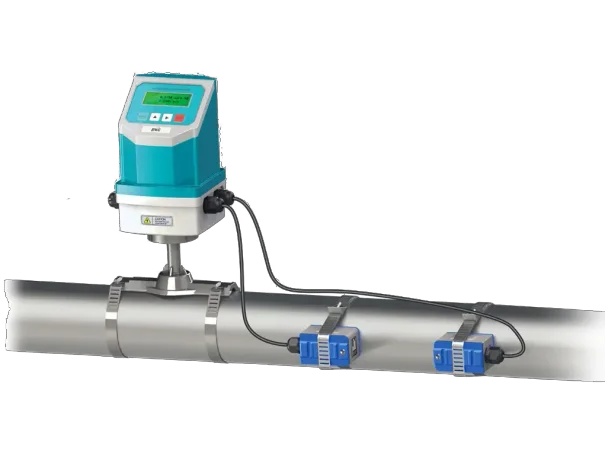
9. How do clamp-on and inline ultrasonic flowmeters differ in installation?
- Clamp-on meters: Non-intrusive; transducers are mounted externally using straps or magnetic clamps. No pipe cutting or process shutdown is needed. Ideal for retrofits or temporary monitoring.
- Inline meters: The transducers are integrated into the pipe body or flow cell for permanent, high-accuracy installations. They provide superior repeatability and stability in demanding industrial systems.
10. What is the recommended positioning for transducers (V, Z, W, or X configuration)?
Transducer arrangement depends on pipe size and fluid properties:
- V-Mode: Two reflections; standard for small to medium pipes.
- Z-Mode: Direct path; used for large pipes or clean fluids.
- W-Mode: Multiple reflections; enhances signal strength in small pipes.
- X-Mode: Crossed paths; useful in non-uniform or partially filled flow profiles.
11. What is the typical accuracy and repeatability of an ultrasonic flowmeter?
High-quality ultrasonic flowmeters achieve:
- Accuracy: ±0.5% to ±1.0% of reading (for clean fluids).
- Repeatability: Better than ±0.2%.
Accuracy depends on installation, transducer alignment, and flow profile.
12. How does temperature variation affect ultrasonic transit time?
Temperature influences both sound velocity and pipe dimensions. Since sound speed increases with temperature, built-in temperature sensors and compensation algorithms automatically adjust calculations. Without compensation, measurement error can exceed ±1% per 10°C variation.
13. What is the minimum and maximum flow velocity range measurable?
Typical range:
- Minimum: 0.03 to 0.1 m/s.
- Maximum: 25 m/s or higher (depending on model).
The operating range depends on pipe size, signal strength, and fluid type. Transit-time meters perform best in laminar to moderate flow regimes.
14. How does gas entrainment or suspended solids affect accuracy?
Entrained gas or solids cause scattering and attenuation of the ultrasonic beam, leading to weak signals or fluctuating readings. Transit-time meters require clear flow, while Doppler meters handle multiphase flows better. Modern instruments employ advanced digital filtering and automatic gain control to stabilize readings under disturbed conditions.
15. What is the response time and sampling frequency of modern ultrasonic meters?
Response time varies between 0.1 to 2 seconds, depending on signal processing and averaging algorithms. Sampling frequencies typically range from 1 to 10 Hz, enabling real-time monitoring for process control, leak detection, or batching operations.