A sound level meter is an instrument used to measure sound pressure levels. Also called a decibel meter. Environmental health and safety professionals often use a good level meter to measure noise exposure in the workplace. These meters typically have a microphone that picks up sound from the environment and converts it into an electrical signal. The signal is amplified and displayed on a scale, usually decibels (dB). It converts an acoustic signal into an electrical signal, which is then displayed on a scale in decibels. These measurements are taken with the A-weighting filter to mimic how the human ear hears the sound. The C-weighting filter is used to measure low-frequency noise, such as that from machinery or transportation.
Parts Of The Sound Level Meter
A sound level meter has many parts that work together to measure sound pressure levels. The main parts of a sound level meter are:
Detector and indicator head
A detector is also required to convert the rapidly changing voltage signal into a slower-changing DC signal. The most common type of detector is the rectifier. The rectifier converts the AC signal into a DC signal by only passing through the positive half-cycles of the AC signal. This results in a pulsating DC signal whose amplitude is proportional to the sound pressure level. Detectors can be divided into average, peak, and RMS.
The indicator head is the final component of the sound meter. It displays the sound level in either decibels or pascals. Most sound level meters have an analog display, which uses a needle to indicate the sound level on a scale. Some also have a digital display, which uses a numerical readout to indicate the sound level.
Amplifiers and Attenuators:
After the sound pressure is converted into an electrical signal by the microphone, that signal is amplified by one or more amplifiers. The first amplifier is a preamplifier with high and low output impedance. This allows a strong signal to be sent to the following stages with little loss.
The next stage is the filter amplifier, which filters out unwanted frequencies before passing the signal onto the meter. The final stage is the power amplifier, which increases the signal's amplitude before it reaches the meter.
To properly measure sound levels, it is important to use an attenuator. An attenuator reduces the amplitude of a signal without distorting its waveform. There are two main types of attenuators: input attenuators and output attenuators. Each gear's attenuation is 10 decibels, which means the sound level decreases by one-tenth.
An input attenuator is placed between the microphone and the amplifier. It prevents clipping and distortion by reducing the signal level before it reaches the amplifier. An output attenuator is placed between the amplifier and the meter. It protects the meter from damage by reducing the signal level before it reaches the meter.
The input and output attenuators' knob faces are frequently assigned colors to make them more distinguishable from one another.
Microphone:
The microphone is crucial to the sound level meter, converting sound pressure into voltage signals. The moving coil sensor comprises a diaphragm, coil, and magnet. The pressure waves hit the diaphragm and cause it to vibrate. This vibration creates a magnetic field that interacts with the fixed magnet, causing the coil to move. The movement of the coil generates an electric current that is proportional to the sound pressure.
Capacitive sensors are generally made of metal diaphragms and metal electrodes near each other but not in touch. The sound pressure causes the diaphragm to vibrate, changing the electrodes' capacitance. This change in capacitance is converted into voltage by an external circuit. The diaphragm is often coated with a polymer to improve the sensor's sensitivity.
When sound pressure is applied to the diaphragm, it deforms, the distance between the two polar plates changes, and the capacitance varies. As a result, an alternating voltage is generated whose waveform is linked to the sound pressure level within the microphone's linear range.
A condenser microphone is ideal for acoustic measurement because it doesn't distort frequencies, is very sensitive and produces little white noise. The frequency response of a microphone is the amplitude-frequency characteristics of the voltage produced by the microphone in response to a sound wave striking its diaphragm.
Weighted network:
A "weighting filter" is a network that can simulate the human ear's auditory characteristics. This type of filter gives more importance to certain frequencies than others. The three most common weighting filters are "A-weighting," "B-weighting," and "C-weighting."
The A-weighted network attenuates high and low frequencies, which means that it emphasizes midrange frequencies. This weighting is based on how human ears perceive sound. The A-weighted network is used to measure environmental noise, such as traffic and machinery noise. Low-intensity noise below 55 dB can be masked by other sounds and is not easily heard by humans.
The B-weighted network does not attenuate any frequencies, which means that all frequencies are given equal importance. This weighting is used to measure the noise that contains many low frequencies, such as music and speech. It produces a frequency of medium-intensity noise that is usually 55 to 85 decibels.
The C-weighted network emphasizes high frequencies, which attenuates low frequencies. This weighting is used for measuring impact noise, such as the noise made by a hammer hitting a nail.
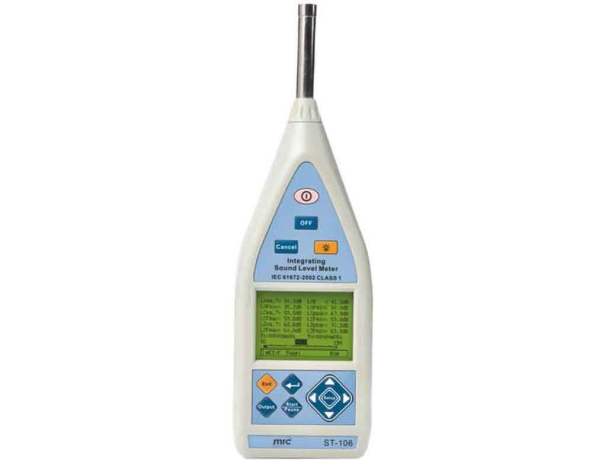
Application of sound level meters
The uses of the sound level meter are many in the industry and include, noise in factories, noise from airplanes, noise in public stations, cinemas, opera houses, various music systems and more
How Does A Sound Level Meter Work?
A sound level meter, a decibel or noise meter, measures the sound pressure level in a given environment. This device operates on the principle that noise is transmitted through the air as fluctuations in atmospheric pressure. The Decibel meter has a microphone that detects these fluctuations and converts them into electronic signals.
These signals are then amplified and measured using a weighted filter, which considers the sensitivity of human hearing at different frequencies. The final reading is displayed on the decibel meter screen or audibly announced through speakers.
The amplifier adds the output signal to a DC offset voltage proportional to the reference sound pressure. The amplifier output is connected to a demodulator that rectifies the AC signal and removes the DC offset. This rectified signal is then integrated over time, displayed on a meter, or read out audibly.
The sound pressure level is no longer a physical but rather a subjective measure that reflects how the human ear hears the sound. The A-weighting filter is the most commonly used weighting network because it best reflects the human ear's frequency response. The unweighted signal-to-noise ratio does not consider how human hearing perceives noise levels. You can enhance the objective quality of sound by establishing an equalization network. This reduces both low and high frequencies somewhat.
The IF noise of the equipment is also a consideration in the overall noise level. You can minimize the effects of the equipment's self-noise by using a low-noise preamplifier.
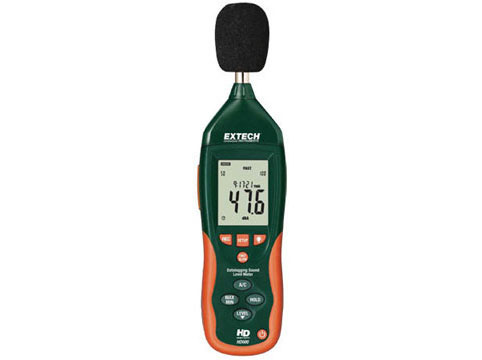
Occupational Health and Safety Compliance
Protecting Workers from Noise Exposure
Industries such as construction, mining, and manufacturing are often noisy. Prolonged exposure to high decibel levels can cause hearing loss or tinnitus.
SLMs are used to:
-
Monitor workplace noise levels
-
Ensure compliance with OSHA, NIOSH, or EU regulations
-
Identify areas where hearing protection is mandatory