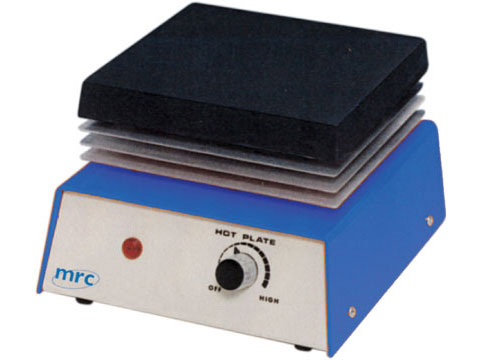
A laboratory hotplate is an electric heating device used to warm liquids, solutions, samples and laboratory vessels on a flat heated surface.
It is commonly used in chemistry, biology, education, research and quality-control laboratories where controlled heating is required without using an open flame.
Hotplates are useful for heating beakers, flasks, evaporating small quantities of liquid, supporting chemical reactions, warming reagents and maintaining samples at a defined temperature.
Unlike a Bunsen burner, a laboratory hotplate provides a stable heated surface and avoids the direct flame hazard. However, it still creates heat, electrical and chemical risks and must be used correctly.
How Does a Laboratory Hotplate Work?
A laboratory hotplate uses an electrical heating element positioned below a flat top plate.
When the unit is switched on, electrical energy is converted into heat. The heat is transferred to the top plate and then to the vessel placed on it.
The basic working process is:
- The user sets the required heating level or temperature.
- The heating element warms the plate.
- Heat passes from the plate into the glassware or container.
- The sample temperature rises.
- The controller adjusts heating to maintain the selected setting.
In simple models, the user controls heat output with an analogue dial. In digital models, the user may set a target temperature and view the current temperature on a display.
Some laboratory hotplates can control the plate surface temperature. Other systems can use an external probe to control the actual liquid temperature, which is often more useful for precise work.
Hotplate Temperature Is Not Always Sample Temperature
One of the most common misunderstandings is assuming that the hotplate setting equals the liquid temperature.
It usually does not.
The actual sample temperature depends on:
- Plate temperature
- Vessel material
- Vessel shape
- Liquid volume
- Stirring
- Heat loss to the room
- Evaporation
- Whether the vessel is covered
- Sensor position
- Contact between vessel and plate
For example, a hotplate set to 120°C does not mean the liquid inside a beaker is immediately at 120°C.
For accurate work, use a suitable temperature probe or thermometer positioned according to the laboratory procedure.
Common Applications of Laboratory Hotplates
Laboratory hotplates are used for many routine heating tasks.
Typical applications include:
- Heating aqueous solutions
- Warming reagents
- Dissolving solids in liquids
- Supporting chemical reactions
- Evaporating small quantities of solvent
- Preparing culture media
- Heating buffers
- Drying small residues
- Maintaining sample temperature
- Teaching laboratory demonstrations
- Quality-control sample preparation
The correct hotplate depends on the required temperature, vessel size, chemical exposure and whether stirring is needed.
Laboratory Hotplate or Magnetic Hotplate Stirrer?
A basic laboratory hotplate provides heat only.
A magnetic hotplate stirrer provides both heat and stirring.
Laboratory Hotplate
A standard hotplate is suitable when the main requirement is heating.
It may be used when:
- Stirring is not required
- Manual mixing is sufficient
- Solids or vessels are being warmed
- The sample does not need constant agitation
Magnetic Hotplate Stirrer
A magnetic hotplate stirrer contains a rotating magnet below the surface.
When a magnetic stir bar is placed inside the liquid, the rotating field causes the stir bar to spin and mix the liquid.
A hotplate stirrer may be preferable when:
- A solution must be heated evenly
- Solids must dissolve
- Temperature gradients must be reduced
- The reaction mixture must remain mixed
- Manual stirring is impractical
Stirring can improve heat distribution in liquids and reduce local overheating.
However, the stir bar, vessel and speed must be suitable for the volume and viscosity of the liquid.
Main Types of Laboratory Hotplates
Analogue Hotplates
Analogue hotplates use simple dial controls.
They are often easy to operate and suitable for routine heating where exact temperature control is not critical.
Advantages:
- Simple operation
- Lower cost
- Fewer settings
- Suitable for basic heating
Limitations:
- Less precise control
- No digital temperature display
- Less suitable for documented methods
Digital Hotplates
Digital hotplates allow the user to set and display temperature more clearly.
They may include:
- Digital temperature display
- Timer
- Safety cut-off
- Over-temperature protection
- Probe input
- Programmable settings
- Error alarms
Digital models are better suited for laboratories that require repeatable heating conditions.
Ceramic Hotplates
Ceramic or ceramic-glass hotplates are popular in laboratories because they are easy to clean and resistant to many chemical spills.
They are suitable for many routine chemical applications.
Limitations:
- Can crack from impact
- May not be suitable for all metal vessels
- Surface can remain hot without looking hot
Ceramic surfaces are often selected when chemical resistance and cleanability are important.
Aluminium Hotplates
Aluminium hotplates provide good thermal conductivity and can offer efficient heat transfer.
They may be suitable for general heating where good heat distribution and fast response are required.
According to MRC technical guidance, aluminium hotplates are commonly used up to around 300-400°C, with deformation risk above certain higher temperatures.
Stainless-Steel or Coated Hotplates
Some hotplates use stainless steel, coated surfaces, anodised aluminium, PTFE coating or other customised surfaces.
These may be required when:
- Chemical resistance is important
- Corrosive materials are used
- Cleaning is frequent
- The application requires a specific surface material
- A non-standard plate size is required
Multi-Position Hotplates
Multi-position hotplates or stirrers allow several vessels to be heated or stirred at the same time.
They may be useful for:
- Repetitive sample preparation
- Parallel reactions
- Teaching laboratories
- Quality-control workflows
- Small batch processing
When using several positions, check that each position provides suitable heating and stirring performance.
How to Choose the Right Laboratory Hotplate
1. Define the Heating Task
Start with the actual application.
Ask:
- What will be heated?
- Is the sample liquid, solid, powder or paste?
- What volume will be heated?
- What temperature is required?
- How long will heating continue?
- Will the sample release vapours?
- Is stirring needed?
- Is precise temperature control required?
- Will the work be performed inside a fume hood?
2. Choose the Correct Plate Size
The vessel should fit safely on the heated surface.
Common plate sizes include small square plates for beakers and larger rectangular plates for multiple vessels.
The existing article mentions examples such as 115 × 115 mm, 175 × 175 mm, 400 × 600 mm and 600 × 600 mm..
When choosing plate size, consider:
- Beaker or flask diameter
- Number of vessels
- Required working space
- Stability of glassware
- Weight of vessels and contents
- Space inside a Laboratory fume hood
- Clearance around the hotplate
Avoid placing oversized vessels on a small plate.
3. Check the Temperature Range
The hotplate must reach the required working temperature safely and consistently.
Do not choose a hotplate only by maximum temperature.
Also check:
- Minimum controllable temperature
- Stability at the working temperature
- Heat-up time
- Overshoot behaviour
- Cooling time
- Surface material limits
- Whether external probe control is available
For work above several hundred degrees Celsius, surface material becomes especially important.
4. Decide Whether Surface or Sample Control Is Needed
For simple warming, surface temperature control may be enough.
For precise liquid heating, sample temperature control is better.
With a suitable external probe, the hotplate can regulate heating according to the actual liquid temperature instead of only the plate temperature.
This is important for:
- Reactions
- Temperature-sensitive samples
- Reproducible protocols
- Long heating processes
- Methods requiring a defined liquid temperature
5. Match the Surface Material to the Chemicals
Choose a surface that suits the chemicals and cleaning requirements.
Consider:
- Acid resistance
- Solvent exposure
- Corrosion risk
- Spill frequency
- Mechanical impact
- Temperature requirement
- Ease of cleaning
If aggressive chemicals are used frequently, a customised or coated plate may be required.
6. Check Safety Features
Important safety features may include:
- Over-temperature protection
- Hot-surface warning
- Timer shut-off
- Error alarms
- Probe failure shut-off
- Spill-resistant design
- Stable base
- Separate heat and stir controls
- Clear display
- Electrical safety compliance
Some advanced models include user-adjustable over-temperature protection and timer shut-off functions.
Laboratory Hotplate Safety
A hotplate may look simple, but it can create serious risks.
The main hazards include:
- Burns
- Fire
- Electrical shock
- Chemical exposure
- Broken glassware
- Boiling over
- Thermal shock
- Ignition of vapours
- Unattended heating
Before Use
Before using a hotplate:
- Check the power cable and plug.
- Make sure the hotplate is clean and dry.
- Confirm the surface is not cracked or damaged.
- Place it on a stable, level, heat-resistant bench.
- Keep it away from bench edges.
- Remove paper, wipes, cardboard and combustibles nearby.
- Confirm the vessel is suitable for heating.
- Use appropriate PPE.
- Work in a fume hood if heating volatile or hazardous substances.
Laboratory safety guidance recommends checking cords for damage before use and not storing flammable or combustible materials near hotplates.
During Use
During heating:
- Do not leave unsafe heating processes unattended.
- Do not touch the plate surface.
- Keep flammable materials away.
- Use heat-resistant gloves or tongs.
- Avoid sudden temperature changes to glassware.
- Do not heat sealed containers unless designed for that purpose.
- Do not heat liquids to dryness unless the method specifically allows it.
- Use stirring or boiling aids where appropriate.
- Monitor the process for splashing, boiling or unexpected reactions.
Hotplates should not be stored or used near combustible materials, and older hotplates should be used cautiously with flammable materials.
After Use
After heating:
- Turn off heating and stirring.
- Unplug the unit where required by procedure.
- Allow the plate to cool completely.
- Keep a warning sign if the surface remains hot.
- Remove glassware safely.
- Clean spills only after the surface is safe to touch.
- Store the unit in a safe, dry area.
A hotplate can remain dangerously hot after it is switched off.
Hotplate vs Bunsen Burner
A hotplate is often safer and more controllable than an open flame.
Hotplate Advantages
- No direct flame
- More stable heating surface
- Better temperature control
- Suitable for many glass vessels
- Can include stirring
- Lower risk of igniting nearby vapours than open flame
Bunsen Burner Advantages
- Very rapid direct flame heating
- Useful for specific teaching or microbiology tasks
- Simple visual heat source
Important Limitation
A hotplate is not automatically safe for flammable solvents.
It removes the open flame, but the heated surface and electrical components may still create ignition risk.
If flammable vapours are produced, use suitable controls, ventilation and risk assessment.
Hotplate vs Heating Mantle
A heating mantle is designed to heat round-bottom flasks more evenly around the curved glass surface.
A hotplate heats from below through a flat surface.
Use a Hotplate When:
- Heating beakers or flat-bottom vessels
- General warming is required
- Magnetic stirring is needed
- The vessel has good contact with the surface
Use a Heating Mantle When:
- Heating round-bottom flasks
- More even flask heating is needed
- Direct contact with a flat plate is poor
- Solvent reflux or synthesis work requires flask support
For round-bottom flasks, a heating mantle is often more appropriate than a hotplate.
Hotplate vs Water Bath
A Laboratory water bath heats samples indirectly through water.
Use a Hotplate When:
- Higher temperatures are needed
- Faster heating is required
- Direct vessel heating is acceptable
- Stirring is needed
Use a Water Bath When:
- Gentle uniform heating is required
- Samples should not contact a hot surface directly
- Temperature must remain near or below 100°C
- Evaporation or overheating must be reduced
A water bath may be safer for some temperature-sensitive biological or chemical samples.
Common Mistakes When Using Laboratory Hotplates
Common mistakes include:
- Assuming the set temperature equals sample temperature
- Using the wrong surface material for the chemical
- Heating flammable solvents outside a fume hood
- Leaving combustible materials nearby
- Placing a large vessel on a small plate
- Using cracked or unsuitable glassware
- Forgetting that the surface remains hot
- Heating sealed containers
- Heating liquids to dryness
- Ignoring probe placement
- Using a damaged power cord
- Confusing the heat control with the stir control
- Leaving an unsafe process unattended
Laboratory Hotplates from MUNRO Scientific
MUNRO Scientific supplies laboratory hotplates and magnetic hotplate stirrers for heating, mixing, sample preparation and routine laboratory applications.
Available options may include analogue or digital control, different plate sizes, ceramic or metal surfaces, magnetic stirring, temperature probes, safety controllers and customised hotplates for specific applications.
Contact MUNRO Scientific with details of the sample, vessel size, required temperature, chemical exposure and stirring requirement to identify a suitable laboratory hotplate.
What is a laboratory hotplate used for?
A laboratory hotplate is used to heat liquids, solutions, samples and laboratory vessels on a flat electric heating surface. It is commonly used for sample preparation, reagent warming, dissolving solids and supporting chemical reactions.
What is the difference between a hotplate and a hotplate stirrer?
A hotplate provides heat only. A hotplate stirrer provides both heating and magnetic stirring, allowing liquids to be heated and mixed at the same time.
Is the hotplate setting the same as the liquid temperature?
No. The hotplate setting usually refers to the plate or controller setting. The actual liquid temperature depends on vessel type, liquid volume, stirring, heat loss and probe placement.
Which surface is best for a laboratory hotplate?
The best surface depends on the application. Ceramic glass is easy to clean and chemically resistant, while aluminium provides good heat transfer. Coated or customised plates may be required for aggressive chemicals.
Can flammable solvents be heated on a hotplate?
Flammable solvents require careful risk assessment, suitable ventilation and appropriate equipment. A hotplate removes the open flame but does not remove all ignition or vapour hazards.
What safety checks are needed before using a hotplate?
Check the power cord, plug, surface condition, work area, glassware, PPE, temperature setting and nearby combustible materials before starting work.
