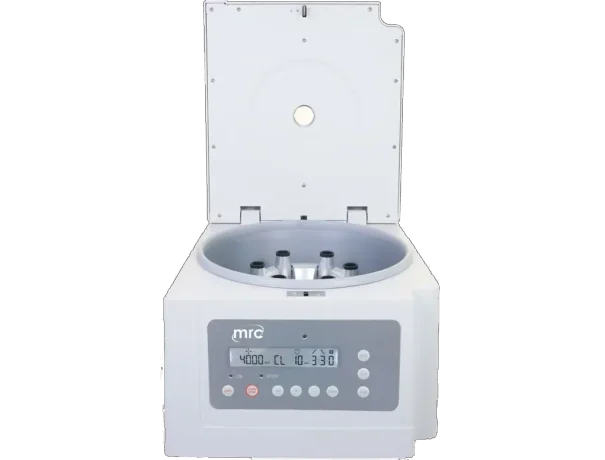
These machines are workhorses in medical and research labs, quietly spinning samples at high speeds to separate fluids and particles. From diagnosing illnesses to preparing plasma, they’re a cornerstone of clinical diagnostics.
The Working Principle
So, how does a centrifuge actually work? Think of swinging a bucket of water around your head. As long as it spins fast enough, the water stays in the bucket. That’s centrifugal force at play.
A swing-out rotor allows the sample holders to swing horizontally during spinning, letting heavier components settle neatly at the bottom. This is different from a fixed-angle rotor, where samples remain tilted.
Types of Clinical Centrifuges
- Swing-out centrifuge – Ideal for clear layer separation.
- Fixed-angle centrifuge – Faster but less precise layering.
- Microcentrifuge – Handles small-volume samples.
- High-speed centrifuge – Used in research labs for advanced applications.
Key Components of a Swing Clinical Centrifuge
- Rotor system – The heart of the centrifuge, dictating speed and capacity.
- Buckets and adapters – Hold tubes securely, adaptable for different sizes.
- Motor and speed control – Determines accuracy and performance.
- Safety lid – Prevents accidents from high-speed spinning.
Applications in Healthcare and Research
- Blood separation – Plasma and serum isolation for diagnostics.
- Urine analysis – Detecting sediments and abnormalities.
- Plasma preparation – For transfusions or medical treatments.
- Cell culture – Used in microbiology and molecular biology.
Advantages of Swing Clinical Centrifuges
- Produce clear, distinct layers of separation.
- Can handle multiple samples at once.
- Adaptable for various tube sizes.
- Easy to observe results without disturbing samples.
Limitations to Consider
- Slower speeds compared to fixed-angle models.
- Takes up more bench space in the lab.
- Requires regular maintenance for smooth operation.
How to Use a Swing Clinical Centrifuge Safely
- Always balance samples by weight and volume.
- Set correct RPM (revolutions per minute) or RCF (relative centrifugal force).
- Ensure the lid is locked before starting.
- Don’t open the lid until the rotor stops completely.
Choosing the Right Centrifuge for Your Lab
Ask yourself:
- How many samples will I run daily?
- Do I need faster processing or clearer separation?
- What’s my budget for purchase and maintenance?
- Which brands have a proven record of reliability?
Swing vs. Fixed-Angle Centrifuges: Which is Better?
- Swing-out centrifuges are perfect for clinical labs needing clear separation.
- Fixed-angle centrifuges are better when speed and compactness matter.
- The choice depends on application, space, and budget.
Maintenance Tips
- Wipe down the rotor chamber after each use.
- Inspect buckets and tubes for cracks.
- Service the motor periodically.
- Calibrate settings for accurate performance.