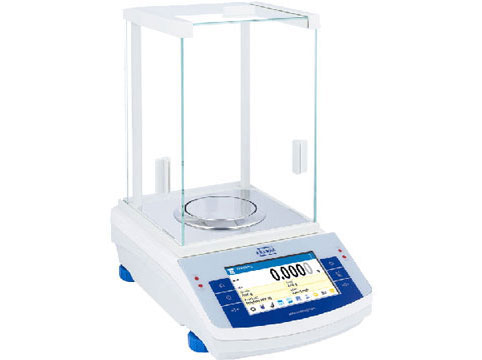
Laboratory Balances measure the mass of an object, in the laboratory they are used to measure solids, liquids, tissues. They have a wide range of uses in almost any laboratory including clinical, research and environmental settings. Used to determine the weight or mass of a sample. Scientific balances are among the more essential pieces of laboratory equipment. These weighing instruments are available in a variety of sizes, variable resolutions and multiple weight capacities.
Principle of laboratory balances:
Both current laboratory balances and their predecessors have arms with equal lengths. Modifying the recorded measurement on one pivot side indicates the unknown weight torque applied on the other pivot side when utilizing an older instrument. The position of the moving weights is utilized to estimate the measurement when the pointer returns to similar regions with equivalent torques. Due to its current equivalent, it is known as magnetic force restoration. The electromagnet determines how much force a substance exerts. In magnetic locations, wire coils are typically utilized as the mechanism. Due to the coil regulating the magnetic field, it is often a continuous field. At each point, the directions of the magnetic field and the current flow are perpendiculars.
As a result, the coil's axis is under force. This wire coil is supported by precision springs, allowing it to move along its axis. An electronic amplifier receives signal feedback from an optical sensor that senses coil position. Using an electronic amplifier, the location of the coil is maintained relative to a fixed point. The tension exerted by a wire coil is precisely proportional to the current that flows through it.
Consequently, the force exerted can be calculated by measuring that current. By appropriately balancing the arm, two torques will be equal and opposing, causing the needle to deviate and return to the reference point. The electromagnetics framework for force restoration limits the application of direct power by the obscure to the configurable. In addition, looping is used to apply direct electricity to a specified location.
Other things to keep in mind:
- Calibration:
For the case of calibration, weight readings are compared in accordance with the supplied mass values. Such weighing is often carried out at maximum potential.
- Reproducibility:
How frequently identical measurements may be conducted determines an object's measuring capacity. It can also be expressed using the standard deviation.
- Linearity:
In the intermediate reading, this is the focus across the entire measuring instrument range. The device's weighing range is comparable to the measuring range of a laboratory analytical balance. This is a vital characteristic of balance in a laboratory, as it is typically used to measure small items rather than the capacity of the equipment.
- Precision:
The accuracy of analytical balances should be examined whenever a lab examination program is carried out. This is primarily used for weighing-in controls or analytical calibration calibrations. When using pipettes, their accuracy should also be checked. Testing for lab balance accuracy consists of four parts: corner load, linearity, calibration, and repeatability.
The Core Working Principle: Electromagnetic Force Restoration (EMFR)
Most modern electronic laboratory balances operate on the Electromagnetic Force Restoration principle. Here’s how it works:
-
Initial Placement: When a sample is placed on the pan, gravity exerts a downward force proportional to its mass.
-
Displacement Detection: The pan is connected to a coil suspended in a magnetic field. This added mass causes a vertical displacement.
-
Electromagnetic Compensation: A counteracting electromagnetic force is generated to restore the coil (and the pan) to its original position.
-
Feedback Loop: The system uses a feedback loop to adjust the electromagnetic current until equilibrium is reached.
-
Digital Output: The amount of current required to restore balance is directly proportional to the sample's mass. This value is then displayed digitally.
This system eliminates mechanical wear and tear while enabling extremely precise and repeatable measurements.
Mechanical Balances: A Historical Perspective
While largely obsolete in modern labs, mechanical balances like the triple-beam or two-pan balances operate on the principle of equilibrium:
Mechanical balances are still used in educational settings or where electronic devices are impractical.