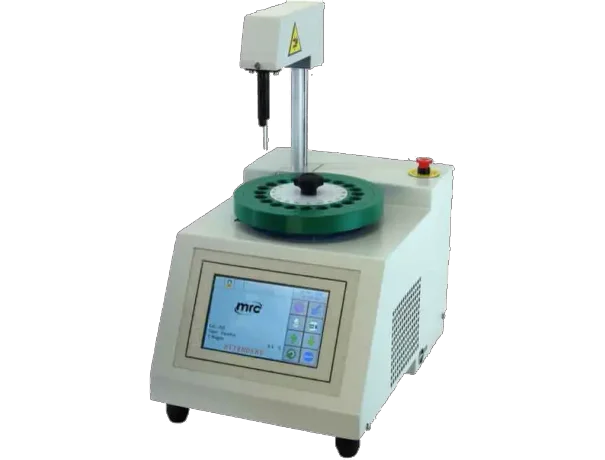
Complete information about Cryoscope Milk Freezing Point Analyzer
1. What is the working principle of a cryoscope for determining milk freezing point?
A cryoscope measures the freezing point depression of milk to detect adulteration — mainly added water.
When milk is cooled below its freezing point, it initially supercools. The instrument then triggers crystallization, and the latent heat released raises the temperature slightly until a stable equilibrium is reached.
This stabilized temperature represents the true freezing point.
Because milk’s freezing point depends on its dissolved solids (lactose, salts, proteins), any dilution with water raises the freezing point toward zero.
Thus, by measuring this precise temperature, the cryoscope can quantify water adulteration to a fraction of a percent.
2. What type of cooling system does the cryoscope use (Peltier, compressor, or thermoelectric)?
Two main systems are used:
- Peltier (thermoelectric) cooling – Compact, energy-efficient, and maintenance-free. Suitable for medium-throughput dairy labs.
- Compressor refrigeration – Provides faster cooling and shorter test cycles, often used in industrial dairy plants handling hundreds of samples daily.
Both ensure precise, uniform cooling. The choice depends on sample load and laboratory infrastructure.
3. What is the accuracy and resolution of the freezing point measurement?
High-quality cryoscopes achieve:
- Accuracy: ±0.001 °C
- Resolution: 0.0001 °C
This extreme precision enables detection of even 0.1–0.2 % added water, meeting international reference method standards.
4. What is the typical freezing-point range measurable for milk samples?
Cryoscopes typically measure within –0.300 °C to –0.700 °C, covering the full range of natural milk types.
Pure cow milk usually freezes near –0.540 °C; readings less negative than –0.515 °C usually suggest added water.
5. What are the standard reference freezing points for pure cow and buffalo milk?
| Milk Type | Typical Freezing Point (°C) | Comment |
| Cow milk | –0.540 °C | Standard reference value in ISO 5764 |
| Buffalo milk | –0.570 °C | Naturally higher solids → lower freezing point |
| Goat milk | –0.520 °C | Slightly higher than cow milk due to fat/lactose ratio |
Deviation from these reference points indicates possible adulteration or compositional change.
6. How long does one test cycle take from sample loading to result?
Modern cryoscopes complete a full analysis in 90 – 150 seconds.
The total time includes:
- automatic cooling of the sample,
- initiation of freezing (nucleation),
- thermal stabilization, and
- digital recording of the equilibrium point.
High-speed Peltier models can deliver results in under 2 minutes, ideal for rapid screening.
7. What is the volume of milk sample required per analysis?
Only 2 – 3 mL of milk is needed for each test.
This small sample size allows continuous testing without wasting product and supports testing of multiple sources or collection batches with minimal handling.
8. Is the cryoscope compliant with ISO 5764:2009 or IDF 108 standards?
Yes. Reliable laboratory instruments for dairy testing strictly adhere to:
- ISO 5764:2009 – Milk — Determination of freezing point — Thermistor cryoscope method
- IDF 108:2009 – International Dairy Federation equivalent standard.
Compliance guarantees traceability and international acceptance of results for official quality control and export documentation.
9. What are the typical ambient operating temperature and humidity requirements?
Cryoscopes are temperature-sensitive precision instruments.
They should be installed in laboratories where:
- Ambient temperature: 15 °C – 30 °C
- Relative humidity: below 80 %, non-condensing
Excess heat or humidity can cause unstable readings and slow cooling rates, while too-cold environments may affect nucleation control.
10. How often should the cryoscope be calibrated?
Calibration frequency depends on usage intensity:
- Daily or weekly in high-throughput dairy plants.
- Monthly in smaller labs or research settings.
Calibration ensures that measurement drift, caused by sensor aging or thermal changes, is corrected before it affects accuracy.
11. What type of calibration standards or reference solutions are used?
Cryoscopes are calibrated using aqueous sodium chloride (NaCl) reference solutions with known freezing points.
Common reference values:
- –0.400 °C,
- –0.500 °C, and
- –0.600 °C.
These solutions mimic the ionic strength of milk and are traceable to ISO-certified standards.
12. How to perform multi-point calibration for improved accuracy?
Multi-point calibration establishes a linear relationship between measured and theoretical freezing points.
Procedure:
- Measure two or three NaCl standards.
- Record their freezing points.
- Plot measured values versus certified values.
- Adjust the instrument’s slope and offset until deviations are minimal.
This provides accurate results across the full milk range, especially important for laboratories testing different species.
13. Does the system automatically compensate for temperature drift or external variations?
Advanced cryoscopes include automatic drift-compensation software.
Built-in thermistors monitor internal temperature, and digital algorithms correct for environmental fluctuations.
This feature ensures stable readings even when ambient temperature varies slightly during the test day.
14. What are the signs that indicate the need for recalibration?
You should recalibrate when:
- Measured values of reference standards deviate by more than ±0.002 °C.
- Repeated tests show inconsistent readings.
- The instrument has been moved or exposed to temperature shocks.
- Service or maintenance (e.g., sensor replacement) has been performed.
Ignoring these signs can compromise compliance with ISO 5764.
15. Can calibration data be stored or exported digitally?
Yes. Modern digital cryoscopes include:
- Internal memory for 1,000–10,000 test records
- USB, RS-232, or Ethernet ports for data transfer
- Export formats such as CSV or PDF
- Integration with LIMS (Laboratory Information Management Systems)
This enables secure archiving, traceability, and automated quality-control reporting — essential for accredited dairy laboratories.
MUNRO provides a wide range of Cryoscope Milk freezing point analyzer. Contact us