Laboratory mills are used to process samples in various industries, including pharmaceuticals, food, chemicals, Agriculture, Environmental Science and cosmetics.
These mills are designed to reduce the size of a sample and prepare it for further analysis. There are several types of laboratory mills, each with its own unique design and function.
Jaw Crusher: A jaw crusher is a type of mill that uses two plates to crush the sample material. The plates are made of hardened steel and move in a reciprocating motion to crush the sample. Jaw crushers are typically used for hard and brittle samples and can reduce the sample size to a fine powder.
Centrifugal Mill: A centrifugal mill uses a rotating drum to rapidly grind the sample material against a static ring. The high-speed motion of the drum generates a centrifugal force that grinds the sample material. Centrifugal mills are typically used for soft and fibrous samples, and can achieve a high degree of fineness.
Cutting Mill: A cutting mill is a type of mill that uses blades to grind the sample material. The blades rotate at high speed and chop the sample into smaller pieces. Cutting mills are typically used for fibrous and tough samples, and can produce a uniform particle size.
Knife Mill: A knife mill is similar to a cutting mill, but it uses a series of knives to grind the sample material. The knives rotate at high speed and cut the sample into smaller pieces. Knife mills are typically used for soft and fibrous samples, and can produce a fine particle size.
Mortar Mill: A mortar mill is a type of mill that uses a pestle to grind the sample material against a mortar. The pestle is rotated by hand and grinds the sample into a fine powder. Mortar mills are typically used for small samples and can produce a fine particle size.
Disc Mill: A disc mill is a type of mill that uses two flat plates to grind the sample material. The plates are made of hardened steel and rotate against each other, grinding the sample into a fine powder. Disc mills are typically used for tough and brittle samples, and can achieve a high degree of fineness.
Ball Mill: A ball mill is a type of mill that uses balls made of hardened steel to grind the sample material. The balls are placed in a rotating drum and grind the sample by friction and impact. Ball mills are typically used for soft and fibrous samples, and can achieve a high degree of fineness.
Laboratory mills are used in a variety of industries for sample preparation and analysis. Some of the industries that use laboratory mills include:
Pharmaceuticals: In the pharmaceutical industry, laboratory mills are used to reduce the size of active ingredients and excipients for analysis and formulation.
Food: In the food industry, laboratory mills are used to grind food samples for analysis of nutrients, contaminants, and other properties.
Chemicals: In the chemical industry, laboratory mills are used to grind chemical samples for analysis of composition and purity.
Cosmetics: In the cosmetics industry, laboratory mills are used to grind cosmetic samples for analysis of ingredients and formulation.
Environmental Science: In environmental science, laboratory mills are used to grind environmental samples for analysis of pollutants, heavy metals, and other contaminants.
Agriculture: In agriculture, laboratory mills are used to grind plant and soil samples for analysis of nutrients, toxins, and other properties.
Material Science: In material science, laboratory mills are used to grind materials for analysis of structure, composition, and mechanical properties.
What is Laboratory Mill
Laboratory Mills are used for sample preparation and chemical and physical analyses.
Applications Laboratory Mills
used primarily for sample prep prior to analysis, use particle size reduction (comminution) to grind or homogenize wet, dry, hard, soft, elastic, brittle, and fibrous materials.
What should we pay attention to before purchasing
-types of mill
-cleanability
-power
- instrument’s throughput
-reproducibility
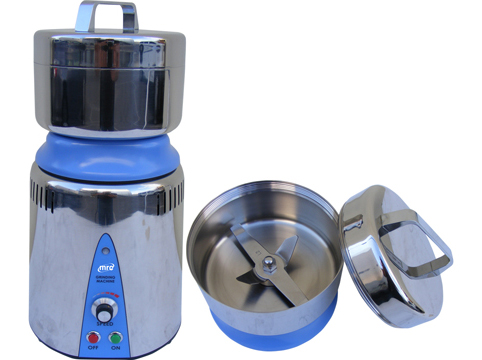
How To Choose The Right Lab Mills For Your Applications
The first step in the processing of your samples is the homogenization step. In this step, the sample is crushed according to its structure, material, and purpose of homogenization. There are several types of laboratory mills and grinders for this purpose, but different mills serve different purposes. Determining the mill or grinder for your laboratory application is critical for the effectiveness and efficiency of your laboratory work.
The oldest version of a laboratory mill is the simple mortar and pestle technology. Even though mortars and pestles are still in use today, the technology of grinding or milling samples in the laboratory has advanced beyond that. Grinders for different types of samples are now available. Buying a mill for your laboratory is determined by the texture, structure, strength, and size of the samples you work with.
The two main types of laboratory mills/grinder are
Hard crushing: Hard crushing mills are used for hard, dry, or brittle samples (for example, glass and coal). They utilize impact, pressure, and friction to crush samples into homogenous particles. High impact and pressure are first used to reduce the size of the material before friction is used to reduce it to an even smaller size. Mining, metallurgy, and geology laboratories and company are ideal users of hard crushing mills or grinders.
Soft crushing: Soft crushing uses cutting and shearing to grind samples. Samples made of soft, elastic, or fibrous materials are reduced to smaller particles, either as dry particles or liquid paste. Soft crushing mills are ideal for beauty and pharmaceutical laboratories.
Proper preparation of the sample will ensure easy grinding, regardless of the mill being used.
There are qualities to look out for in an ideal mill for your application.
Versatility: A mill that can do both hard and soft grinding is most useful and ideal. A versatile mill can carry out impact, pressure, friction, cutting, and shearing. Mills may even have different rotors for different materials.
Durability: A mill is long-use equipment and hence, must be durable. Brands whose durability is tested and trusted should be considered above other brands when buying a mill.
Easy cleaning: A mill should be easy to clean, especially if it is used for different purposes. Easy to clean mill should be among the top consideration when purchasing a mill.
Efficiency: Laboratory materials are expensive to come by. A grinder or mill should yield a large percentage of the materials poured into it.
How can sample type help you choose the best mill or grinder?
Knowing the type of sample, especially its malleability or hardness is an essential factor in deciding the mill or grinder needed. For instance, some models of mills are designed for harder objects, while some are the best used for breakable things such as mixer mills, mortar mills, crushers, jet pulverizes, to name a few. However, if you are need mills and grinders that will be suitable for a wide range of purposes, then buying the planetary beads mills should top your cart list. These machines have multifunctional features that make them fit for various materials such as brittle, fibrous, pasty, and other soft and hard materials.
Can the downstream analysis technique type influence the choice of laboratory mill?
There are situations where analytical processes such as X-ray powder diffraction and particle-size distribution are vital when analyzing samples. So, in this instance, what you need the most is having a grinder or mill that can produce the required reproducible particle size required for distribution. To meet these specific demands, manufacturers are now developing mills and grinding technologies machine that can be used for specific analytical processes.