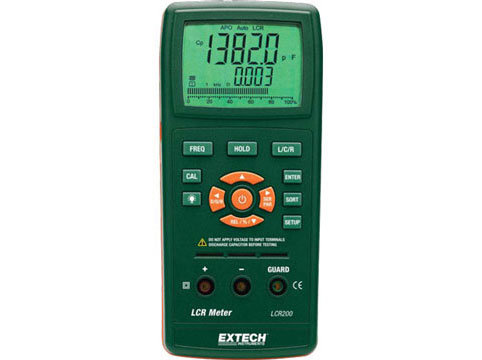
An LCR meter is one of the most important instruments for characterizing electronic components. It measures the impedance of inductors, capacitors, and resistors under controlled test conditions. While a standard multimeter provides basic functions, a true LCR meter is designed for precision analysis, high frequency operation, and accurate separation of real and imaginary impedance components. This article explains how LCR meters work, how to use them correctly, and how to understand their readings when testing passive components.
1. Fundamental Principles of LCR Measurement
LCR Meter vs. Standard Multimeter
A multimeter measures resistance using a DC method. When switched to capacitance or inductance modes, it typically uses simplified internal circuits that assume ideal behavior. The results are approximate and often inaccurate for modern components.
An LCR meter, by contrast, applies an AC test signal at a controlled frequency. It measures both the magnitude and the phase of the voltage and current through the device under test. This allows it to compute the full complex impedance. This means it separates:
- R: the real resistive component
- X: the reactive component
- L: inductive reactance, where X is positive
- C: capacitive reactance, where X is negative
The instrument does not guess the component type. It calculates impedance first, then derives L or C mathematically from the reactive part.
How Complex Impedance is Measured
The meter generates a sinusoidal signal and measures:
- The current through the device
- The voltage across it
- The phase angle between them
From these values, it computes:
Z = R + jX
Where R is the resistive component and X is the inductive or capacitive reactance. The meter then calculates L or C using:
- L = X divided by (2πf)
- C = 1 divided by (2πfX)
2. Importance of Test Frequency
The inductance and capacitance of real components vary with frequency. This means the same capacitor tested at 100 Hz, 1 kHz, and 100 kHz will often show different values.
Effects on Inductors
At low frequencies, inductors behave close to ideal. At higher frequencies, core losses and parasitic capacitance shift the measured value and increase dissipation.
Effects on Capacitors
Electrolytic capacitors exhibit large changes at different frequencies. Ceramic capacitors experience voltage coefficient effects and resonance phenomena.
The chosen frequency must match the component's intended operating conditions. Many industry standards specify 100 Hz, 120 Hz, 1 kHz, or 100 kHz for accurate comparison.
3. Handling Parasitics During Measurement
Real setups include parasitic inductance in leads, stray capacitance between test fixtures, and resistance in connections. LCR meters compensate for these errors using:
- Open compensation for stray capacitance in the cables
- Short compensation for lead inductance and series resistance
- Load or fixture compensation when measuring inside custom holders or sockets
These procedures remove the measurement contribution of the test setup so the reading reflects the component alone.
4. Test Modes: Series vs. Parallel Models
LCR meters allow measurements using either:
- Series equivalent circuit (Rs, Ls, Cs)
- Parallel equivalent circuit (Rp, Lp, Cp)
When to use the series model
- Low impedance components
- Inductors at high frequencies
- Small capacitors or ESR measurements
When to use the parallel model
- High impedance components
- Large capacitors
- Leakage current analysis
Selecting the correct model ensures that the derived values accurately describe the behavior of the component in its real application.
5. Accuracy and Key Specifications
Understanding Basic Accuracy
The accuracy of an LCR meter is expressed as:
(Percentage of reading) plus (percentage of range)
For example, 0.1 percent plus 0.05 percent means the error is composed of both a proportional and a fixed term.
Measurement Range
High precision meters can measure capacitance from femtofarads to farads, inductance from nanohenry into henry ranges, and resistance from milliohm to megohm levels.
Impact of Output Impedance
The internal resistance of the AC test source affects low impedance measurements because any significant series output resistance will cause loading effects. A Kelvin 4-wire method removes this influence.
DC Bias Capability
Some components require DC bias during measurement:
- Electrolytic capacitors
- Ceramic capacitors with strong voltage coefficients
- Varactors
- Inductors in magnetized cores
LCR meters specify the maximum DC bias voltage or current they can apply. This is critical for realistic measurement.
Dissipation Factor and Quality Factor Ranges
Precision instruments measure:
- D from 0.0001 to values above 1
- Q from below 1 to thousands
These ranges allow testing from high performance RF inductors to lossy electrolytic capacitors.
Choosing the Test Signal Level
Too high a signal level can push components into nonlinear behavior. Too low a signal risks poor signal to noise ratio. Follow these guidelines:
- Use 1 Vrms or 0.5 Vrms for ceramic capacitors
- Use low current for ferrite inductors
- Use higher levels only when datasheets specify testing at a particular voltage
6. Measurement Techniques and Compensation
Open and Short Calibration
This process tells the meter to treat:
- The test fixture with no device as the baseline capacitance
- A direct short across the terminals as the baseline series inductance and resistance
After calibration, the meter subtracts these parasitics from all readings.
Load or Fixture Compensation
Used when the device is mounted in a socket, jig, or custom fixture. The process measures the fixture itself and corrects future readings.
Kelvin 4 Terminal Method
Using separate force and sense leads eliminates the effect of contact and lead resistance. Essential for:
- ESR measurements
- Milliohm resistances
- Very low inductances
Measuring Very Small Values
For nanohenry or femtofarad ranges:
- Use high frequency, often above 1 MHz
- Use shielded test fixtures
- Keep leads extremely short
- Perform careful open/short/load compensation
Frequency or Level Sweeps
A benchtop LCR meter can sweep:
- Frequency across a defined range
- Test signal voltage or current
This is used to study resonance, saturation, core behavior, or dielectric effects across operating conditions.
7. Component Specific Considerations
D and Q for High Frequency Inductors
Dissipation Factor represents losses in the component.
Quality Factor is 1 divided by D.
For RF inductors, a high Q means:
- Low core losses
- Low series resistance
- Good performance at the intended frequency
Interpreting these values helps design efficient RF filters and resonant circuits.
Difference Between ESR and D in Capacitors
- ESR is the real resistive loss in series with the capacitor.
- D (dissipation factor) is the ratio of ESR to the capacitive reactance at the test frequency.
D depends on frequency while ESR is a frequency dependent but more absolute measure. They show related but different aspects of loss.
Determining Self Resonant Frequency (SRF)
Using a frequency sweep:
- At low frequency, the component looks inductive or capacitive
- At SRF, reactance becomes zero because parasitics cancel
- Above SRF, the component behaves as the opposite type
Identifying SRF is essential when selecting inductors or capacitors for broadband or high frequency applications.
Selecting Capacitors for SMPS Applications
An LCR meter helps evaluate:
- ESR at switching frequency
- Ripple current capability
- Capacitance under DC bias
- Dissipation factor
- Behavior near resonant frequency
- Temperature dependence
Low ESR and stable capacitance under bias are crucial for converter efficiency and reliability.