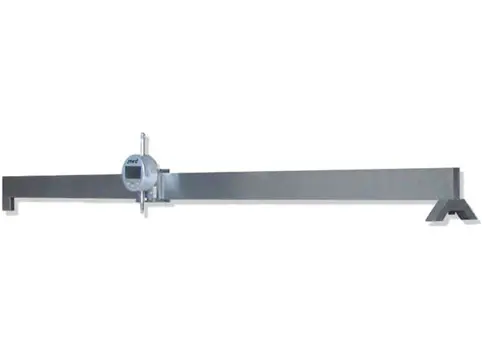
Straightness Gauges with Micron Digital Indicators are precision measuring instruments used to assess the straightness of a surface, shaft, or linear object with extremely high accuracy. These gauges are equipped with micron-level digital indicators, which provide precise readings in micrometers (µm), ensuring accurate straightness measurements.
Key Features:
- High Precision Measurement: Measures straightness deviations in the range of microns (typically 0.001 mm or better).
- Digital Indicator Display: Provides easy-to-read digital readings with high resolution.
- Stable Base and Guides: Ensures reliable and repeatable measurements.
- Portable and Easy to Use: Often designed for shop-floor or laboratory use.
- Application in Various Industries: Used in machining, aerospace, automotive, and quality control processes.
Applications:
- Machine Tool Alignment: Ensures that machine components are aligned correctly.
- Shaft and Roller Inspection: Measures straightness deviations in rotating components.
- Surface Flatness Measurement: Checks for any warping or deviations in precision surfaces.
- Manufacturing Quality Control: Verifies compliance with strict tolerance requirements.
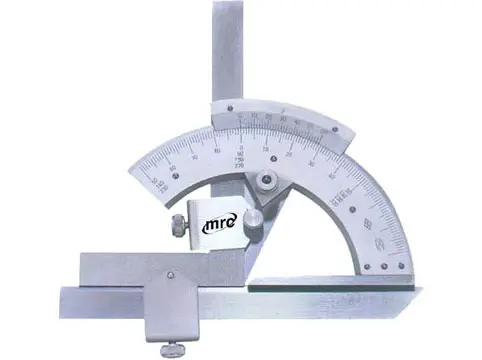
Universal Bevel Protractors
A Universal Bevel Protractor is a precision measuring instrument used to measure angles with high accuracy. It consists of a base, a circular graduated scale (protractor), a vernier scale for finer measurements, and an adjustable blade or arm that can be set to different angles.
Features of a Universal Bevel Protractor:
- Graduated Circular Scale: Measures angles from 0° to 360°.
- Vernier Scale: Provides precise readings with an accuracy of up to 5 minutes (1/12 of a degree).
- Adjustable Blade: Can be rotated and fixed at any angle for accurate measurement.
- Locking Mechanism: Ensures the blade stays in place while transferring measurements.
- Material: Typically made of stainless steel for durability and accuracy.
Uses of a Universal Bevel Protractor:
- Metalworking & Machining: Checking angles of tools, molds, and machine parts.
- Woodworking: Ensuring precise cuts and joints.
- Engineering & Construction: Measuring and marking accurate angles in design and assembly.
- Quality Control: Used in industries to verify angles of manufactured components.
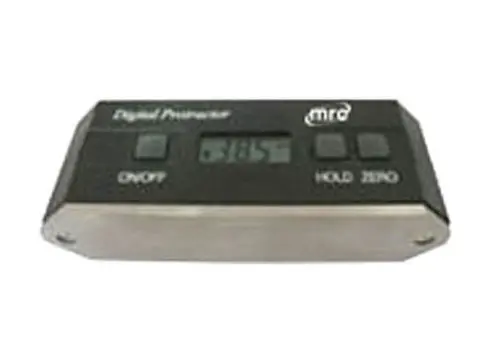
Inclinometers
An inclinometer, also known as a tilt sensor or clinometer, is an instrument used to measure the angle of tilt, slope, or inclination of an object concerning gravity. It provides angular measurement in degrees, radians, or percentage slope.
Uses of Inclinometers:
- Geotechnical Monitoring – Used in civil engineering to monitor soil movement, landslides, and structural stability.
- Aviation & Navigation – Helps in aircraft and ship navigation by measuring pitch and roll.
- Construction & Engineering – Ensures proper alignment of buildings, bridges, and roads.
- Medical Applications – Used in physical therapy and rehabilitation to measure body posture and joint movement.
- Industrial Machinery & Robotics – Helps in positioning and stabilization of machinery and robotic arms.