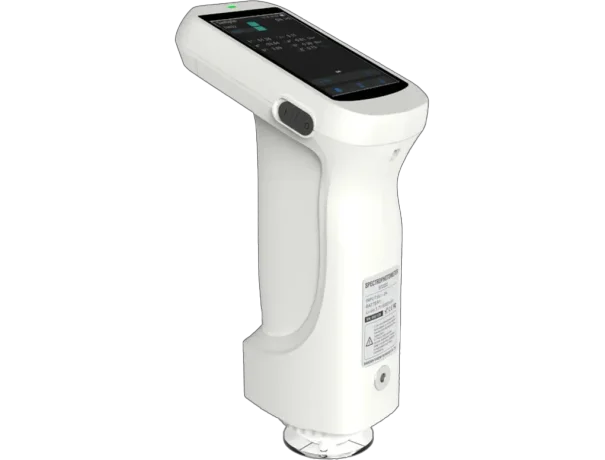
A colorimeter is a measurement device that reports color as numbers. In the simplest terms, it shines light on a sample, captures the reflected light through filters that mimic human vision, and calculates values like L*a*b* and ΔE. That is the practical foundation of the Application of Colorimeters.
The core idea behind the Application of Colorimeters
The Application of Colorimeters works best when you need quick, repeatable checks. A production line does not have time for long lab workflows. You need a tool that can say, “This matches,” or “This is drifting,” in seconds.
Colorimeters are great at:
- Fast checks on solid colors
- Pass/fail decisions on stable materials
- Consistency control across shifts and sites
Colorimeter vs spectrophotometer
Understanding limits is part of doing the Application of Colorimeters correctly.
A colorimeter measures color using broad filters. A spectrophotometer measures a full spectrum. So:
- Use a colorimeter when you need speed, simple operation, and routine control.
- Use a spectrophotometer when you need spectral detail, better control of complex pigments, or metamerism detection.
If your product has tricky metallics, heavy texture, strong fluorescence, or you must match under multiple lights, the Application of Colorimeters might still help, but you may need to validate with spectral tools.
Key terms you will see in specs
To run a strong Application of Colorimeters program, you should recognize these terms:
- L*a*b*: A common color space. L* is lightness, a* is red-green, b* is yellow-blue.
- ΔE (Delta E): A single number that shows how far a sample is from the target.
- Illuminants (D65, A, F2): “Standard lights” used in calculations.
- Observer angle (2°, 10°): A standard model of human vision used for calculations.
- Geometry (45/0 or d/8): The lighting and viewing setup. Geometry changes results, so it must be consistent.
Core Industry Workflows: Where Colorimeters Deliver Fast Value
The Application of Colorimeters becomes more powerful when it is built into daily workflows, not treated as a special lab event.
Below is a quick table showing typical industry goals.
| Industry | What they control | Typical output | Why colorimeters help |
| Plastics | Resin and part color | ΔE, L*a*b* | Fast checks per batch |
| Coatings | Batch and spray consistency | ΔE trend | Catch drift early |
| Printing | Brand and proof matching | ΔE, density support | Faster approvals |
| Textiles | Dye lot shading | ΔE, shade sorting | Reduce returns |
| Food | Appearance and browning | L*, b* | Objective grading |
| Cosmetics | Shade matching | ΔE, L*a*b* | Consistent claims |
Plastics, injection molding, and polymers
In plastics, the Application of Colorimeters often starts with incoming resin or masterbatch verification. Then it continues with molded part checks on the line.
Common uses:
- Confirm masterbatch concentration consistency
- Detect yellowing from overheating
- Keep multi-cavity parts aligned in shade
Paints, coatings, and powder coating
Coatings change with mixing, pigment dispersion, and curing. The Application of Colorimeters helps teams spot drift before the whole batch is out.
Typical checkpoints:
- After mixing
- After application and cure
- After aging tests (UV, heat, humidity)
Printing and packaging
Printing is where the Application of Colorimeters saves time and avoids brand headaches. Teams use colorimeters to:
- Check spot colors against brand targets
- Compare proofs to press sheets
- Monitor consistency across print runs
When you combine objective checks with good lighting booths, arguments drop fast.
Textiles, leather, and footwear
Textiles are classic territory for the Application of Colorimeters because shade differences cause returns.
Use cases include:
- Dye lot approval
- Shade sorting (binning rolls or hides)
- Checking color changes after washing or abrasion
Food and agriculture
Food color is strongly linked to freshness perception. The Application of Colorimeters helps grade and standardize decisions that used to depend on “experienced eyes.”
Examples:
- Browning index in baked goods
- Ripeness signals in fruit
- Color uniformity in grains and powders
Cosmetics and personal care
Cosmetics buyers care a lot about shade consistency. The Application of Colorimeters supports:
- Raw pigment verification
- Batch consistency checks
- Matching product families (foundation lines, powders, creams)
High Impact Use Cases: 21 Practical Applications
This section lists 21 practical scenarios where the Application of Colorimeters is commonly used. The goal is not to be fancy. It is to be useful.
Incoming inspection
- Verify supplier color targets
Measure incoming parts against a stored standard. The Application of Colorimeters here prevents bad material from entering production. - Approve raw materials (resins, pigments, powders)
Catch off-spec lots early, before they create costly rework. - Audit supplier drift over time
Trend data shows which suppliers are stable.
In-process checks
- Monitor batch-to-batch color drift
A simple ΔE trend chart is often enough. - Control mixing or dispersion time
If pigment dispersion is poor, color can shift. The Application of Colorimeters helps confirm you reached the stable point. - Detect overheating or burning
In plastics and baking, L* often drops when overheating occurs. - Confirm coating cure consistency
Some coatings shift color as they cure.
Final QC and release
- Pass/fail final inspection
This is a direct, high ROI Application of Colorimeters workflow. - Generate color compliance records
Save readings with timestamps and batch IDs. - Support certificates of conformity
Customers like traceable proof.
Shade sorting and binning
- Sort parts for assemblies
If a product uses multiple visible pieces, you can group the closest matches. - Grade textiles by shade group
Reduce customer complaints by delivering uniform lots. - Reduce “visual mismatch” returns
The Application of Colorimeters can set clear bins that match visual perception under controlled light.
Troubleshooting color problems
- Identify root cause patterns
Is drift mostly in Δb (yellow-blue)? That hints at process or pigment issues. - Compare machine, line, or shift performance
Objective data removes blame games. - Check the effect of additives
UV stabilizers, fillers, and recycled content can shift color. - Monitor aging and stability
Measure after UV exposure, heat cycles, or humidity.
Customer support and dispute resolution
- Resolve customer complaints with data
The Application of Colorimeters provides numbers instead of opinions. - Confirm color match to a competitor sample
Useful when customers bring a reference item. - Support field inspections
Portable units help service teams verify color on site. - Brand consistency across sites
If two factories make the same product, the Application of Colorimeters makes the target measurable everywhere.