MUNRO offers a diverse range of sterilization autoclaves designed to meet the needs of laboratories, hospitals, universities, dental clinics, and medical facilities. Available as benchtop or vertical models, our autoclaves come in sizes ranging from compact 1-liter units to large 300-liter models (8,10,12,18,23,45,50,60,80…), ensuring the perfect fit for any application.
What Makes Autoclaves Essential?
Invented by Charles Chamberland in 1879, autoclaves have become indispensable in sterilization processes for medical centers, clinics, and laboratories. Munro’s devices use high-temperature steam and pressure to eliminate germs, bacteria, spores, and other contaminants that resist conventional cleaning methods.
Whether sterilizing liquids, solids, hollow tools, or intricate mechanisms, Munro’s autoclaves are critical for ensuring safety and hygiene.
Applications of MUNRO Autoclaves
Our Products are designed to serve diverse industries and applications, including:
- Medical and Dental: Sterilization of surgical tools, dental instruments, and veterinary equipment.
- Laboratory Use: Sterilizing glassware, stands, cages, and purifying substances in fields such as medicine, biology, and food research.
- Beauty and Aesthetics: Sterilization of tools used by beauticians, pedicurists, tattoo artists, and aestheticians.
From small tabletop autoclaves, ideal for dental offices and clinics, to larger units used in hospital Central Sterile Services Departments (CSSD), MUNRO provides solutions tailored to your needs.
Depending on the desired sterilization process and the number and size of the contaminated material, you can choose between different sterilizers
Key Features
- Sterilization Power: Effective against bacteria, spores, and germs using high-temperature steam and pressure.
- Range of Models: Choose from Class N or Class B autoclaves, as well as vertical and tabletop designs.
- Volume Options: Available in sizes from 1 liter to 600 liters, catering to small clinics and large-scale operations alike.
- Applications Across Industries: Ideal for medical, dental, research, clinical, and aesthetic fields.
In the context, Class N and Class B refer to categories defined by the European standard EN 13060, which classifies autoclaves based on their sterilization capabilities and applications. Here's an explanation of the two classes:
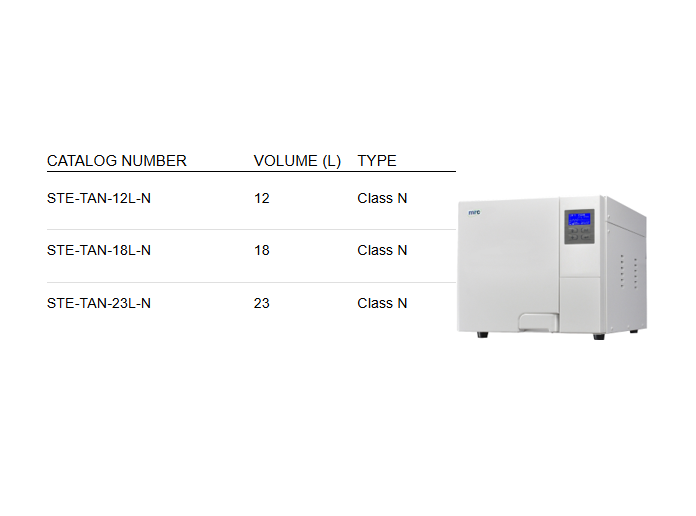
Class N Autoclaves
- Definition: The "N" stands for non-vacuum. These use gravity displacement to remove air from the chamber.
- How it works: Steam is introduced into the chamber, forcing air out through a drain at the bottom. No vacuum pump is used.
- Applications:
- Sterilizing solid, unwrapped instruments.
- Suitable for small, low-risk loads where air removal is less critical.
- Advantages:
- Cost-effective and simple design.
- Suitable for basic sterilization needs.
- Limitations:
- Cannot sterilize hollow, porous, or wrapped items effectively.
- Less efficient air removal may compromise sterilization of complex items.
- Best for: Small dental or medical clinics with basic sterilization needs.
Class B Autoclaves
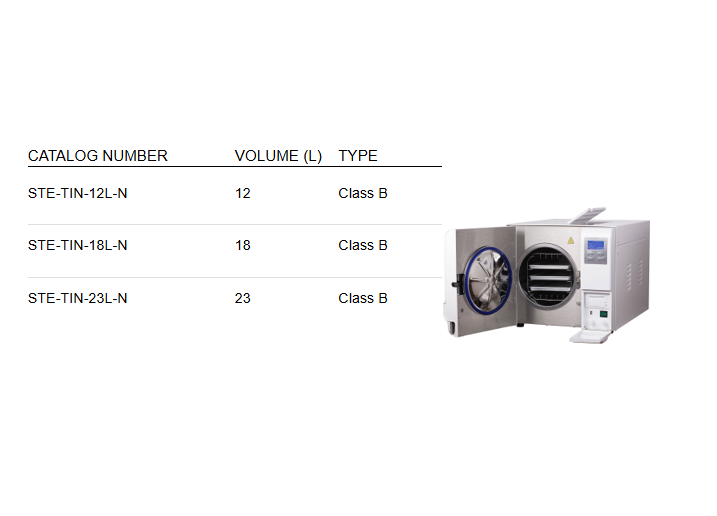
- Definition: The "B" stands for big sterilization range. These use a pre-vacuum and post-vacuum pump to create a vacuum and ensure better air removal.
- How it works:
- Before sterilization, a vacuum pump removes air from the chamber to ensure steam penetrates all parts of the load, including hollow or porous items.
- After sterilization, a post-vacuum ensures effective drying of the load.
- Applications:
- Sterilizing wrapped instruments, hollow instruments (e.g., dental handpieces), porous materials, and textiles.
- Ideal for complex loads requiring thorough sterilization.
- Advantages:
- Ensures complete sterilization of all item types.
- Effective drying process reduces the risk of contamination.
- Limitations:
- More expensive than Class N.
- Requires more maintenance and technical expertise.
- Best for: High-demand settings like dental clinics, hospitals, and research labs where a wide variety of items need to be sterilized.
Class S (Bonus Info)
There is also a Class S category, which falls between Class N and Class B:
- How it works: Uses limited vacuum or gravity displacement.
- Applications: For specific types of loads (manufacturer-defined).
- Flexibility: Not as versatile as Class B but more capable than Class N.
Choosing Between Class N and Class B:
- Choose Class N if:
- You have a limited budget.
- You sterilize only solid, unwrapped instruments.
- Choose Class B if:
- You sterilize a variety of items, including wrapped, hollow, or porous materials.
- You need reliable and comprehensive sterilization.
Why Choose MUNRO for Your Autoclave Needs?
With a strong reputation for quality and reliability, MUNRO specializes in providing autoclaves to a wide array of industries, including dental clinics, beauty salons, laboratories, and beyond. Our solutions ensure safety and sterility, meeting the highest standards of hygiene and performance.
Whether you are a dental practitioner, researcher, or aesthetic professional, MUNRO's sterilization autoclaves deliver the precision and dependability you need to maintain a sterile environment.