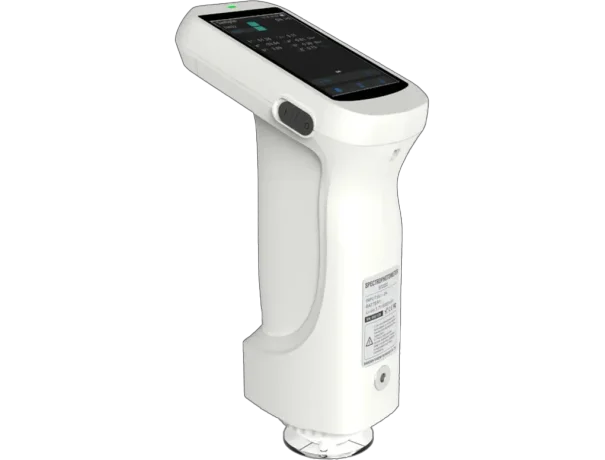
Color meters are precision instruments used to quantify and analyze color in an objective, repeatable manner. They are essential in industries where color consistency, quality control, and compliance with international standards are critical. Unlike visual inspection, which is subjective and influenced by lighting and human perception, color meters provide numerical data that can be reliably compared over time, between batches, and across production sites.
Color meters are widely used in plastics, paints and coatings, textiles, printing, packaging, automotive interiors, consumer electronics, food, pharmaceuticals, cosmetics, and advanced research laboratories.
A color meter is a device that measures the spectral or tristimulus properties of reflected or transmitted light from a sample. The result is expressed in standardized color spaces such as CIE Lab*, LCh°, XYZ, or RGB. These values allow precise comparison between a reference sample and a test sample, enabling accurate pass or fail decisions.
Depending on design and application, color meters may be contact-based or non-contact, portable or benchtop, and may use different optical geometries and illumination systems.
Why Accurate Color Measurement Matters
Color is often a defining quality attribute of a product. Even small deviations can lead to product rejection, brand inconsistency, or regulatory issues.
Key reasons for using professional color meters include:
- Ensuring batch-to-batch color consistency
- Reducing waste caused by color mismatches
- Meeting customer and brand specifications
- Supporting objective quality control processes
- Complying with ISO, ASTM, DIN, and other international standards
- Improving communication across global supply chains using numerical color data
Main Types of Color Meters in This Product Category
Multi Angles Spectrophotometers
Multi angles spectrophotometers are specialized instruments designed to measure color at multiple viewing angles. They are essential for materials with special optical effects such as metallic, pearlescent, or effect pigments.
Key characteristics
- Measures color at several predefined angles, typically 15°, 25°, 45°, 75°, and 110°
- Captures color flop, sparkle, and graininess
- Critical for automotive coatings, plastics, and decorative finishes
Typical applications
- Automotive exterior and interior components
- Effect coatings and paints
- High-end consumer products with visual effects
Spectrophotometers
Standard spectrophotometers measure the full visible spectrum of light reflected or transmitted by a sample. They provide high accuracy and flexibility across a wide range of materials.
Key characteristics
- Measures spectral reflectance across the visible range
- Converts spectral data into multiple color spaces
- Suitable for both solid and liquid samples, depending on configuration
Typical applications
- Plastics and polymers
- Paints and inks
- Textiles
- Research and development laboratories
Spectrophotometers are considered the backbone of professional color measurement systems
Geometry: D/8 with SCI and SCE Modes
The D/8 geometry is one of the most widely used optical configurations in color measurement.
What D/8 means
- Diffuse illumination using an integrating sphere
- Measurement at 8° viewing angle relative to the sample normal
SCI and SCE explained
- SCI (Specular Component Included): Measures color including surface gloss
- SCE (Specular Component Excluded): Measures color excluding surface gloss
Why this matters
- SCI is ideal for color formulation and consistency control
- SCE correlates better with human visual perception
- Switching between SCI and SCE allows deeper understanding of surface and color interactions
Typical applications
- Plastics and molded parts
- Painted surfaces
- Paper and packaging materials
Non-contact Benchtop Spectrophotometers
Non-contact benchtop spectrophotometers are designed to measure color without physically touching the sample. This is crucial for delicate, wet, soft, or uneven surfaces.
Key characteristics
- Optical measurement at a controlled distance
- High repeatability in laboratory environments
- Eliminates contamination or sample deformation
Typical applications
- Fresh paints and coatings
- Cosmetic products
- Food samples
- Textiles and soft materials
- Research applications requiring maximum sample integrity
These systems are commonly used in central laboratories and quality control departments where precision and repeatability are critical.
Spectrocolorimeters
Spectrocolorimeters combine the principles of spectrophotometry with simplified operation, offering a balance between accuracy and ease of use.
Key characteristics
- Uses spectral measurement rather than filtered sensors
- More accurate than traditional colorimeters
- Often more compact and user-friendly than full laboratory spectrophotometers
Typical applications
- Production line quality control
- Incoming and outgoing inspection
- General industrial color checks
Spectrocolorimeters are an excellent choice for companies that need reliable color data without the complexity of high-end laboratory systems.
Key Technical Parameters to Consider
When selecting a color meter, several technical factors must be evaluated carefully:
Optical Geometry
Choice between D/8, 45/0, or multi-angle geometry affects how surface texture and gloss influence results.
Measurement Aperture
Different aperture sizes allow measurement of small components, textured surfaces, or large uniform areas.
Repeatability and Inter-instrument Agreement
Critical for multi-site production and long-term quality programs.
Illumination and Observer Conditions
Standard illuminants such as D65, A, or F and observer angles such as 2° and 10° ensure compliance with international standards.
Software and Data Management
Advanced software enables color difference calculations, tolerance setting, trend analysis, and integration into quality systems.
Color Difference and Tolerances
Color meters calculate color differences using formulas such as:
- Delta E*ab
- Delta E*94
- Delta E*00
These values define acceptable tolerances for production. Proper tolerance management reduces disputes between suppliers and customers and ensures consistent decision-making.
Industries Using Color Meters
Color meters are essential across many sectors:
- Automotive and aerospace
- Plastics and polymers
- Paints, coatings, and inks
- Printing and packaging
- Textiles and apparel
- Food and beverages
- Cosmetics and personal care
- Pharmaceutical and medical devices
- Research and academic laboratories