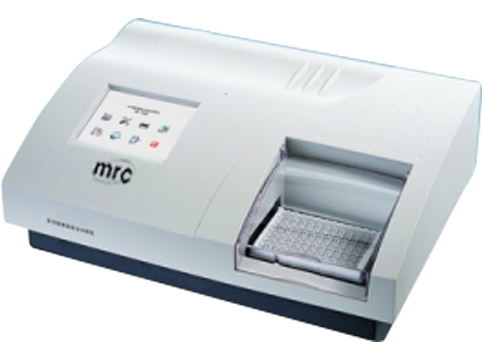
An ELISA reader is a laboratory instrument used to quantify the amount of a specific substance, such as an antigen or antibody, in a sample. The acronym ELISA stands for Enzyme-Linked Immuno Sorbent Assay, which is a type of biological assay that measures the presence of a substance by detecting the binding of specific antibodies or antigens to specific receptors.
How to works
The ELISA reader works by illuminating the sample in a cuvette and measuring the light absorbance at a specific wavelength. The absorbance value is proportional to the concentration of the substance being measured. This measurement is performed in a microtiter plate, which contains multiple wells in which the sample can be added. The ELISA reader can be used to read the absorbance of a single well or multiple wells simultaneously.
1. Principle of ELISA:
- ELISA is based on the binding of specific antibodies to their corresponding antigens, with an enzyme-linked detection system to produce a measurable signal, usually a color change.
2. Operation of the Reader:
- Sample Preparation: Samples and reagents are added to a microplate (96 or 384 wells).
- Reaction: The enzyme catalyzes a reaction producing a color change proportional to the concentration of the target substance.
- Detection:
- The ELISA reader measures the absorbance (optical density, OD) of light at specific wavelengths.
- The OD values correspond to the concentration of the target substance, calculated using a standard curve.
Types
There are two main types of ELISA readers: spectrophotometric and fluorometric. Spectrophotometric ELISA readers measure the absorbance of light at a specific wavelength, while fluorometric ELISA readers measure the fluorescence of the sample. Fluorometric ELISA readers are often more sensitive and specific than spectrophotometric ELISA readers and are commonly used for the detection of low-abundance substances.
Types of ELISA Readers
1. Absorbance-Based Readers:
- Detect changes in color intensity.
- Common wavelengths: 405, 450, 492, and 630 nm.
2. Fluorescence ELISA Readers:
- Measure fluorescent signals emitted by labeled substances.
- Offer higher sensitivity for low-abundance targets.
3. Luminometry ELISA Readers:
- Detect luminescent signals emitted by enzymatic reactions.
- Provide extremely high sensitivity and are suitable for detecting very low concentrations.
4. Multi-Mode ELISA Readers:
- Combine absorbance, fluorescence, and luminescence capabilities.
- Versatile and widely used in advanced research.
Applications
The ELISA reader is a crucial tool for many laboratory applications, including diagnosing diseases, monitoring therapeutic treatment, and performing basic research. The ELISA reader is used in both research and clinical laboratories, providing fast and reliable results. In addition, ELISA readers can be programmed to perform specific tests, such as testing for the presence of specific antibodies or antigens in a sample.
Benefits
One of the major benefits of the ELISA reader is its ability to automate the process of quantifying substances in a sample. ELISA readers can be programmed to perform multiple tests in a single run, reducing the amount of time required for manual testing and increasing the speed and accuracy of the results.
The ELISA reader is an important laboratory instrument for quantifying specific substances in a sample. Its ability to automate the testing process and provide fast and reliable results make it a valuable tool for both research and clinical laboratories. Whether used for disease diagnosis or basic research, the ELISA reader is an indispensable tool for modern biology.
Microplate Washer
An ELISA washer is a laboratory instrument used in the process of performing an ELISA test. The ELISA washer is used to remove any unbound substances from the well after each step of the assay, ensuring that only the specific binding reaction is measured.
The ELISA test consists of several steps, including adding the sample, adding the specific antibody or antigen, and washing the well to remove any unbound substances. The washing step is crucial to the accuracy of the test as it ensures that only the specific binding reaction is measured.
Manually washing the wells can be time-consuming and prone to human error, leading to inconsistent results. The ELISA washer automates the washing process, making it faster and more reliable. The ELISA washer uses a combination of vacuum pressure and aspiration to remove unbound substances from the well, ensuring that the wells are thoroughly cleaned before the next step of the assay.
In addition, the ELISA washer can be programmed to perform specific washing protocols, such as performing a specific number of washes or using a specific wash solution. This ensures that the wells are thoroughly cleaned and reduces the risk of human error.
The ELISA washer is an essential tool for performing accurate and reliable ELISA tests. Its ability to automate the washing process and reduce the risk of human error makes it a valuable tool for both research and clinical laboratories. Whether used for disease diagnosis or basic research, the ELISA washer is a crucial component of the ELISA test.
Uses and Applications of ELISA Readers
1. Clinical Diagnostics:
- Detection of diseases by identifying specific antigens or antibodies in blood or other biological fluids.
- Examples: COVID-19 testing, HIV, hepatitis, and autoimmune disorders.
2. Pharmaceutical Research:
- Monitoring drug efficacy by measuring biomarker levels.
- Drug discovery and development.
3. Food Safety Testing:
- Detecting contaminants such as allergens, toxins, or pathogens.
- Ensuring food quality and regulatory compliance.
4. Environmental Monitoring:
- Testing for pollutants, toxins, and contaminants in water and soil samples.
5. Veterinary Medicine:
- Disease detection and monitoring in animals.