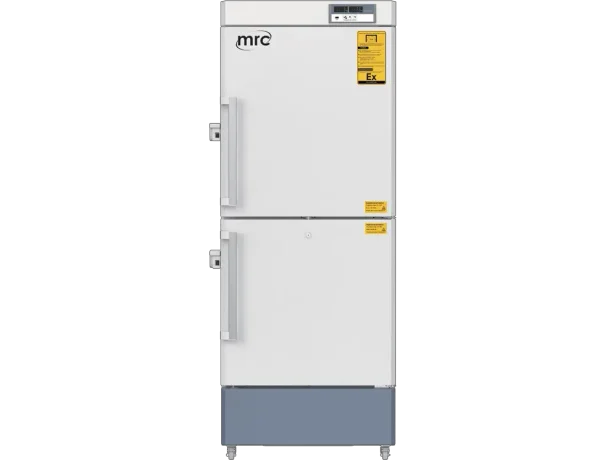
Explosion-proof refrigerators/freezers exist for one job: keep ignition sources from triggering an explosion in a hazardous environment.
Why Standard Refrigerators Are Dangerous for Flammables
A normal household fridge is full of tiny ignition opportunities. It was never designed for flammable vapors.
Hidden Ignition Sources Inside Common Units
Common internal ignition sources include:
- Thermostats and relays that can arc
- Light switches and interior lamps
- Fan motors inside the compartment
- Defrost heaters and wiring connections
- Static discharge points depending on materials and humidity
You might never notice these in daily life, because most food vapors are not flammable. Swap the contents to solvents, and the whole equation changes.
The “Vapor Cloud” Scenario Explained Simply
Imagine you store a bottle of solvent. The cap is not perfect. Or someone spills a little into a tray and forgets it. Vapors build up in the cold compartment. Now the compressor cycles or a switch arcs. That spark meets the vapor cloud. The result is exactly what you think it is.
This is why safety teams are strict about “no flammables in domestic fridges.” It is not paranoia. It is physics plus probability.
Where Explosion-proof Refrigerators/Freezers Are Used
Explosion-proof units show up anywhere that chemical storage meets hazardous atmosphere risk.
Laboratories and Research Facilities
Research labs often store:
- Solvents for chromatography or synthesis
- Flammable standards and reagents
- Sample extracts in volatile matrices
If the lab has solvent-heavy workflows, hazardous zone classification may apply in certain rooms or areas.
Pharma, Biotech, and Compounding
Some facilities store flammable intermediates, cleaning solvents, or alcohol-based solutions. Even if the product is “pharma,” the storage reality can still involve flammables.
Paints, Coatings, Adhesives, and Printing
This is a classic zone: high solvent usage, vapor generation, and frequent transfers. Refrigeration may be needed for viscosity stability, shelf-life, or quality control.
Petrochemical, Oil and Gas, and Refineries
Hazardous locations are part of daily life here. If you are storing anything in flammable zones, your equipment selection is not optional.
The Science of Ignition and Containment
No need for a chemistry PhD. You just need three concepts.
Temperature, Flash Point, and Vapor Pressure in Plain English
- Flash point is the temperature where a liquid produces enough vapor to ignite if a spark is present.
- Vapor pressure tells you how easily a liquid evaporates.
- Lower temperature often reduces evaporation, but it does not eliminate it. Many solvents still produce vapors at refrigeration temperatures.
So refrigeration can reduce vapor generation, but the risk is still real.
What “Hazardous Location” Means
A hazardous location is an area where flammable gases/vapors or combustible dust may be present in enough quantity to create an ignition risk.
Gas/Vapor Zones and Dust Zones
Some environments are gas/vapor hazards. Others are dust hazards. Some can be both. The classification drives what type of protection and certification you need.