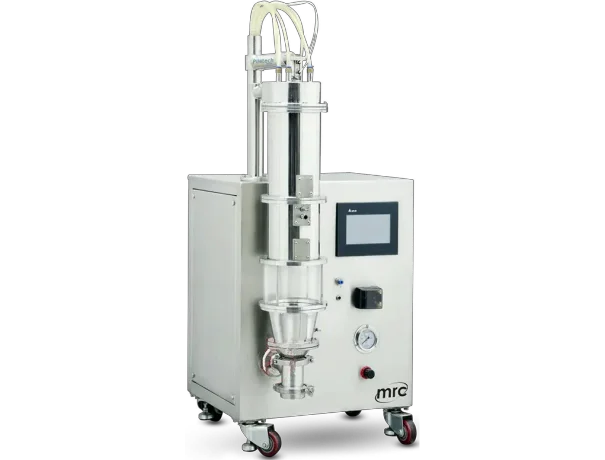
Fluid bed dryers deliver efficient drying for powders and granules.
They support consistent product quality across demanding production lines.
Moreover, they fit both batch and continuous manufacturing.
As a result, teams achieve predictable throughput and repeatable results.
Key Industries and Applications
Pharmaceutical manufacturers dry granules before tablet compression.
Additionally, they dry pellets for capsules and modified release products.
Food producers dry seasonings, instant mixes, and functional powders.
Meanwhile, chemical plants dry crystals, catalysts, and polymer resins.
Furthermore, nutraceutical lines dry botanicals after wet granulation.
Consequently, many plants standardize on fluid bed drying for flexibility.
Pharmaceuticals
-
Drying wet granules after high-shear granulation
-
Drying pellets and beads
-
Drying APIs and intermediates (where controlled temperature is important)
-
Fluid bed coating (taste masking, controlled release, protective films)
-
Agglomeration and granulation (fluid bed granulators)
Food and nutraceuticals
-
Drying grains, cereals, and starch-based materials
-
Drying sugar, salt, and food powders
-
Instantizing/agglomerating powders (improves wettability and dispersibility, e.g., cocoa mixes, drink powders)
-
Drying plant extracts and nutraceutical blends (with careful temperature control)
Chemicals and industrial materials
-
Drying crystals (e.g., salts) and precipitated solids
-
Drying catalysts and catalyst supports
-
Drying polymers/resins in granular form
-
Drying pigments and fillers where gentle mixing reduces clumping
-
Post-filtration or centrifuge cake drying (when particle size allows fluidization)
Minerals and bulk solids
-
Drying sand, minerals, and ores in sized fractions
-
Drying fertilizers (urea, NPK granules) and conditioning granules
Other process uses (beyond drying)
-
Cooling hot granules or powders after processing
-
Pre-heating solids before downstream steps
-
Moisture conditioning (bringing product to a target residual moisture)
-
Dusting and surface treatment (light coating, anti-caking agents)
When a fluid bed dryer is a good fit
-
Free-flowing particles or granules (typically not sticky)
-
Need for uniform moisture and temperature across the batch
-
Tight control of product temperature (useful for heat-sensitive products)
-
Desire to combine steps (dry + cool, dry + coat, dry + granulate)
Performance Advantages
Fluidization improves contact between air and particles.
Therefore, drying completes faster than many tray-based methods.
Also, the process supports narrow moisture targets.
In contrast, uneven beds often cause wide moisture variation.
Similarly, controlled airflow reduces localized overheating.
As a result, sensitive materials keep their functional properties.
Uniform Drying and Product Consistency
Air distributes through the bed for even moisture removal.
Consequently, operators reduce wet pockets and clumping.
Moreover, uniform drying improves downstream milling performance.
Therefore, sieving and blending become more predictable.
Additionally, final bulk density stays within tighter limits.
Shorter Cycle Times
High surface exposure accelerates mass transfer.
Thus, production schedules tighten without sacrificing quality.
Next, shorter cycles reduce utility consumption per batch.
Consequently, plants improve cost per kilogram.
Process Configurations
Batch fluid bed dryers suit multi-product facilities.
Meanwhile, continuous systems suit high-volume, steady demand.
Additionally, top-spray and bottom-spray options support coating workflows.
Therefore, teams combine drying and granulation in one platform.
Furthermore, integrated filters reduce fines loss and improve housekeeping.
Critical Control Parameters
Airflow, inlet temperature, and humidity drive performance.
Consequently, operators track dew point and exhaust conditions.
Also, bed load and particle size affect fluidization stability.
Therefore, consistent feed preparation matters.
Moreover, nozzle settings influence agglomeration for wet granulation.
Temperature Control
Temperature control protects heat-sensitive ingredients.
Thus, vitamins, enzymes, and flavors maintain potency.
Additionally, staged temperature ramps reduce case hardening.
Consequently, moisture escapes smoothly from particle interiors.
Air Distribution and Bed Behavior
A stable bed indicates balanced airflow and load.
Therefore, plants monitor pressure drop and vibration patterns.
Meanwhile, poor distribution causes channeling and uneven drying.
As a result, corrective maintenance becomes essential.
Product Handling and Containment
Closed systems support dust control and operator safety.
Moreover, containment designs help potent compounds processing.
Additionally, CIP and WIP options reduce manual cleaning.
Consequently, changeovers become faster and more consistent.
In contrast, open transfer increases contamination risk.
Selection Criteria for Buying
Capacity must match batch size and target throughput.
Therefore, define moisture load and drying endpoints early.
Also, evaluate heating method, steam, electric, or gas.
Moreover, confirm filter area to prevent frequent blinding.
Additionally, check controls, alarms, and data logging capabilities.
Consequently, validation and audit readiness improve.
Material Characteristics to Consider
Particle size distribution affects fluidization and entrainment.
Therefore, assess fines content and segregation risk.
Also, sticky products may require anti-stick strategies.
Additionally, hygroscopic powders need low-humidity inlet air.
As a result, performance stays stable across seasons.
Maintenance and Reliability
Routine filter inspection prevents airflow restriction.
Therefore, teams schedule pulse-jet checks and gasket reviews.
Additionally, inspect air heaters and sensors for drift.
Meanwhile, verify door seals and clamp integrity.
Consequently, plants reduce unplanned downtime and rework.
Quality and Compliance Alignment
Modern systems support recipe control and audit trails.
Therefore, regulated industries maintain consistent documentation.
Additionally, sensors enable in-process moisture verification.
Consequently, release decisions become faster and more confident.
Moreover, robust cleaning records strengthen contamination control.
Common Operational Challenges
Over-wetting causes large agglomerates and long cycles.
Therefore, optimize spray rate and atomization settings.
Also, excessive fines can trigger filter loading.
Consequently, adjust air velocity and install pre-separation.
Meanwhile, insufficient fluidization causes hot spots.
As a result, verify distributor plate condition and bed load.