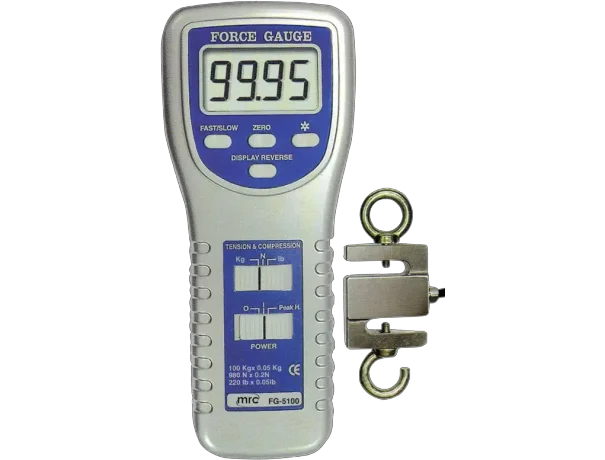
Force is a core concept in physics, engineering, and industrial testing. Every mechanical interaction, whether pushing, pulling, compressing, or stretching, involves force. To ensure accuracy in design, production, and quality control, force must be measured precisely using standardized units and reliable instruments such as force gauges.
What Is Force?
Force can be defined as any interaction that causes an object to change its motion or shape. It is responsible for acceleration, deceleration, deformation, and structural stress. Because force has both size and direction, it is considered a vector quantity. This means that applying force in different directions can produce different outcomes, even if the magnitude is the same.
In practical terms, force is present in nearly every industrial and laboratory process, from testing materials to assembling products.
What Unit Is Force Measured In?
The primary unit of force in the International System of Units (SI) is the newton (N). This unit is universally used in science and most engineering applications.
One newton represents the amount of force required to accelerate a mass of one kilogram at a rate of one meter per second squared. This relationship is expressed in the formula:
F = m × a
Where:
- F represents force
- m represents mass
- a represents acceleration
This definition provides a consistent and measurable way to quantify force across different applications.
Alternative Units of Force
While the newton is the global standard, other units are still used depending on the region or industry:
- Pound-force (lbf), commonly used in the United States
- Kilogram-force (kgf), sometimes used in engineering contexts
- Dyne, used in the centimeter-gram-second (CGS) system
Modern measuring devices typically allow users to switch between these units, making them versatile for international use.
How Force Is Measured
Force is measured using instruments that convert mechanical stress into a readable value. These instruments detect how much an object deforms or resists when a force is applied.
The most common and reliable device for this purpose is the force gauge.
What Is a Force Gauge?
A force gauge is a specialized measuring device designed to quantify both pushing (compression) and pulling (tension) forces. It is widely used in laboratories, manufacturing facilities, and research environments.
Force gauges provide precise, repeatable measurements and are essential for ensuring that materials and products meet required strength and performance standards.
Types of Force Gauges
Mechanical Force Gauges
Mechanical force gauges operate using physical components such as springs. When a force is applied, the spring stretches or compresses, and the displacement is translated into a force reading.
Advantages:
- Simple and durable design
- No need for electrical power
- Cost-effective
Limitations:
- Lower accuracy compared to digital systems
- Limited data recording capabilities
- Susceptible to mechanical wear over time
Digital Force Gauges
Digital force gauges use electronic sensors, typically load cells or strain gauges, to measure force. When force is applied, the sensor undergoes a small deformation that generates an electrical signal. This signal is processed and displayed as a numerical value.
Advantages:
- High precision and repeatability
- Ability to measure peak force
- Data storage and output options
- Easy unit conversion
Digital force gauges are the preferred choice in modern laboratories and industrial environments where accuracy and traceability are critical.
Types of Force Measurements
Force gauges can measure different types of forces depending on the application:
Tension Force
This is the force exerted when an object is pulled. It is commonly used to test cables, wires, and materials under stretching conditions.
Compression Force
This is the force applied when an object is pushed or compressed. It is often used to evaluate the strength of components or materials under load.
Break Force
This measurement determines the amount of force required to cause failure or fracture in a material.
Peel and Adhesion Force
Used to test the bonding strength of materials, especially in packaging and adhesives.
Applications of Force Gauges
Force gauges are used across a wide range of industries where precise force measurement is essential.
Manufacturing and Quality Control
Force gauges ensure that products meet specified mechanical requirements. They are used to test assembly forces, component strength, and product durability.
Laboratory Testing
In laboratory environments, force measurement is critical for material characterization and product validation. Equipment such as hardness testers and other analytical instruments often rely on force measurement.
Pharmaceutical Industry
Force meters are used to test tablet hardness, packaging integrity, and sealing strength. Accurate force measurement ensures compliance with strict regulatory standards.
Automotive and Aerospace
Force meters are used to verify the performance of components, including springs, fasteners, and structural parts. Safety and reliability are critical in these industries.
Packaging Industry
Testing opening force, seal strength, and closure integrity helps ensure product quality and user convenience.
Electronics
Force measurement is used to test buttons, switches, and connectors to ensure proper functionality and durability.
Importance of Accurate Force Measurement
Accurate force measurement is essential for several reasons:
- Ensures consistent product quality
- Prevents mechanical failures
- Supports compliance with international standards
- Provides reliable data for research and development
Even minor deviations in force measurement can lead to significant issues in product performance or safety.
Force vs Torque
It is important to distinguish between force and torque. While force refers to a straight push or pull, torque describes a rotational effect. Torque is measured in newton-meters (Nm), whereas force is measured in newtons (N).
Understanding this difference is essential when selecting the appropriate measurement instrument.