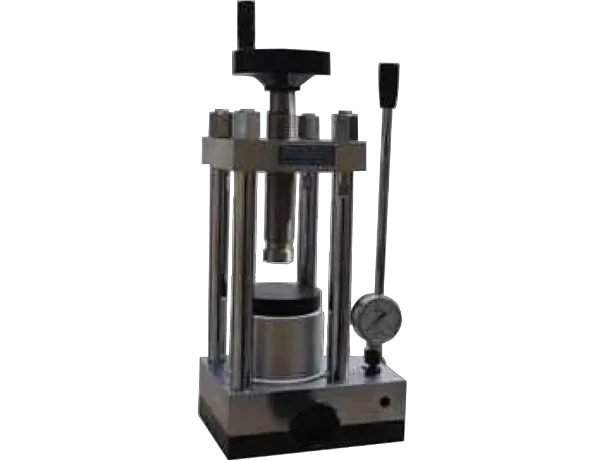
A hydraulic press works on a simple physical principle. Pressure applied to a confined fluid is transmitted equally in all directions. By applying force through a hydraulic cylinder, a relatively small input force can generate very high compressive loads. This makes hydraulic presses ideal for compacting materials with precision and control.
Key Components of a Hydraulic Press
Hydraulic Cylinder
This is the heart of the press. It converts hydraulic pressure into linear force. The size and design of the cylinder determine the maximum load the press can generate.
Pump and Pressure System
The pump supplies hydraulic fluid under pressure. In manual presses, this is done with a hand lever. In automatic models, electric pumps handle pressure generation with high precision.
Frame and Platen
The frame provides structural stability, while the platens support the die and sample. A rigid frame is critical for maintaining alignment and preventing uneven compression.
Why Sample Preparation Matters
The Role of Consistency in Laboratory Analysis
Analytical techniques rely on uniform samples. Variations in density, thickness, or surface flatness directly affect results. For example, in XRF or IR analysis, inconsistent pellets can distort readings and increase measurement uncertainty.
A hydraulic press eliminates guesswork by delivering consistent force every time.
Consequences of Poor Sample Preparation
Poorly prepared samples lead to repeat testing, wasted materials, and unreliable data. Over time, this costs far more than investing in proper preparation equipment.
How a Hydraulic Press Is Used for Sample Preparation
Powder Compaction
Loose powders are compressed into solid forms with controlled density. This improves handling and ensures consistent analytical performance.
Pellet Formation
Pellets are commonly required for spectroscopy, elemental analysis, and quality control. Hydraulic presses produce flat, crack free pellets with uniform thickness.
Molding and Shaping Samples
Some applications require specific shapes or dimensions. Hydraulic presses work with custom dies to mold samples accurately.
Common Applications Across Industries
Analytical Chemistry and Spectroscopy
Hydraulic presses are widely used to prepare pellets for XRF, FTIR, and other spectroscopic methods.
Materials Science and Metallurgy
In materials research, pressed samples allow controlled testing of mechanical and structural properties.
Pharmaceutical and Life Sciences
Tablet formulation, powder characterization, and quality testing rely heavily on consistent compression.
Environmental and Geological Testing
Soil, mineral, and sediment samples are often compacted before analysis to improve reproducibility
Key Specifications to Consider
Pressing Force and Tonnage
Laboratory presses typically range from 5 to 40 tons. The required force depends on sample material, die size, and application.
Pressure Control and Accuracy
Fine pressure control ensures uniform compaction and prevents sample damage.
Platen Size and Daylight
Adequate space is needed to accommodate dies, molds, and accessories.
Safety Features
Pressure relief valves, protective shields, and emergency stops are essential for safe operation.