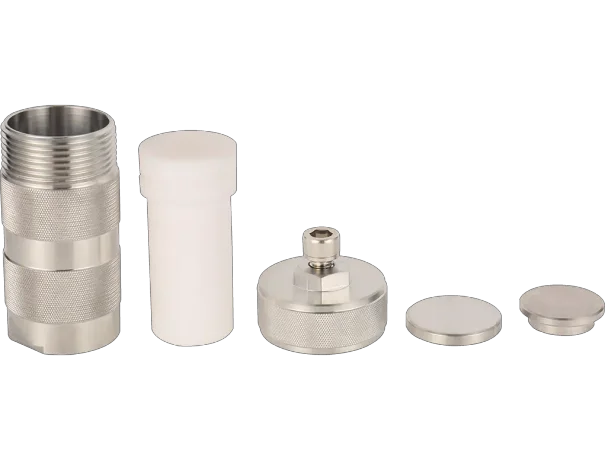
Hydrothermal reactors are advanced laboratory instruments designed to carry out chemical reactions in sealed vessels under elevated pressure and temperature. These systems enable scientists to dissolve, digest, synthesize, and transform materials in liquid environments that cannot be achieved under normal laboratory conditions.
Widely used in materials science, nanotechnology, geochemistry, environmental analysis, and chemical research, hydrothermal reactors are essential tools for controlled experimentation in extreme conditions.
This in depth guide explains how hydrothermal reactors work, their main applications, design features, advantages, safety considerations, and how to choose the right system for your laboratory.
What Is a Hydrothermal Reactor?
A hydrothermal reactor is a pressure resistant vessel, typically made of stainless steel or high alloy metals, often lined with corrosion resistant materials such as PTFE or PPL. The reactor is sealed and heated to temperatures that can reach several hundred degrees Celsius, causing internal pressure to rise as the liquid medium expands and vaporizes.
Under these conditions, water and other solvents exhibit altered chemical properties, enabling:
- Faster reaction kinetics
- Enhanced solubility of solids
- Formation of crystalline phases
- Controlled particle growth
- Efficient sample digestion
Typical laboratory models operate up to 500°C and pressures around 40 to 50 bar, depending on design and volume.
How Do Hydrothermal Reactors Work?
The working principle is straightforward but highly controlled:
- Sample Loading
The sample and solvent are placed inside a removable liner or crucible. - Sealing the Vessel
The outer metal shell is tightened to create a pressure tight environment. - Heating Phase
The reactor is placed in an oven, heating block, or furnace where temperature is gradually increased. - Reaction Stage
At elevated temperature, pressure builds inside the vessel, driving chemical transformations in the liquid phase. - Cooling and Opening
After the reaction is complete, the system is cooled before being safely opened for analysis.
Precise control over temperature, time, and filling ratio is critical to achieving reproducible and safe results.
Applications of Hydrothermal Reactors
Hydrothermal reactors support a wide range of scientific and industrial research tasks.
Sample Digestion
In analytical chemistry and environmental testing, hydrothermal digestion breaks down solid matrices such as:
- Soils and sediments
- Rocks and minerals
- Biological tissues
- Food samples
- Polymers
This prepares samples for downstream analysis using techniques like ICP OES, ICP MS, or atomic absorption spectroscopy.
Hydrothermal Synthesis
Researchers frequently use hydrothermal methods to create advanced materials, including:
- Metal oxide nanoparticles
- Zeolites and porous frameworks
- Battery electrode materials
- Ceramic powders
- Quantum dots
The sealed liquid environment allows precise control of crystal structure, morphology, and particle size.
Dissolution of Difficult Materials
Some solids resist dissolution under ambient conditions. Elevated temperature and pressure improve solvent strength, enabling the processing of refractory or highly stable compounds.
Geochemical and Environmental Studies
Hydrothermal reactors simulate natural underground systems, making them valuable for studying:
- Mineral formation
- Rock water interactions
- Corrosion processes
- Hydrothermal vents
- Fluid transport mechanisms
Components
High performance hydrothermal reactors share several essential design elements.
Pressure Vessel
The outer shell is typically fabricated from hardened stainless steel, Inconel, or similar alloys capable of withstanding repeated thermal cycling and high internal pressure.
Inner Liner
Removable liners protect the metal body and resist aggressive chemicals. Common materials include:
- PTFE for strong acids and bases
- PPL for higher temperature stability
- Quartz or ceramic inserts for specialized reactions
Sealing System
High quality gaskets, O rings, and threaded closures ensure leak free operation. Proper torque and inspection are essential for safety.
Heating System
Hydrothermal reactors are commonly heated using:
- Laboratory ovens
- Electric heating mantles
- Dedicated reactor blocks
- Furnaces with temperature controllers
Temperature Monitoring
Thermocouples or external probes provide accurate readings and allow programmable heating profiles.
Advantages of Using Hydrothermal Reactors
Hydrothermal systems offer several important benefits for laboratory research:
- Ability to perform reactions beyond the boiling point of solvents
- Enhanced solubility and reaction rates
- Production of highly crystalline materials
- Closed environment that limits contamination
- Reproducible experimental conditions
- Compatibility with corrosive reagents
These advantages make them indispensable in advanced chemical and materials research.
How to Choose the Right Hydrothermal Reactor
Selecting the correct system depends on several technical and operational factors.
Operating Limits
Verify maximum allowable temperature and pressure for the reactor body and liner.
Volume and Throughput
Laboratory models range from a few milliliters to several liters. Choose based on sample size and number of parallel experiments.
Liner Material
Match the liner to your chemistry and temperature requirements.
Heating Method
Consider whether you will use an existing oven or a dedicated heating block for faster and more uniform temperature control.
Certification and Quality
Look for systems manufactured according to recognized engineering and safety standards, with pressure testing and clear operating documentation.