Using a light meter, one can measure the amount of light in a specific area with a lightweight, portable device. Various applications and uses are possible with these highly sensitive measuring instruments.
In addition to measuring the amount of light in a room or building, light meters can ensure the area is adequately lit. Lux meters and exposure meters are other terms for light meters.
What is the purpose of light meters?
It is important to measure light levels in public places and workplaces for health and safety reasons. Coming to photography refers to assessing the ideal equipment and settings for a planned photo shoot.
Offices, hospitals, and schools - in fact, any place with significant foot traffic - are examples of the first type of location. The law requires employers to provide adequate and suitable lighting in their workplaces. This has implications for safety in public areas as well.
Professional photographers use handheld meters to optimize shots. By measuring ambient light, they can determine shutter speeds and apertures. When used outdoors, where ambient light levels tend to be complex, this is especially useful.
The lighting for film scenes is also controlled by light meters by cinematographers and film set designers. Light meters can also be used for:
- To ensure that plants receive enough light to grow healthily in hydroponics.
- The lighting system used in construction or architecture must have been installed properly.
- It is important to choose the correct position and angle when installing solar panels.
- Monitor and prevent light pollution by measuring light pollution levels.
Lux meters can easily be used in a domestic, commercial, or industrial environment for the following reasons, among others:
- Determining the light levels and intensity of the light
- To determine whether any adjustments need to be made
- Depending on the application, optimize both performance and comfort
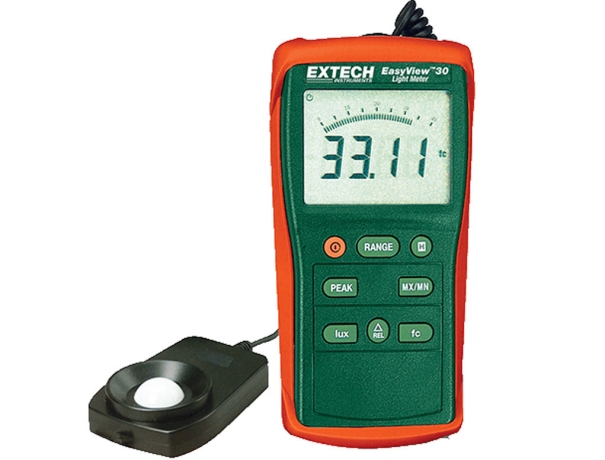
What Does a Light Meter Measure?
The purpose of a light meter is to measure the brightness of the light. This includes things such as: Fluorescent light, High-pressure sodium and metal halide sources, Light-emitting bodies, UV light sources, Visible light sources, Incandescent lighting, LED lights.
Despite the fact that they can be used in several different settings, industries, and applications, the basic concept remains the same. A device such as this is made with the intention of being easy to use and versatile at the same time. As a final point, it is also worth mentioning that some models are evaluative, while others are capable of storing measurements either via internal memory or by means of the data logger that is built into the device. The angle at which the incident light is incident may also be corrected using the cosine function of some meters.
According to the type of light meter, each light meter will record light measurements in one of three different ways: footcandles (fc), candelas per square meter (cd/m2), or lux (lx). Calibration of a meter can help in ensuring that accurate measurements can always be taken, as it will ensure that the meter is operating correctly at all times, but the accuracy may decrease over time.
Advantages of using a Light Meter:
Many lux meters are small and portable handheld devices that are used for measuring light levels. Because of this, they have the advantage of being easy to transport, as well as being flexible enough to be used in a wide range of environments.
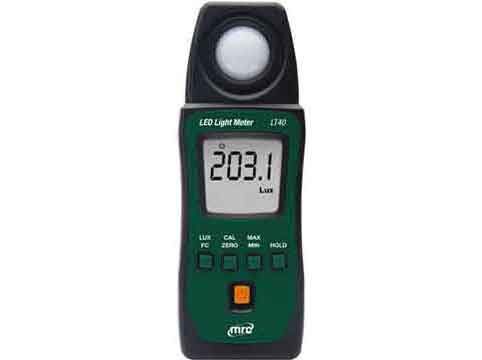
PAR (Photosynthetically Active Radiation)
- Definition: PAR is the portion of the light spectrum that plants use for photosynthesis, specifically light with wavelengths between 400 and 700 nanometers. This range includes visible light that plants can absorb using pigments like chlorophyll.
- Units: Measured in micromoles per square meter per second (µmol/m²/s), indicating the number of photons hitting a square meter of surface each second.
- Relevance: It quantifies the light intensity plants can use for photosynthesis. Higher PAR values generally support faster photosynthesis, up to a saturation point where plants cannot use more light efficiently.
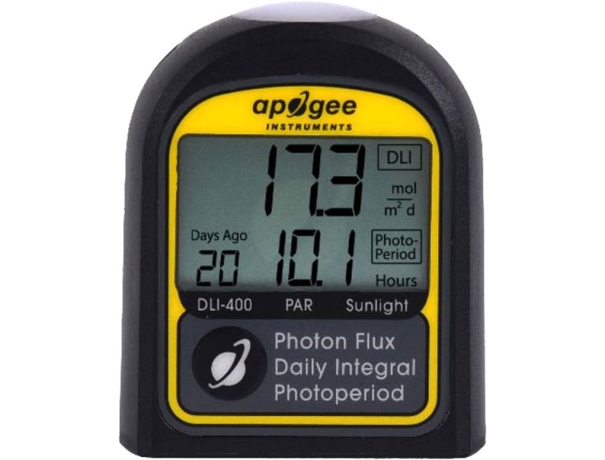
DLI (Daily Light Integral)
- Definition: DLI is the total amount of PAR light a plant receives over a 24-hour period. It integrates the light intensity (PAR) over time, providing a cumulative measure.
- Units: Measured in moles of photons per square meter per day (mol/m²/day).
- Relevance: DLI is crucial for understanding the total "dose" of light plants receive daily. Different plants have optimal DLI requirements:
- Low-light plants (e.g., shade plants): 5–10 mol/m²/day.
- Medium-light plants (e.g., most vegetables): 15–25 mol/m²/day.
- High-light plants (e.g., fruiting crops, cannabis): 25–40+ mol/m²/day.
DLI helps growers manage light delivery in greenhouses or growth chambers to optimize plant productivity.
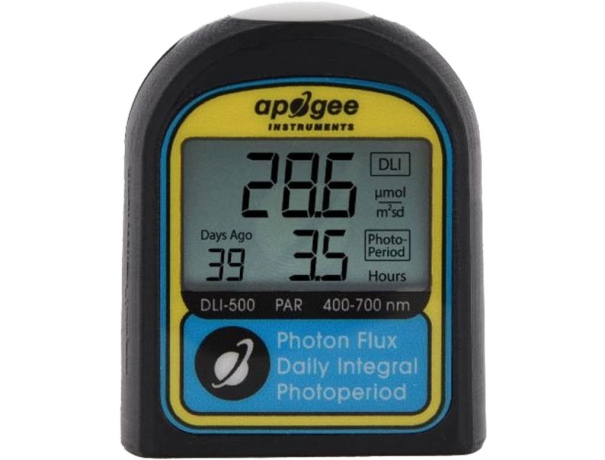
Photoperiod
- Definition: Photoperiod refers to the duration of light exposure a plant receives in a 24-hour period.
- Units: Measured in hours (e.g., 12 hours light/12 hours dark).
- Relevance: Photoperiod influences flowering and vegetative growth in many plants. Based on photoperiodic response, plants are categorized as:
- Short-day plants: Flower when daylight is shorter than a critical duration (e.g., chrysanthemums, poinsettias).
- Long-day plants: Flower when daylight is longer than a critical duration (e.g., spinach, lettuce).
- Day-neutral plants: Flower regardless of the photoperiod (e.g., tomatoes, peppers).
Photoperiod management is a vital tool in controlled environments to trigger flowering or keep plants vegetative.
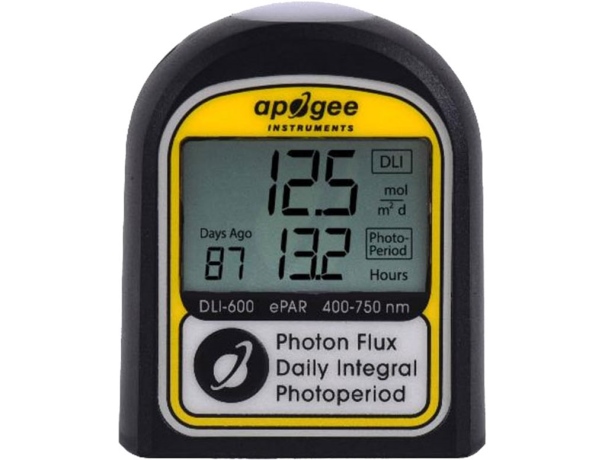
Relationship Between PAR, DLI, and Photoperiod
- PAR represents the light intensity plants use for photosynthesis at any given moment.
- DLI is the cumulative effect of PAR over the entire day, capturing both light intensity and photoperiod duration.
- Photoperiod sets the length of time plants are exposed to light, affecting their developmental stages and contributing to the total DLI.
By balancing these parameters, growers can optimize light conditions to suit specific plant species and desired growth outcomes.